Top Upcoming Smartphones - April 2020🔥🔥🔥
Namaskar Dosto, is video mein maine aapse baat ki hai January 2020 mein launch hone waale phones ke baare mein. Yaha pe is saal 2020 mein hume bahut se phones dekhne ko milenge aur kuch phones bahut interesting hai. Yaha mein baat ki hai iPhone 9, Oneplus 8 & 8 Pro, Pixel 4a, Nokia 8.3, 5.3 & 1.3, Red magic 5G, Redmi K30 Pro and Poco F2, Find X2 & X2 Pro, Moto Edge +, Realme Narzo 10 and 10A, Xiaomi Mi 10, Redmi 9 & Redmi Note 9, Galaxy M41, Realme 108MP Phone, vivo V19 aur bahut se phones ke baare mein. Mujhe umeed hai ki aapko Upcoming Smartphones ke baare mein yeh video pasand aayegi. Share, Support, Subscribe!!! Subscribe: http://bit.ly/1Wfsvt4 Android App: https://ift.tt/2mrm9Gy Youtube: http://www.youtube.com/c/TechnicalGuruji Twitter: http://www.twitter.com/technicalguruji Facebook: https://ift.tt/1Pi5LDP Facebook Myself: https://goo.gl/zUfbUU Instagram: https://ift.tt/1OW2vue Google Plus: https://ift.tt/1Pi5LDS Website: https://ift.tt/2mcM6KV Merchandise: https://ift.tt/2lN4Vbu About : Technical Guruji is a YouTube Channel, where you will find technological videos in Hindi, New Video is Posted Everyday :)

This Blog is created to share Technical Solutions for public interest. The Content is related with IT solutions, SEO tips, Online Earning, online marketing, website developement, CSS, java, C++, python, C sharp Languages.
Tuesday, March 31, 2020
TECH Solutions - Coronavirus: Zoom under increased scrutiny as popularity soars
The New York attorney general has written to the videoconferencing company about its security measures.
from BBC News - Technology https://ift.tt/2JtoX4f
Original Content From: http://bbci.co.uk
from BBC News - Technology https://ift.tt/2JtoX4f
Original Content From: http://bbci.co.uk
TECH Solutions - Coronavirus: Racist 'zoombombing' at virtual synagogue
Hackers hijacking Zoom meetings to shout abuse is on the rise as more people talk virtually.
from BBC News - Technology https://ift.tt/3bDEsCz
Original Content From: http://bbci.co.uk
from BBC News - Technology https://ift.tt/3bDEsCz
Original Content From: http://bbci.co.uk
TECH Solutions - Apple buys weather app Dark Sky
The iPhone maker will shut down the Android and Wear OS versions of the app in July.
from BBC News - Technology https://ift.tt/347fn0o
Original Content From: http://bbci.co.uk
from BBC News - Technology https://ift.tt/347fn0o
Original Content From: http://bbci.co.uk
TECH Solutions - What does a pandemic say about the tech we’ve built?
There’s a joke* being reshared on chat apps that takes the form of a multiple choice question — asking who’s the leading force in workplace digital transformation? The red-lined punchline is not the CEO or CTO but: C) COVID-19.
There’s likely more than a grain of truth underpinning the quip. The novel coronavirus is pushing a lot of metaphorical buttons right now. ‘Pause’ buttons for people and industries, as large swathes of the world’s population face quarantine conditions that can resemble house arrest. The majority of offline social and economic activities are suddenly off limits.
Such major pauses in our modern lifestyle may even turn into a full reset, over time. The world as it was, where mobility of people has been all but taken for granted — regardless of the environmental costs of so much commuting and indulged wanderlust — may never return to ‘business as usual’.
If global leadership rises to the occasional then the coronavirus crisis offers an opportunity to rethink how we structure our societies and economies — to make a shift towards lower carbon alternatives. After all, how many physical meetings do you really need when digital connectivity is accessible and reliable? As millions more office workers log onto the day job from home that number suddenly seems vanishingly small.
COVID-19 is clearly strengthening the case for broadband to be a utility — as so much more activity is pushed online. Even social media seems to have a genuine community purpose during a moment of national crisis when many people can only connect remotely, even with their nearest neighbours.
Hence the reports of people stuck at home flocking back to Facebook to sound off in the digital town square. Now the actual high street is off limits the vintage social network is experiencing a late second wind.
Facebook understands this sort of higher societal purpose already, of course. Which is why it’s been so proactive about building features that nudge users to ‘mark yourself safe’ during extraordinary events like natural disasters, major accidents and terrorist attacks. (Or indeed why it encouraged politicians to get into bed with its data platform in the first place — no matter the cost to democracy.)
In less fraught times, Facebook’s ‘purpose’ can be loosely summed to ‘killing time’. But with ever more sinkholes being drilled by the attention economy that’s a function under ferocious and sustained attack.
Over the years the tech giant has responded by engineering ways to rise back to the top of the social heap — including spying on and buying up competition, or directly cloning rival products. It’s been pulling off this trick, by hook or by crook, for over a decade. Albeit, this time Facebook can’t take any credit for the traffic uptick; A pandemic is nature’s dark pattern design.
What’s most interesting about this virally disrupted moment is how much of the digital technology that’s been built out online over the past two decades could very well have been designed for living through just such a dystopia.
Seen through this lens, VR should be having a major moment. A face computer that swaps out the stuff your eyes can actually see with a choose-your-own-digital-adventure of virtual worlds to explore, all from the comfort of your living room? What problem are you fixing VR? Well, the conceptual limits of human lockdown in the face of a pandemic quarantine right now, actually…
Virtual reality has never been a compelling proposition vs the rich and textured opportunity of real life, except within very narrow and niche bounds. Yet all of a sudden here we all are — with our horizons drastically narrowed and real-life news that’s ceaselessly harrowing. So it might yet end up wry punchline to another multiple choice joke: ‘My next vacation will be: A) Staycation, B) The spare room, C) VR escapism.’
It’s videoconferencing that’s actually having the big moment, though. Turns out even a pandemic can’t make VR go viral. Instead, long lapsed friendships are being rekindled over Zoom group chats or Google Hangouts. And Houseparty — a video chat app — has seen surging downloads as barflies seek out alternative night life with their usual watering-holes shuttered.
Bored celebs are TikToking. Impromptu concerts are being livestreamed from living rooms via Instagram and Facebook Live. All sorts of folks are managing social distancing and the stress of being stuck at home alone (or with family) by distant socializing — signing up to remote book clubs and discos; joining virtual dance parties and exercise sessions from bedrooms. Taking a few classes together. The quiet pub night with friends has morphed seamlessly into a bring-your-own-bottle group video chat.
This is not normal — but nor is it surprising. We’re living in the most extraordinary time. And it seems a very human response to mass disruption and physical separation (not to mention the trauma of an ongoing public health emergency that’s killing thousands of people a day) to reach for even a moving pixel of human comfort. Contactless human contact is better than none at all.
Yet the fact all these tools are already out there, ready and waiting for us to log on and start streaming, should send a dehumanizing chill down society’s backbone.
It underlines quite how much consumer technology is being designed to reprogram how we connect with each other, individually and in groups, in order that uninvited third parties can cut a profit.
Back in the pre-COVID-19 era, a key concern being attached to social media was its ability to hook users and encourage passive feed consumption — replacing genuine human contact with voyeuristic screening of friends’ lives. Studies have linked the tech to loneliness and depression. Now we’re literally unable to go out and meet friends the loss of human contact is real and stark. So being popular online in a pandemic really isn’t any kind of success metric.
Houseparty, for example, self-describes as a “face to face social network” — yet it’s quite the literal opposite; you’re foregoing face-to-face contact if you’re getting virtually together in app-wrapped form.
While the implication of Facebook’s COVID-19 traffic bump is that the company’s business model thrives on societal disruption and mainstream misery. Which, frankly, we knew already. Data-driven adtech is another way of saying it’s been engineered to spray you with ad-flavored dissatisfaction by spying on what you get up to. The coronavirus just hammers the point home.
The fact we have so many high-tech tools on tap for forging digital connections might feel like amazing serendipity in this crisis — a freemium bonanza for coping with terrible global trauma. But such bounty points to a horrible flip side: It’s the attention economy that’s infectious and insidious. Before ‘normal life’ plunged off a cliff all this sticky tech was labelled ‘everyday use’; not ‘break out in a global emergency’.
It’s never been clearer how these attention-hogging apps and services are designed to disrupt and monetize us; to embed themselves in our friendships and relationships in a way that’s subtly dehumanizing; re-routing emotion and connections; nudging us to swap in-person socializing for virtualized fuzz that designed to be data-mined and monetized by the same middlemen who’ve inserted themselves unasked into our private and social lives.
Captured and recompiled in this way, human connection is reduced to a series of dilute and/or meaningless transactions. The platforms deploying armies of engineers to knob-twiddle and pull strings to maximize ad opportunities, no matter the personal cost.
It’s also no accident we’re also seeing more of the vast and intrusive underpinnings of surveillance capitalism emerge, as the COVID-19 emergency rolls back some of the obfuscation that’s used to shield these business models from mainstream view in more normal times. The trackers are rushing to seize and colonize an opportunistic purpose.
Tech and ad giants are falling over themselves to get involved with offering data or apps for COVID-19 tracking. They’re already in the mass surveillance business so there’s likely never felt like a better moment than the present pandemic for the big data lobby to press the lie that individuals don’t care about privacy, as governments cry out for tools and resources to help save lives.
First the people-tracking platforms dressed up attacks on human agency as ‘relevant ads’. Now the data industrial complex is spinning police-state levels of mass surveillance as pandemic-busting corporate social responsibility. How quick the wheel turns.
But platforms should be careful what they wish for. Populations that find themselves under house arrest with their phones playing snitch might be just as quick to round on high tech gaolers as they’ve been to sign up for a friendly video chat in these strange and unprecedented times.
Oh and Zoom (and others) — more people might actually read your ‘privacy policy‘ now they’ve got so much time to mess about online. And that really is a risk.
*Source is a private Twitter account called @MBA_ish

from Social – TechCrunch https://ift.tt/2JuePIh
Original Content From: https://techcrunch.com
FCC mandates strict caller ID authentication to beat back robocalls
The FCC unanimously passed a new set of rules today that will require wireless carriers to implement an tech framework to combat robocalls. Called STIR/SHAKEN, and dithered over for years by the carriers, the protocol will be required to be put in place by summer of 2021.
Robocalls have grown from vexation to serious problem as predictable “claim your free vacation” scams gave way to “here’s how to claim your stimulus check” or “apply for coronavirus testing here” scams.
A big part of the problem is that the mobile networks allow for phone numbers to be spoofed or imitated, and it’s never clear to the call recipient that the number they see may be different from the actual originating number. Tracking and preventing fraudulent use of this feature has been on the carriers’ roadmap for a long time, and some have gotten around to it in some ways, for some customers.
STIR/SHAKEN, which stands for Secure Telephony Identity Revisited / Secure Handling of Asserted information using toKENs, is a way to securely track calls and callers to prevent fraud and warn consumers of potential scams. Carriers and the FCC have been talking about it since 2017, and in 2018 the FCC said it needed to be implemented in 2019. When that hadn’t happened, the FCC gave carriers a nudge, and at the end of the year Congress passed the TRACED Act to spur the regulator into carrying out its threat of mandating use of the system.
Rules to that effect were proposed earlier this month, and at the FCC’s open meeting today (conducted remotely), the measure passed unanimously. Commissioner Jessica Rosenworcel, who has been vocal about the lack of concrete action on this issue, gladly approved the rules but vented her frustration in a statement:
It is good news that today the Federal Communications Commission adopts rules to reduce robocalls through call authentication. I only wish we had done so sooner, like three years ago when the FCC first proposed the use of STIR/SHAKEN technology.
Commissioner Brendan Starks called the rules a “good first step,” but pointed out that the carriers need to apply call authentication technology not just on the IP-based networks but all over, and also to work with each other (as some already are) to ensure that these protections remain in place across networks, not just within them.
Chairman Ajit Pai concurred, pointing out there was much work to do:
It’s clear that FCC action is needed to spur across-the-board deployment of this important technology…Widespread implementation of STIR/SHAKEN will reduce the effectiveness of illegal spoofing, allow law enforcement to identify bad actors more easily, and help phone companies identify—and even block—calls with illegal spoofed caller ID information before those calls reach their subscribers. Most importantly, it will give consumers more peace of mind when they answer the phone.
There’s no silver bullet for the problem of spoofed robocalls. So we will continue our aggressive, multi-pronged approach to combating it.
Consumers won’t notice any immediate changes — the deadline is next year, after all — but it’s likely that in the coming months you will receive more information from your carrier about the technology and what, if anything, you need to do to enable it.


from Mobile – TechCrunch https://ift.tt/2wSLHaT
ORIGINAL CONTENT FROM: https://techcrunch.com/
TECH Solutions - No proof of a Houseparty breach, but its privacy policy is still gatecrashing your data
Houseparty has been a smashing success with people staying home during the coronavirus pandemic who still want to connect with friends.
The group video chat app, interspersed with games and other bells and whistles, raises it above the more mundane Zooms and Hangouts (fun only in their names, otherwise pretty serious tools used by companies, schools and others who just need to work) when it comes to creating engaged leisure time, amid a climate where all of them are seeing a huge surge in growth.
All that looked like it could possibly fall apart for Houseparty and its new owner Epic Games when a series of reports appeared Monday claiming Houseparty was breached, and that malicious hackers were using users’ data to access their accounts on other apps such as Spotify and Netflix.
Houseparty was swift to deny the reports and even go so far as to claim — without evidence — it was investigating indications that the “breach” was a “paid commercial smear to harm Houseparty,” offering a $1 million reward to whoever could prove its theory.
For now, there is no proof that there was a breach, nor proof that there was a paid smear campaign, and when we reached out to ask Houseparty and Epic about this investigation, a spokesperson said: “We don’t have anything to add here at the moment.”
But that doesn’t mean that Houseparty doesn’t have privacy issues.
As the old saying goes, “if the product is free, you are the product.” In the case of the free app Houseparty, the publishers detail a 12,000+ word privacy policy that covers any and all uses of data that it might collect by way of you logging on to or using its service, laying out the many ways that it might use data for promotional or commercial purposes.
There are some clear lines in the policy about what it won’t use. For example, while phone numbers might get shared for tech support, with partnerships that you opt into, to link up contacts to talk with and to authenticate you, “we will never share your phone number or the phone numbers of third parties in your contacts with anyone else.”
But beyond that, there are provisions in there that could see Houseparty selling anonymized and other data, leading Ray Walsh of research firm ProPrivacy to describe it as a “privacy nightmare.”
“Anybody who decides to use the Houseparty application to stay in contact during quarantine needs to be aware that the app collects a worrying amount of personal information,” he said. “This includes geolocation data, which could, in theory, be used to map the location of each user. A closer look at Houseparty’s privacy policy reveals that the firm promises to anonymize and aggregate data before it is shared with the third-party affiliates and partners it works with. However, time and time again, researchers have proven that previously anonymized data can be re-identified.”
There are ways around this for the proactive. Walsh notes that users can go into the settings to select “private mode” to “lock” rooms they use to stop people from joining unannounced or uninvited; switch locations off; use fake names and birthdates; disconnect all other social apps; and launch the app on iOS with a long press to “sneak into the house” without notifying all your contacts.
But with a consumer app, it’s a longshot to assume that most people, and the younger users who are especially interested in Houseparty, will go through all of these extra steps to secure their information.

from Social – TechCrunch https://ift.tt/2w3itpr
Original Content From: https://techcrunch.com
TECH Solutions - Coronavirus: 3D-printer owners rally to create NHS face masks
More than 1,000 people volunteer to help make face shields for front-line workers.
from BBC News - Technology https://ift.tt/3dFW4zH
Original Content From: http://bbci.co.uk
from BBC News - Technology https://ift.tt/3dFW4zH
Original Content From: http://bbci.co.uk
TECH Solutions - Facebook launches a global version of its Community Help feature in response to the COVID-19 pandemic
Facebook first launched its Community Help feature in 2017, to give users a way to offer assistance, search for and receive help in the wake of a crisis. The feature has since been used to connect Facebook users after man-made, accidental, and natural disasters, like terrorist attacks or weather events, for example. Today, Facebook is expanding Community Help as part of its COVID-19 efforts. The new COVID-19 Community Help hub will allow people to request or offer help to those impacted by the coronavirus outbreak as well as donate to nonprofit fundraisers.
This is the first time Facebook has launched Community Help on a global scale. It’s also the first time it’s been used for a health pandemic.
The feature will launch first in the U.S., Canada, France, U.K. and Australia, Facebook says.
A somewhat similar feature, Help Map, was recently introduced by the neighborhood social network and Facebook competitor Nextdoor, but it hasn’t yet seen widespread adoption. In part, that’s because Nextdoor isn’t making the new addition as obvious as it could be — it’s currently buried in the “More” tab instead of being a central focus in the app. Also, the Help Map simply allows people to list themselves as being able to offer assistance to someone in need or as being in need of aid.
Facebook’s Community Help hub, meanwhile, builds on Facebook’s earlier efforts with Crisis Response, which connected multiple tools in one place.
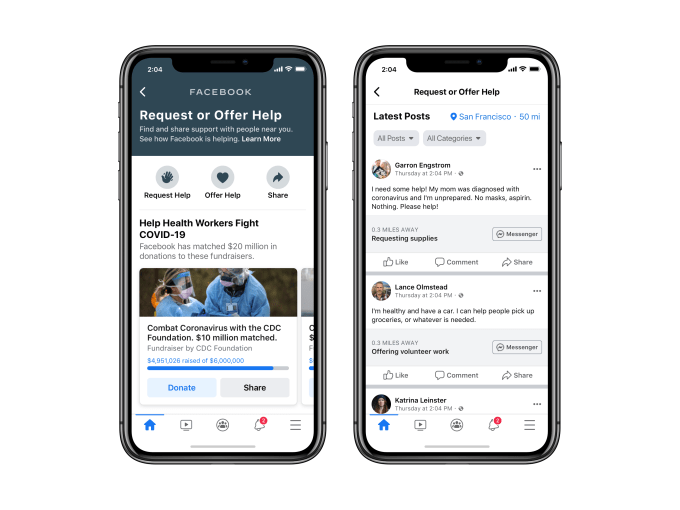
The COVID-19 Community Help feature will be found within Facebook’s existing COVID-19 Information Center, which is live in over 30 countries.
Launched earlier in March, the COVID-19 Information Center today sits at the top of the News Feed and connects users to authoritative health information from global health authorities along with curated posts from politicians, journalists, and other public figures.
Since its debut, over 1 billion users have accessed the information shared by health authorities on the Information Center and through the educational pop-ups on Facebook and Instagram, the company claims. More than 100 million people clicked through to learn more from the sources directly.
 Before today’s official launch, the COVID-19 Information Center tested Community Help in select U.S. cities. There, local users have been posting requests for help — like those about a hospital in need of masks or volunteers to help distribute food. Others shared their free assistance being offered — like free meals for hourly workers now out of a job or free virtual workouts for those missing their gym routine.
This now continues as the Community Hub launches across the supported markets. However, it will now exist as its own destination, which includes fundraisers. It will also include additional categories, like Food, Baby Supplies, Toiletries, and Business Support — the latter which allows local businesses to ask for help and respond to offers for help.
Facebook also clarifies that users will be able to post or comment in reply to posts about offering assistance, as either an individual user or as a Facebook Page. And both individuals and Facebook Pages will be able to share posts to let others know what they need.
In addition, the COVID-19 Community Help hub will fundraise through two COVID-response efforts: the UNF/WHO COVID-19 Solidarity Response Fund Facebook Fundraiser and the Combat Coronavirus with the CDC Foundation Facebook Fundraiser (U.S.-only), where Facebook is matching donations, up to $10 million to each fundraiser. While not available today, Facebook will soon allow people to seek out and donate to local fundraisers, it says.
Facebook says the COVID-10 Community Hub will arrive in more countries around the world in the next few weeks, starting first with higher-risk countries across Europe and Asia-Pacific.


from Social – TechCrunch https://ift.tt/3bDZWPK
Original Content From: https://techcrunch.com
TECH Solutions - Houseparty: How safe is Epic Games' video chat app?
Security experts back owner's assertion that chat app is not hacking other products.
from BBC News - Technology https://ift.tt/2UvkAf2
Original Content From: http://bbci.co.uk
from BBC News - Technology https://ift.tt/2UvkAf2
Original Content From: http://bbci.co.uk
Technical Solutions - Tech Talks #1091 - Poco F2 Price in India, OnePlus 8 Key Specs, Whatsapp Hack, Jio ATM, P40 Pro Cam
Tech Talks #1091 - Poco F2 Price in India, OnePlus 8 Key Specs, Whatsapp Hack, Jio ATM, P40 Pro Cam
TG Deals@ https://tg.deals/ New Channel: https://goo.gl/Jz6p5K Namaskaar Dosto, Tech Talks ke is Episode mein maine aapse kuch interesting Tech News Share ki hai jaise Poco F2 Price in India, OnePlus 8 Key Specs, Whatsapp Hack, Jio ATM, P40 Pro Cam aur bahut kuch. Mujhe umeed hai ki yeh video aapko pasand aayega. Share, Support, Subscribe!!! Subscribe: http://bit.ly/1Wfsvt4 Android App: https://ift.tt/2mrm9Gy Youtube: http://www.youtube.com/c/TechnicalGuruji Twitter: http://www.twitter.com/technicalguruji Facebook: https://ift.tt/1Pi5LDP Facebook Myself: https://goo.gl/zUfbUU Instagram: https://ift.tt/1OW2vue Google Plus: https://ift.tt/1Pi5LDS Website: https://ift.tt/2mcM6KV Merchandise: https://ift.tt/2lN4Vbu About : Technical Guruji is a YouTube Channel, where you will find technological videos in Hindi, New Video is Posted Everyday :)
TG Deals@ https://tg.deals/ New Channel: https://goo.gl/Jz6p5K Namaskaar Dosto, Tech Talks ke is Episode mein maine aapse kuch interesting Tech News Share ki hai jaise Poco F2 Price in India, OnePlus 8 Key Specs, Whatsapp Hack, Jio ATM, P40 Pro Cam aur bahut kuch. Mujhe umeed hai ki yeh video aapko pasand aayega. Share, Support, Subscribe!!! Subscribe: http://bit.ly/1Wfsvt4 Android App: https://ift.tt/2mrm9Gy Youtube: http://www.youtube.com/c/TechnicalGuruji Twitter: http://www.twitter.com/technicalguruji Facebook: https://ift.tt/1Pi5LDP Facebook Myself: https://goo.gl/zUfbUU Instagram: https://ift.tt/1OW2vue Google Plus: https://ift.tt/1Pi5LDS Website: https://ift.tt/2mcM6KV Merchandise: https://ift.tt/2lN4Vbu About : Technical Guruji is a YouTube Channel, where you will find technological videos in Hindi, New Video is Posted Everyday :)
TECH Solutions - Coronavirus: 5G ‘certainly delayed’ in Europe and UK
UK and European 5G network rollouts will certainly be delayed during the pandemic, Huawei says.
from BBC News - Technology https://ift.tt/3bIP4QL
Original Content From: http://bbci.co.uk
from BBC News - Technology https://ift.tt/3bIP4QL
Original Content From: http://bbci.co.uk
TECH Solutions - Coronavirus: UK considers virus-tracing app to ease lockdown
Study describes how app would alert citizens if someone they came into contact with tests positive.
from BBC News - Technology https://ift.tt/3awYcrx
Original Content From: http://bbci.co.uk
from BBC News - Technology https://ift.tt/3awYcrx
Original Content From: http://bbci.co.uk
TECH Solutions - Coronavirus: World leaders' posts deleted over fake news
Social networks usually leave world leaders’ posts alone - but the pandemic is changing that.
from BBC News - Technology https://ift.tt/2xE7Bi6
Original Content From: http://bbci.co.uk
from BBC News - Technology https://ift.tt/2xE7Bi6
Original Content From: http://bbci.co.uk
TECH Solutions - Snapchat preempts clones, syndicates Stories to other apps
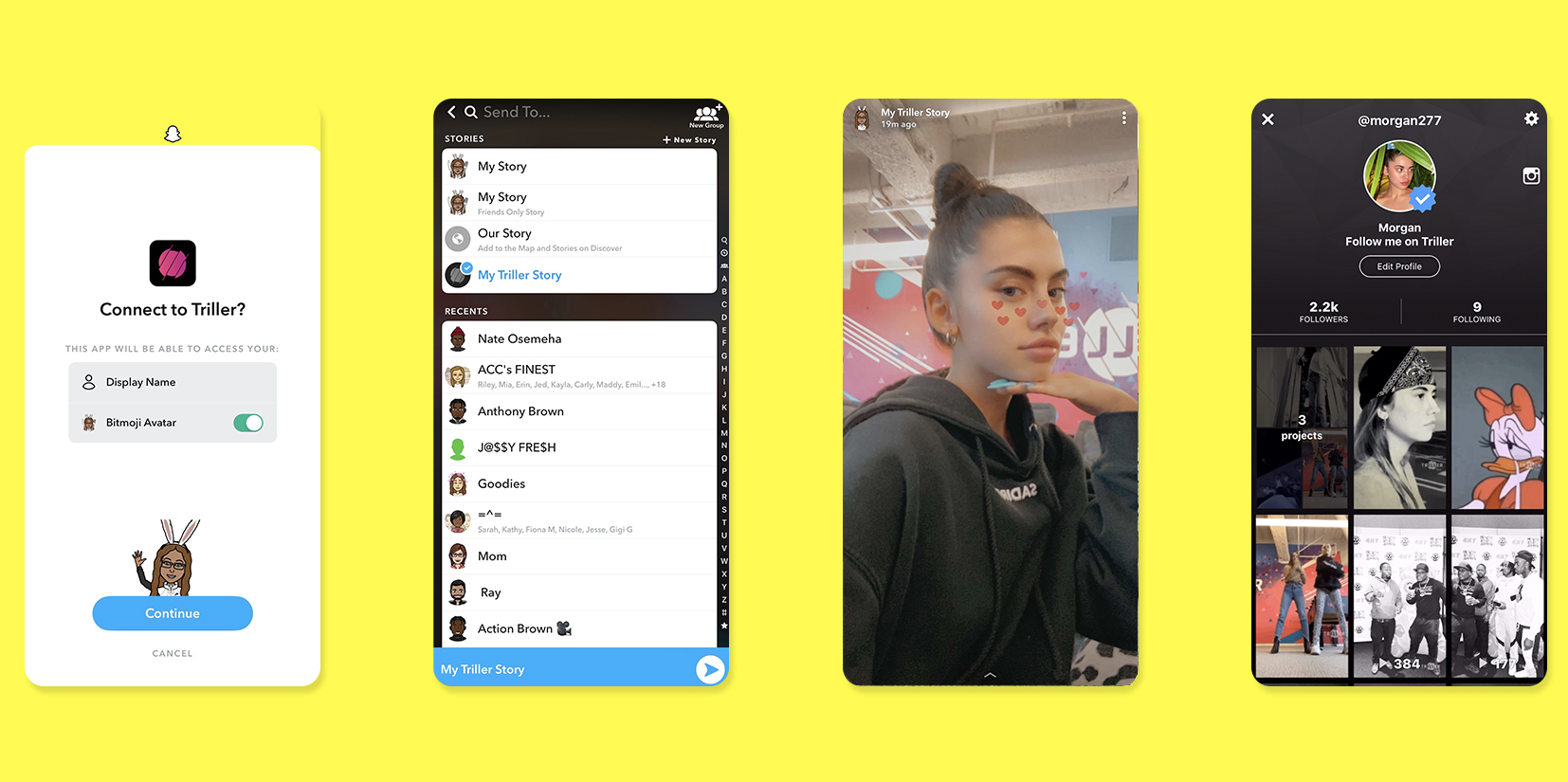
If you can’t stop them, power them. That’s the strategy behind Snapchat App Stories, which launches today to let users show off their ephemeral content in other apps too. The first partners will let you post Stories to your dating profile in Hily, share them alongside [music] videos in Triller, watch them while screensharing in Squad, or give people a peek at your life in augmented reality network Octi. Developers can now sign up to add Stories to their apps.
Snapchat’s Stories format has been widely cloned, most famously by Instagram and Facebook, but with versions in various states of development for YouTube, Twitter, LinkedIn, SoundCloud, and more. Snapchat hopes to retain some grip on Stories and dissuade more copycats by letting developers bake the original version into their apps rather than building a bootleg attempt from scratch.
If you need Snapchat to share Stories to popular apps, that could boost content production plus subsequent viewership and ad impressions inside of Snapchat, remind people to shoot Stories, and make sure having a Snapchat account stays relevant. “We definitely think there’s a potential for monetization in App Stories but not yet” Snap’s VP of partnerships Ben Schwerin tells me. For now, Snapchat isn’t injecting ads into alongside Stories into other apps, though that’s clearly the plan.
“There are certain platforms out there that have decided they want to invest in building their own Stories product and their own camera, but it’s not a trivial thing to do. It takes resources and time. We think we can help developers do that” Schwerin explains. “Getting more people out there, regardless of age or where they live, comfortable using Stories probably makes them more likely to be able to pick up and enjoy Snapchat.”
Snapchat initially announced the plan for App Stories at its Partner Summit exactly a year ago. Unfortunately, its second annual developer conference that was set for this week was cancelled due to coronavirus.
Though advertising spend may be reduced, at least the app has experienced an increase in usage while everyone shelters in place. That includes third-party apps built on its Snap Kit platform that lets developers piggyback on Snapchat’s login, Bitmoji, and camera effects.
“We continue to see incredible growth from established apps like Reddit and Spotify and TikTok, and from startups that are really building from the ground up on Snap Kit like Yolo” Schwerin reveals. “People are spending more time at home and less time with friends. We’re seeing increased usage of Snapchat.”
Snap Kit has allowed Snapchat to rally would-be copycats into a legion of allies as it fights to stave off the Facebook empire. That strategy combined with a high-performance rebuild of its Android app for the developing world led Snapchat’s share price to grow from $11.36 a year ago to a recent high of $18.98 before coronavirus dragged it almost all the way back down.
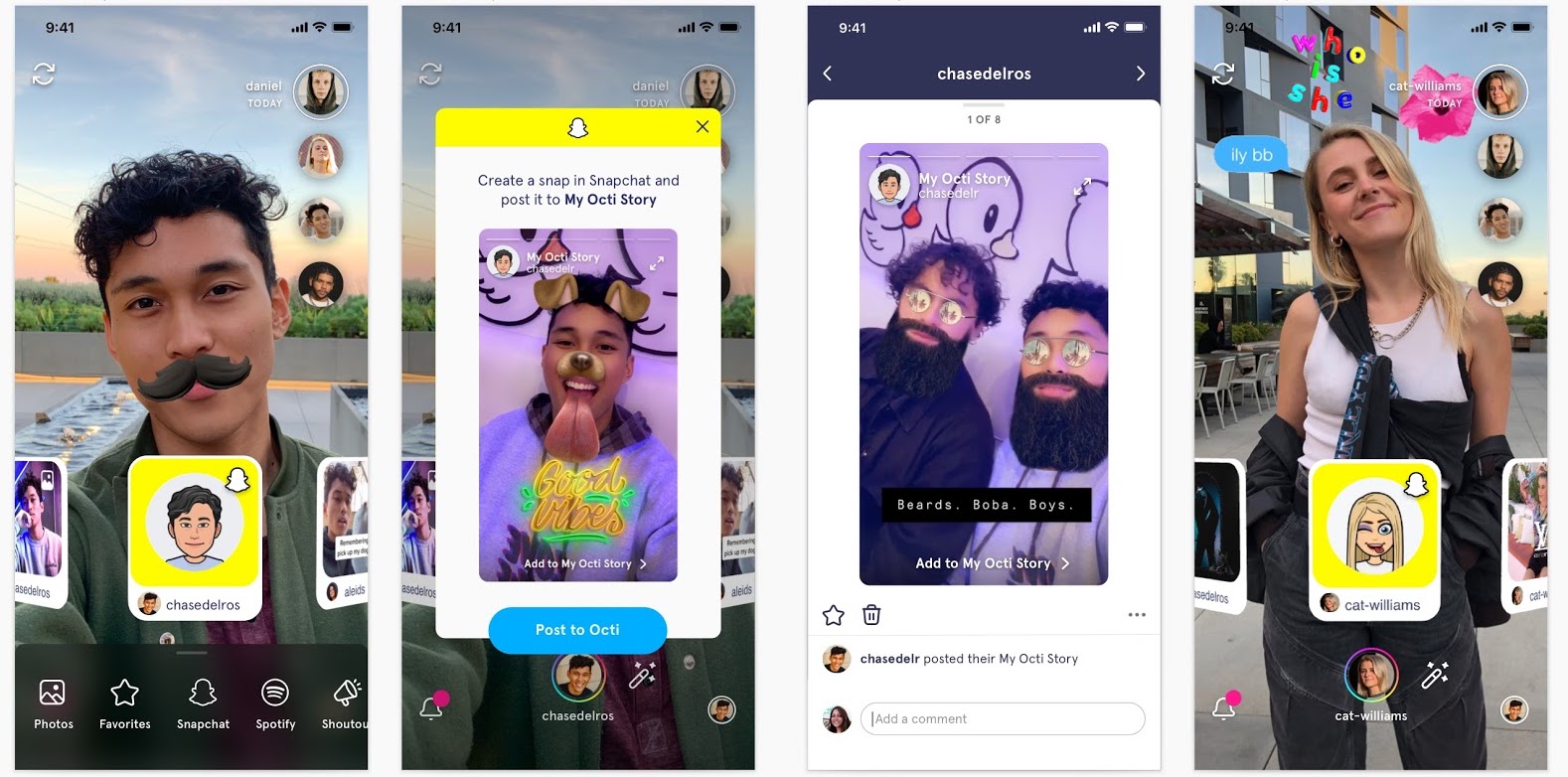
Now, when people shoot a photo or video in the Snapchat camera, they’ll get options to share it not just to their Story or Snap Map and the crowdsourced community Stories, but also to their Story within other apps integrated with Snap Kit. Users will see options to syndicate their Story to products equipped with App Stories where they’re already logged in.
Unlike on Snapchat where Stories disappear after 24 hours, they default to a 7-day expiration in other App Stories. That relieves users of having to constantly post ephemeral Snaps to keep their dating or social app profiles stocked with biographical content.
In Hily, Snapchat Stories partially replaces the homegrown version it’d spun up in the meantime to show potential dates off-the-cuff looks at people’s lives. In Triller, users can tap on a content creator’s profile pic to see biographical Stories instead of just their polished music videos. In Squad, users can co-watch Stories along with other things to screenshare. And in Octi, users can see someone’s Snapchat Story amongst other hidden content revealed by its augmented reality camera.
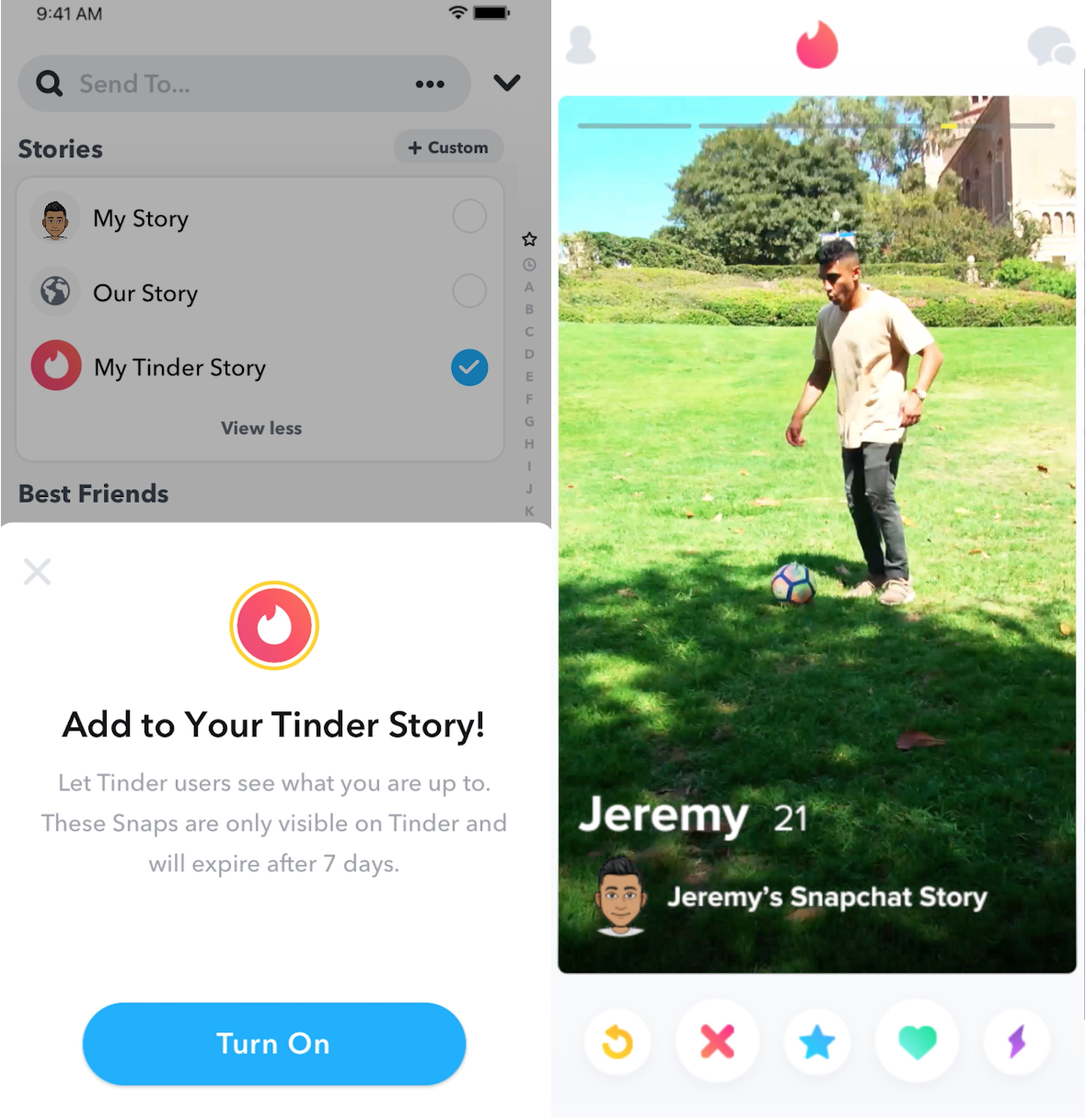
One app missing is Tinder, which Snapchat originally previewed as its launch partner at the App Stories reveal last year. Tinder is using Snapchat’s Bitmoji stickers, but may have gotten cold feet about Stories. The fact that Snap is only now launching App Stories, and still hasn’t officially launched Ad Kit that lets it inject its ads into other apps and split revenue with developers, shows it’s taking time to adjust to its platform strategy after years of shunning outside integrations. It still won’t reveal the revenue percentage split it’s applying to Ad Kit.
For Snapchat to gain momentum it needs two things: a constant influx of new users, eager to use its augmented reality camera and Bitmoji wherever they’re available, and more impressions to monetize with ads after Instagram stole the Stories use case for untold millions of older users. App Stories could help with both.
“The proliferation of stories as the primary way to share video content on mobile we think is a good thing” Schwerin concludes. But Snap has sat by idly as it’s served as the R&D lab for Facebook’s product. Now Snapchat needs to own the viewership and the ad dollars that Stories generate everywhere other than Facebook. Just coining the concept doesn’t bring in cash.

from Social – TechCrunch https://ift.tt/3dGY9v9
Original Content From: https://techcrunch.com
Snapchat preempts clones, syndicates Stories to other apps
If you can’t stop them, power them. That’s the strategy behind Snapchat App Stories, which launches today to let users show off their ephemeral content in other apps too. The first partners will let you post Stories to your dating profile in Hily, share them alongside [music] videos in Triller, watch them while screensharing in Squad, or give people a peek at your life in augmented reality network Octi. Developers can now sign up to add Stories to their apps.
Snapchat’s Stories format has been widely cloned, most famously by Instagram and Facebook, but with versions in various states of development for YouTube, Twitter, LinkedIn, SoundCloud, and more. Snapchat hopes to retain some grip on Stories and dissuade more copycats by letting developers bake the original version into their apps rather than building a bootleg attempt from scratch.
If you need Snapchat to share Stories to popular apps, that could boost content production plus subsequent viewership and ad impressions inside of Snapchat, remind people to shoot Stories, and make sure having a Snapchat account stays relevant. “We definitely think there’s a potential for monetization in App Stories but not yet” Snap’s VP of partnerships Ben Schwerin tells me. For now, Snapchat isn’t injecting ads into alongside Stories into other apps, though that’s clearly the plan.
“There are certain platforms out there that have decided they want to invest in building their own Stories product and their own camera, but it’s not a trivial thing to do. It takes resources and time. We think we can help developers do that” Schwerin explains. “Getting more people out there, regardless of age or where they live, comfortable using Stories probably makes them more likely to be able to pick up and enjoy Snapchat.”
Snapchat initially announced the plan for App Stories at its Partner Summit exactly a year ago. Unfortunately, its second annual developer conference that was set for this week was cancelled due to coronavirus.
Though advertising spend may be reduced, at least the app has experienced an increase in usage while everyone shelters in place. That includes third-party apps built on its Snap Kit platform that lets developers piggyback on Snapchat’s login, Bitmoji, and camera effects.
“We continue to see incredible growth from established apps like Reddit and Spotify and TikTok, and from startups that are really building from the ground up on Snap Kit like Yolo” Schwerin reveals. “People are spending more time at home and less time with friends. We’re seeing increased usage of Snapchat.”
Snap Kit has allowed Snapchat to rally would-be copycats into a legion of allies as it fights to stave off the Facebook empire. That strategy combined with a high-performance rebuild of its Android app for the developing world led Snapchat’s share price to grow from $11.36 a year ago to a recent high of $18.98 before coronavirus dragged it almost all the way back down.
Now, when people shoot a photo or video in the Snapchat camera, they’ll get options to share it not just to their Story or Snap Map and the crowdsourced community Stories, but also to their Story within other apps integrated with Snap Kit. Users will see options to syndicate their Story to products equipped with App Stories where they’re already logged in.
Unlike on Snapchat where Stories disappear after 24 hours, they default to a 7-day expiration in other App Stories. That relieves users of having to constantly post ephemeral Snaps to keep their dating or social app profiles stocked with biographical content.
In Hily, Snapchat Stories partially replaces the homegrown version it’d spun up in the meantime to show potential dates off-the-cuff looks at people’s lives. In Triller, users can tap on a content creator’s profile pic to see biographical Stories instead of just their polished music videos. In Squad, users can co-watch Stories along with other things to screenshare. And in Octi, users can see someone’s Snapchat Story amongst other hidden content revealed by its augmented reality camera.
One app missing is Tinder, which Snapchat originally previewed as its launch partner at the App Stories reveal last year. Tinder is using Snapchat’s Bitmoji stickers, but may have gotten cold feet about Stories. The fact that Snap is only now launching App Stories, and still hasn’t officially launched Ad Kit that lets it inject its ads into other apps and split revenue with developers, shows it’s taking time to adjust to its platform strategy after years of shunning outside integrations. It still won’t reveal the revenue percentage split it’s applying to Ad Kit.
For Snapchat to gain momentum it needs two things: a constant influx of new users, eager to use its augmented reality camera and Bitmoji wherever they’re available, and more impressions to monetize with ads after Instagram stole the Stories use case for untold millions of older users. App Stories could help with both.
“The proliferation of stories as the primary way to share video content on mobile we think is a good thing” Schwerin concludes. But Snap has sat by idly as it’s served as the R&D lab for Facebook’s product. Now Snapchat needs to own the viewership and the ad dollars that Stories generate everywhere other than Facebook. Just coining the concept doesn’t bring in cash.


from Mobile – TechCrunch https://ift.tt/3dGY9v9
ORIGINAL CONTENT FROM: https://techcrunch.com/
Family-friendly Spotify Kids app launches in the U.S., Canada and France
Last fall, Spotify debuted a standalone Kids application, aimed at bringing kid-friendly music and stories to Spotify Premium Family subscribers, initially in Ireland. Today, that app is being made available broadly in the U.S. Canada and France, the company announced on Tuesday. The Kids app is still considered a “beta” as it arrives in these new markets, Spotify says. However, it’s been expanded with more songs, stories and other content since the original beta tests began.
The app is largely designed to boost sign-ups for Spotify’s top-tier subscription, the $14.99 (USD) per month Premium Family plan. This plan offers up to 6 people in the same household access to Spotify’s on-demand, ad-free music streaming service, each with their own personalized account. It also includes other exclusive features like Family Mixes, as well as parental controls, and now, the Spotify Kids application.
Spotify has long since realized its one-size-fits-all strategy didn’t work for families. It needed to build a unique experience separate from its flagship app in order to best cater to children — and to abide by the regulations around data collection and consent with regard to apps aimed at kids.
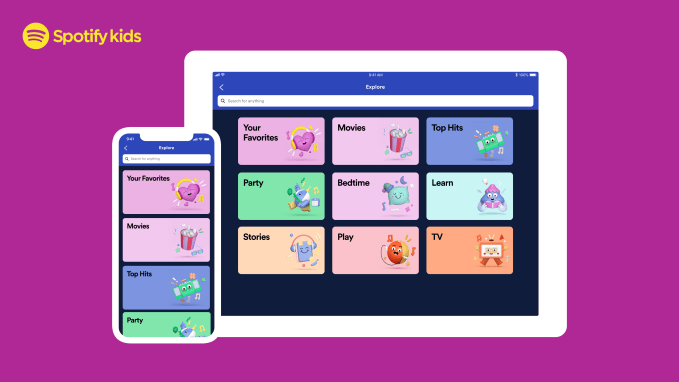
Spotify designed the Kids app from the ground up with the needs of both parents and kids in mind. For parents, it offers peace of mind that children won’t accidentally encounter inappropriate lyrics, for example, or songs with more adult themes. To ensure this remains the case, Spotify editors hand-curate the content on the Kids app by following a set of guidelines about what’s inappropriate for children. It doesn’t utilize algorithms to make selections about what’s included, the way the spinoff app YouTube Kids does.
Instead of being a fully on-demand product, Spotify Kids offers playlists for little ones focused around categories like Movies, TV, Stories, or various activities, like “Learn” or “Party,” among others. As kids grow older, they may also want to follow their favorite artists in the app.
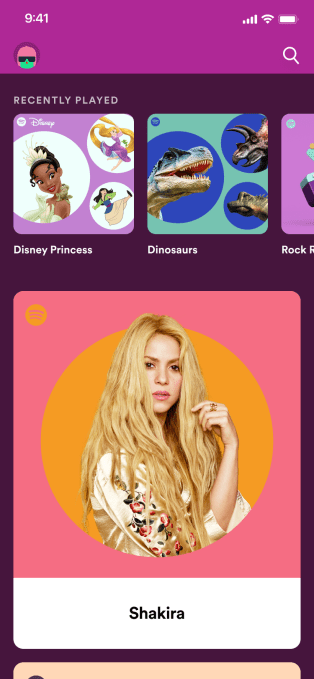
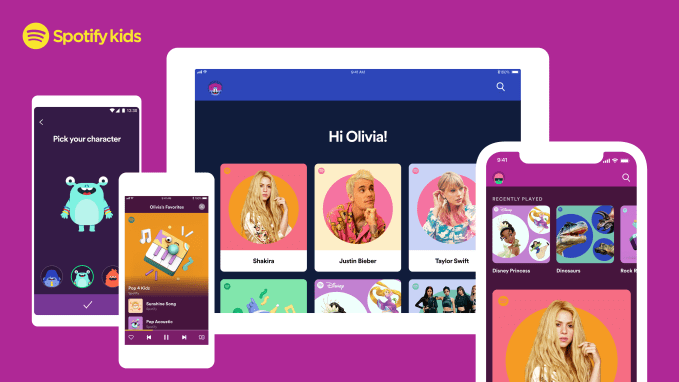
The app can also be customized by age range. For younger kids, there’s character-based artwork and content aimed at the preschool set like singalongs or lullabies. Older kids will see a more detailed experience and have access to more popular tracks that are also age-appropriate.
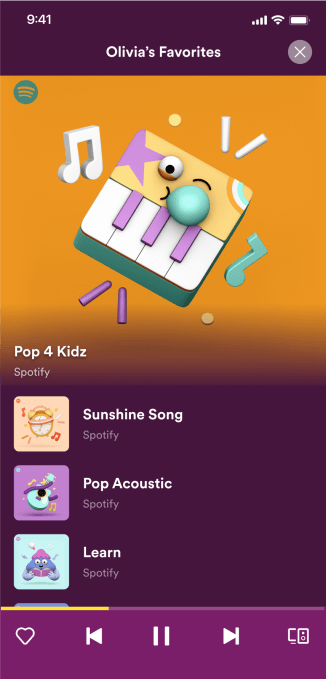
The programmed playlists in Spotify Kids are curated by editors hailing from some of the most well-known brands in kids’ entertainment — including Nickelodeon, Disney, Discovery Kids, Universal Pictures, and others. They know what kids want and also what sells to the parents who pay.
Since its launch in Ireland, Spotify Kids has rolled out to Sweden, Denmark, Australia, New Zealand, the U.K., Mexico, Argentina, and Brazil.
It has also added more content since its original debut, says Spotify.
“We heard loud and clear that both parents and kids are craving more content in the app, so we’ve been increasing the number of tracks available. We’ve also heard from parents that they want even more control of the content, so we are working on some exciting new features,” noted Spotify’s Chief Premium Business Officer Alex Norström, in a statement.
The company isn’t yet going into detail about the upcoming additions, but says they’ll be focused on giving parents more control over the child’s experience. Typically, that would mean letting parents make more specific choices about what’s being streamed. But since parental controls are already available, it could mean letting parents pick specific songs or perhaps, block them. Time will tell.
Today the Spotify Kids app has over 8,000 songs in its catalog — 30% more than when it first arrived in Ireland, and growing.
It also has more local content, with 50% of the catalog in the app localized by market. Its collection of kid-friendly audiobooks and stories has grown as well, and the app now offers over 60 hours of stories, including fairy tales, classics, short stories, and stories from Disney Music Group.
In response to user feedback, there’s also now more bedtime content like lullabies, calming music and sounds, and bedtime stories. (And yes, this finally means that Spotify parents will stop having their year-end Spotify Wrapped ruined by lullabies.)
In the U.S., Spotify Kids launches today with over 125 playlists (approximately 8,000 tracks.) In addition to mainstream kids’ music, the catalog includes Spanish-language, Country, Christian, Motown, and Soul Dance Party playlists. There’s also a Trolls World Tour playlist and another for Frozen.
In response to the COVID-19 outbreak, there’s also a new global playlist called “Wash Your Hands” which includes songs that teach kids to wash hands and to cough and sneeze properly. This includes the new song from Pinkfong “Wash Your Hands with Baby Shark.”
And to aid parents now educating children at home, there’s a “Learning” playlist hub where you’ll find songs about the ABC’s, counting, science and more.
The app is available today in the U.S., Canada, and France on iOS and Android. The app is a free download, but requires a Spotify Premium Family membership.


from Mobile – TechCrunch https://ift.tt/3dHQ75c
ORIGINAL CONTENT FROM: https://techcrunch.com/
Disney+ to launch in India on April 3
Disney said on Tuesday that it will launch its streaming service, Disney+, in India on April 3. The service, available globally in about a dozen markets, will launch in India on Hotstar, one of the most popular on-demand streaming services in the country that is also owned by Disney.
The company said it is raising the yearly subscription cost of the combined entity, Disney+Hotstar, to Rs 1,499 ($20), up from Rs 999 ($13.2) that it previously charged for its most premium content on Hotstar. TechCrunch reported last year that Disney+ will launch in India in 2020 and will increase its subscription cost.
Hotstar, which claimed to have amassed 300 million monthly active users during the cricket season in India last year, would continue to offer an ad-supported service that it will offer to users without a charge. But it is increasing the cost of both of its premium tiers.
Disney is also offering a yearly tier that costs Rs 399 ($5.3) that will include movies from the Marvel Cinematic Universe, access to live sporting events and a wide catalog of movies and shows, and original shows produced by Hotstar. It will not include Disney+ Originals.
The $20 yearly subscription tier will offer over 100 series and 250 superhero and animated titles, including Disney+ Originals and shows from HBO, Fox, and Showtime, the company said. It will also include access to everything that Disney+Hotstar customers are availing at $5.3 tier.
“With the success of Hotstar, we ushered in a new era for premium video streaming in India. Today, as we unveil Disney+ Hotstar, we take yet another momentous step in staying committed to our promise of delivering high-quality impactful stories for India that have not only entertained but also made a difference in people’s lives, a promise that is even more meaningful in challenging times such as this,” said Uday Shankar, President of The Walt Disney Company APAC and Chairman, Star & Disney India, said in a statement.
“We hope the power of Disney’s storytelling, delivered through Hotstar’s technology, will help our viewers find moments of comfort, happiness and inspiration during these difficult times,” he added.
The company had originally planned to introduce Disney+Hotstar in India on March 29, but it began testing the service in the country weeks prior to that.
But as the coronavirus outbreak prompted New Delhi to order a nation-wide lockdown, which put a halt to public events including the cricket tournament Indian Premier League (IPL), Disney postponed the launch of Disney+Hostar in India.
IPL cricket tournament is by far the biggest attraction on Hotstar. According to people familiar with the matter, the months following IPL saw Hotstar’s userbase drop from 300 million to about 60 million.
If the IPL cricket tournament, which has been postponed until mid next month, is further delayed — or cancelled — it might significantly hurt Hotstar’s relevance and financials.
Disney was also recently criticized for blocking and censoring episodes of John Oliver’s “Last Week Tonight.” Hotstar did not stream a recent episode of Oliver’s show that was critical of India’s Prime Minister Narendra Modi and some of his policies. Hotstar has also edited out jokes from Oliver’s show that mocked Disney.
Oliver called out Disney and Hotstar for the censorship. Disney has not responded to multiple requests for comment on this matter.


from Mobile – TechCrunch https://ift.tt/2w0VgnO
ORIGINAL CONTENT FROM: https://techcrunch.com/
Technical Solutions - How To Get FULL SPEED WiFi??? Fix Your SLOW WiFi Problem!!!🔥🔥🔥
How To Get FULL SPEED WiFi??? Fix Your SLOW WiFi Problem!!!🔥🔥🔥
Namaskaar Dosto, is video mein maine aapse WiFi speed ke baare mein baat ki hai ki aur bataya hai ki aap kaise apni WiFi Speed ko improve kar sakte hai aur abhi maja utha sakte hai high speed WiFi ka. Chahe Router ki position ho ya fir interference se bachna, bahut saare tips hai High speed WiFi ko use karne ke liye. Mujhe umeed hai ki aapko WiFi Speed ka yeh video pasand aayegi. Share, Support, Subscribe!!! Subscribe: http://bit.ly/1Wfsvt4 Android App: https://ift.tt/2mrm9Gy Youtube: http://www.youtube.com/c/TechnicalGuruji Twitter: http://www.twitter.com/technicalguruji Facebook: https://ift.tt/1Pi5LDP Facebook Myself: https://goo.gl/zUfbUU Instagram: https://ift.tt/1OW2vue Google Plus: https://ift.tt/1Pi5LDS Website: https://ift.tt/2mcM6KV Merchandise: https://ift.tt/2lN4Vbu About : Technical Guruji is a YouTube Channel, where you will find technological videos in Hindi, New Video is Posted Everyday :)
Namaskaar Dosto, is video mein maine aapse WiFi speed ke baare mein baat ki hai ki aur bataya hai ki aap kaise apni WiFi Speed ko improve kar sakte hai aur abhi maja utha sakte hai high speed WiFi ka. Chahe Router ki position ho ya fir interference se bachna, bahut saare tips hai High speed WiFi ko use karne ke liye. Mujhe umeed hai ki aapko WiFi Speed ka yeh video pasand aayegi. Share, Support, Subscribe!!! Subscribe: http://bit.ly/1Wfsvt4 Android App: https://ift.tt/2mrm9Gy Youtube: http://www.youtube.com/c/TechnicalGuruji Twitter: http://www.twitter.com/technicalguruji Facebook: https://ift.tt/1Pi5LDP Facebook Myself: https://goo.gl/zUfbUU Instagram: https://ift.tt/1OW2vue Google Plus: https://ift.tt/1Pi5LDS Website: https://ift.tt/2mcM6KV Merchandise: https://ift.tt/2lN4Vbu About : Technical Guruji is a YouTube Channel, where you will find technological videos in Hindi, New Video is Posted Everyday :)
TECH Solutions - Coronavirus: Contagion cast share Covid-19 advice
Kate Winslet, Matt Damon, Jennifer Ehle and Laurence Fishburne post public service announcements.
from BBC News - Technology https://ift.tt/3dK8xSD
Original Content From: http://bbci.co.uk
from BBC News - Technology https://ift.tt/3dK8xSD
Original Content From: http://bbci.co.uk
Tech Solutions -'Consider this break a chance to reinvigorate yourself' - Misbah-ul-Haq to Pakistan's players
Pakistan's coach and chief selector talks about life in the time of the coronavirus pandemic
from Pakistan news from ESPN Cricinfo.com https://ift.tt/33VNR5U
Original Content From : https://ift.tt/Ti8aBD
from Pakistan news from ESPN Cricinfo.com https://ift.tt/33VNR5U
Original Content From : https://ift.tt/Ti8aBD
Tech Solutions -Misbah hopes to leverage Shadab's batting ability
Pakistan's head coach also looking to widen the net in search of ideal Nos. 5 and 6
from Pakistan news from ESPN Cricinfo.com https://ift.tt/2JunHOd
Original Content From : https://ift.tt/Ti8aBD
from Pakistan news from ESPN Cricinfo.com https://ift.tt/2JunHOd
Original Content From : https://ift.tt/Ti8aBD
Monday, March 30, 2020
TECH Solutions - Houseparty offers $1m reward for proof of sabotage
The company says claims it exposed users data were part of a commercial smear campaign.
from BBC News - Technology https://ift.tt/2QXGdCJ
Original Content From: http://bbci.co.uk
from BBC News - Technology https://ift.tt/2QXGdCJ
Original Content From: http://bbci.co.uk
TECH Solutions - Facebook deletes Brazil President’s coronavirus misinfo post
Facebook has diverted from its policy of not fact-checking politicians in order to prevent the spread of potentially harmful coronavirus misinformation from Brazilian President Jair Bolsonaro. Facebook made the decisive choice to remove a video shared by Bolsonaro on Sunday where he claimed that “hydroxychloroquine is working in all places.” That’s despite the drug still undergoing testing to determine its effectiveness for treating COVID-19, which researchers and health authorities have not confirmed.
“We remove content on Facebook and Instagram that violates our Community Standards, which do not allow misinformation that could lead to physical harm” a Facebook spokesperson told TechCrunch. Facebook specifically prohibits false claims regarding cure, treatments, the availability of essential services, and the location or intensity of contagion outbreaks.
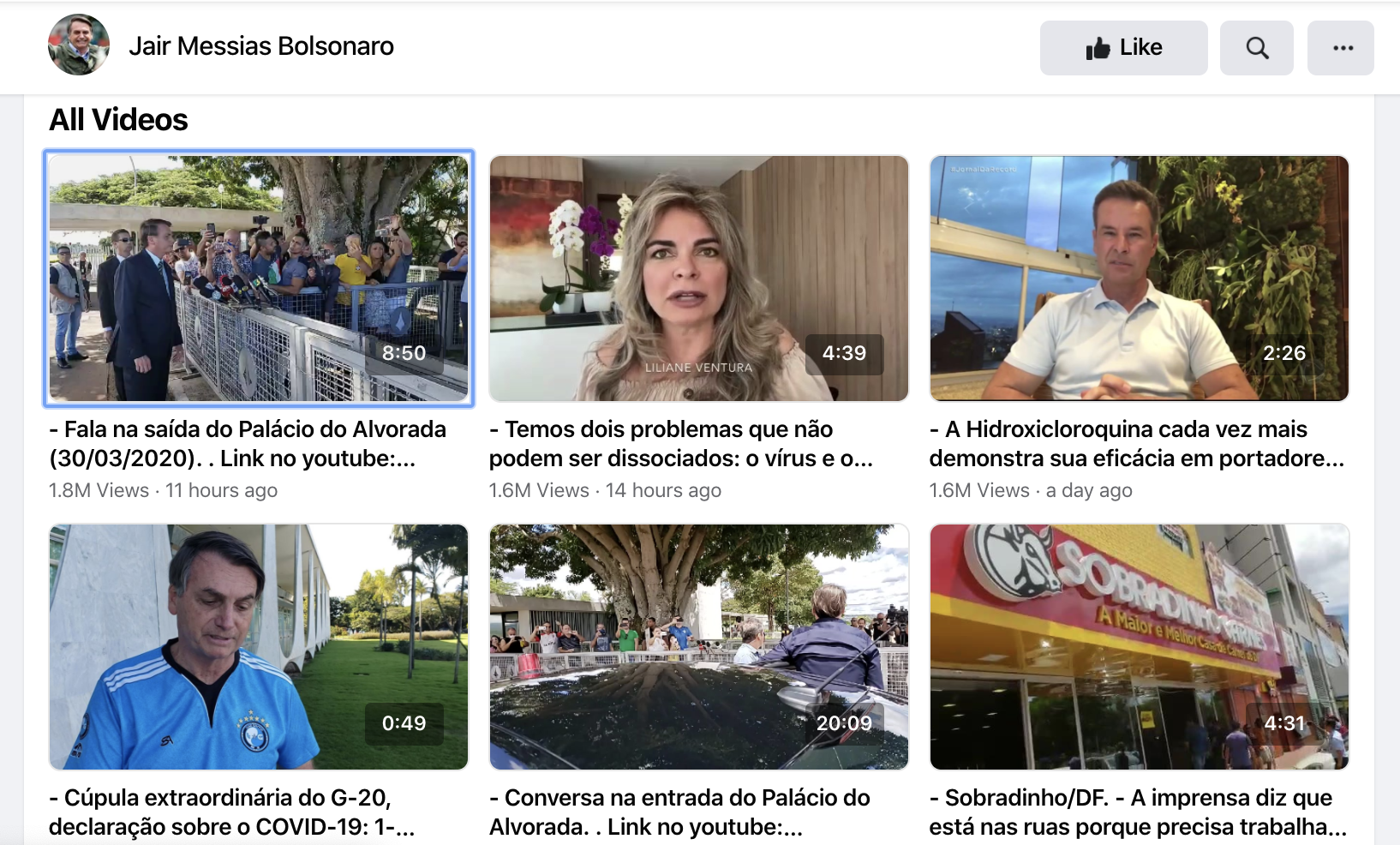
BBC News Brazil first reported the takedown today in Portuguese. In the removed video, Bolsonaro had been speaking to a street vendor, and the President claimed “They want to work”, in contrast to the World Health Organization’s recommendation that people practice social distancing. He followed up that “That medicine there, hydroxychloroquine, is working in all places.”
If people wrongly believe there’s an widely-effective treatment for COVID-19, they may be more reckless about going out in public, attending work, or refusing to stay in isolation. That could cause the virus to spread more quickly, defeat efforts to flatten the curve, and overrun health care systems.
This why Twitter removed two of Bolsonaro’s tweets on Sunday, as well as one from Rudy Giuliani, in order to stop the distribution of misinformation. But to date, Facebook has generally avoided acting as an arbiter of truth regarding the veracity of claims by politicians. It notoriously refuses to send blatant misinformation in political ads, including those from Donald Trump, to fact-checkers.
Last week, though, Facebook laid out that COVID-19 misinformation “that could contribute to imminent physical harm” would be directly and immediately removed as it’s done about other outbreaks since 2018, while less urgent conspiracy theories that don’t lead straight to physical harm are sent to fact-checkers that can then have the Facebook reach of those posts demoted.
Now the question is whether Facebook would be willing to apply this enforcement to Trump, who’s been criticized for spreading misinformation about the severity of the outbreak, potential treatments, and the risk of sending people back to work. Facebook is known to fear backlash from conservative politicians and citizens who’ve developed a false narrative that it discriminates against or censors their posts.

from Social – TechCrunch https://ift.tt/2vYZGeT
Original Content From: https://techcrunch.com
TECH Solutions - 'The phone slipped into the bath': Conference call tales
How to avoid some of the pitfalls of teleconferencing and how it is changing the way we meet and do business.
from BBC News - Technology https://ift.tt/2xx5TPR
Original Content From: http://bbci.co.uk
from BBC News - Technology https://ift.tt/2xx5TPR
Original Content From: http://bbci.co.uk
Facebook Messenger preps Auto Status location type sharing
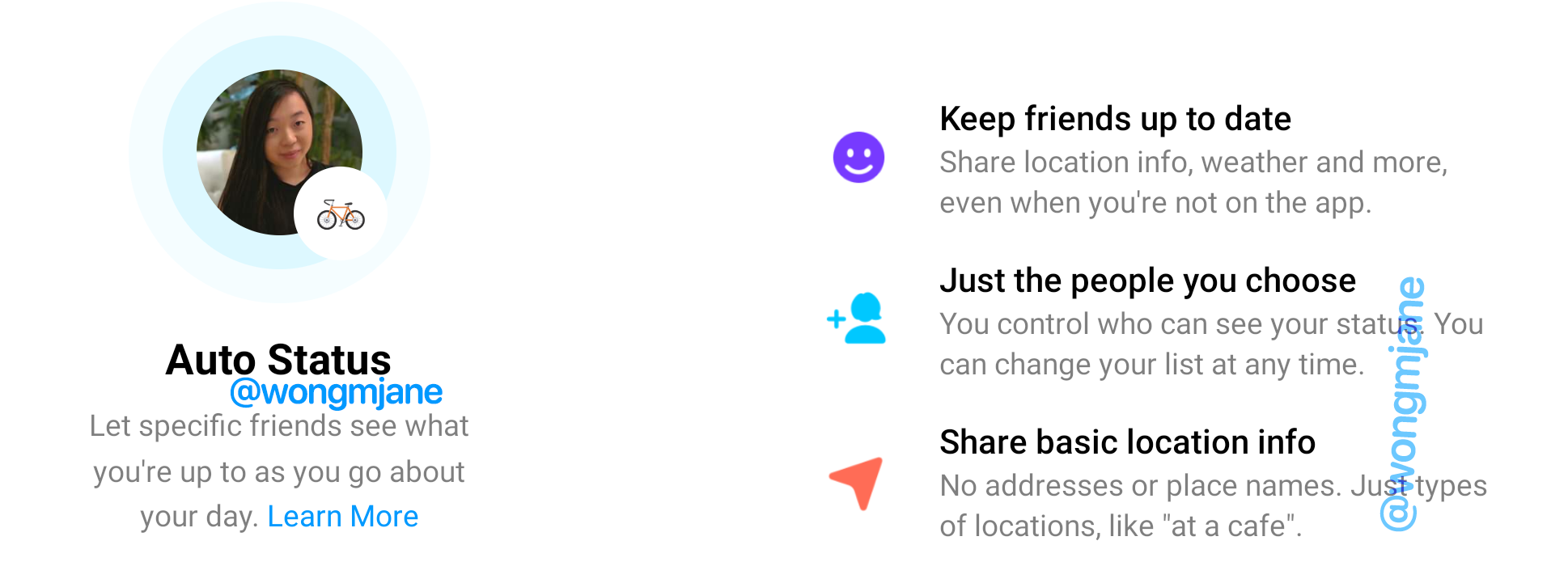
Facebook Messenger could soon automatically tell your closest friends you’re at the gym, driving, or in Tokyo. Messenger has been spotted prototyping a ported version of the Instagram close friends-only Threads app’s Auto Status option that launched in October.
The unreleased Messenger feature would use your location, accelerometer, and battery life to determine what you’re up to and share it with a specific subset of your friends. But instead of sharing your exact coordinates, it overlays an emoji on your Messenger profile pic to indicate that you’re at the movies, biking, at the airport, or charging your phone.
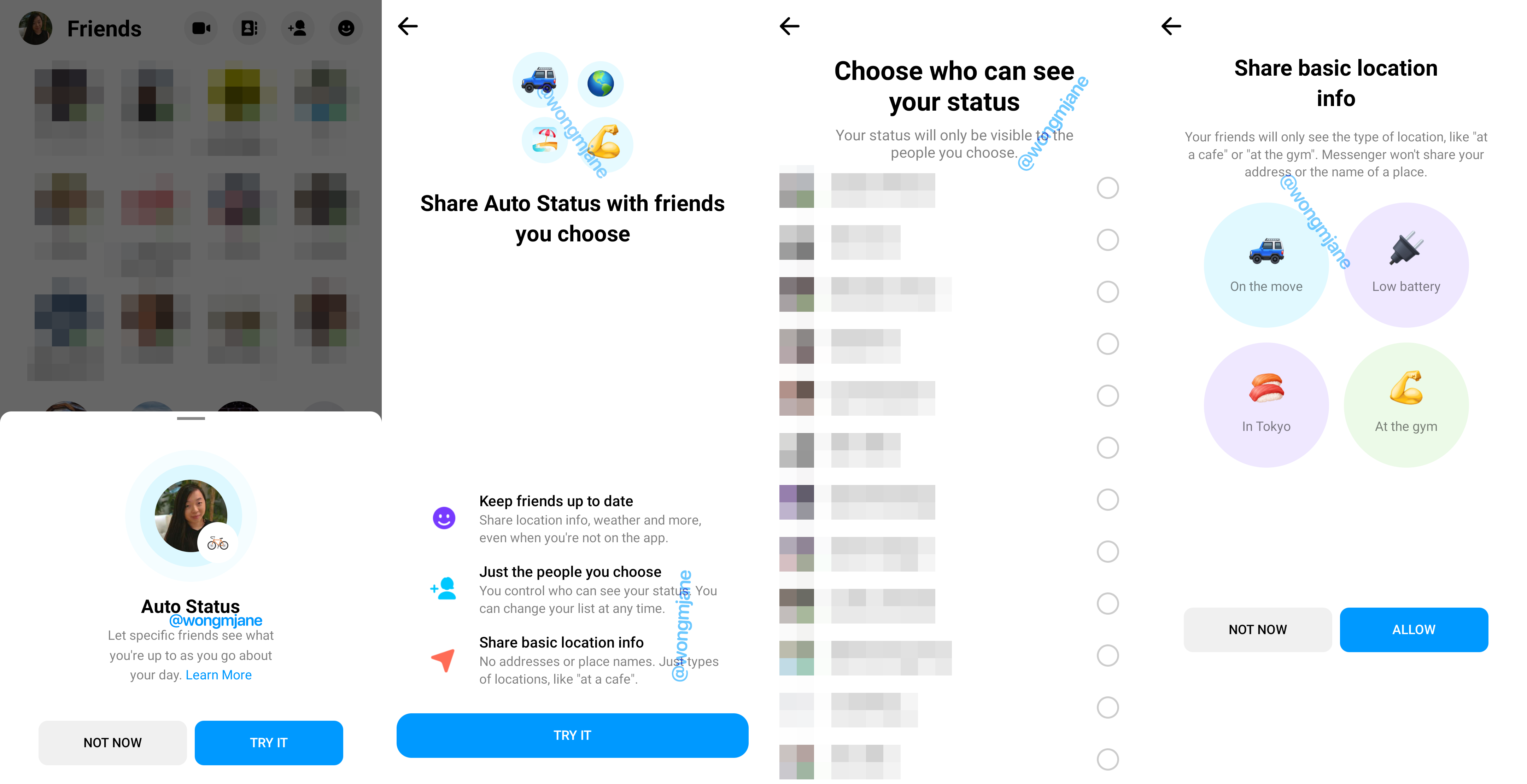
It’s unclear if or when Messenger might launch Auto Status. But if released, the feature could become Facebook’s version of the AOL Away Message, allowing people to stay in closer touch without the creepiness of exact location sharing. It might also help people coordinate online or offline meetups by revealing what friends are up to. Auto Status creates an ice breaker, so if it says a close friend is “at a cafe”, or “chilling” you could ask to hang out.
Back in 2016, I wrote about how exact location sharing had failed to become mainstream because knowing where someone is doesn’t tell you their intention. What matters is whether they’re free to interact with you, which none of the social networks offered.
A few products like Down To Lunch and Free have came and went in the meantime. Snapchat’s Snap Map and its acquisition Zenly both doubled down on precise location sharing, yet still we’re often stuck home wondering if anyone we care about is similarly bored and might want to hang out.
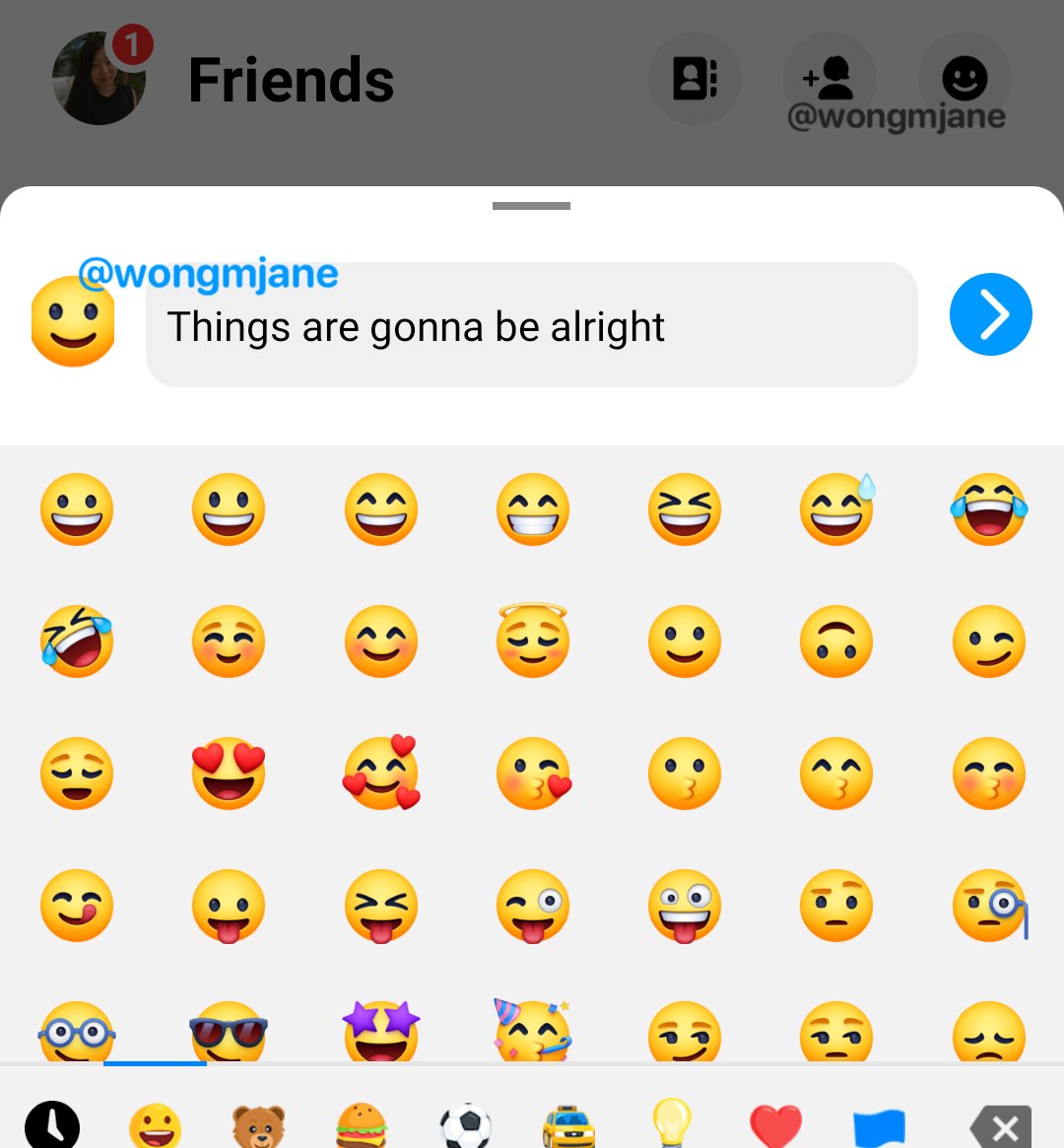
Facebook has been experimenting in this space since at least early 2018, when its manual Emoji Status was spotted. That allowed you to append an emoji of your choosing to your Messenger profile pic. Then in October Facebook introduced Auto Status, but only in the Instagram side-app Threads.
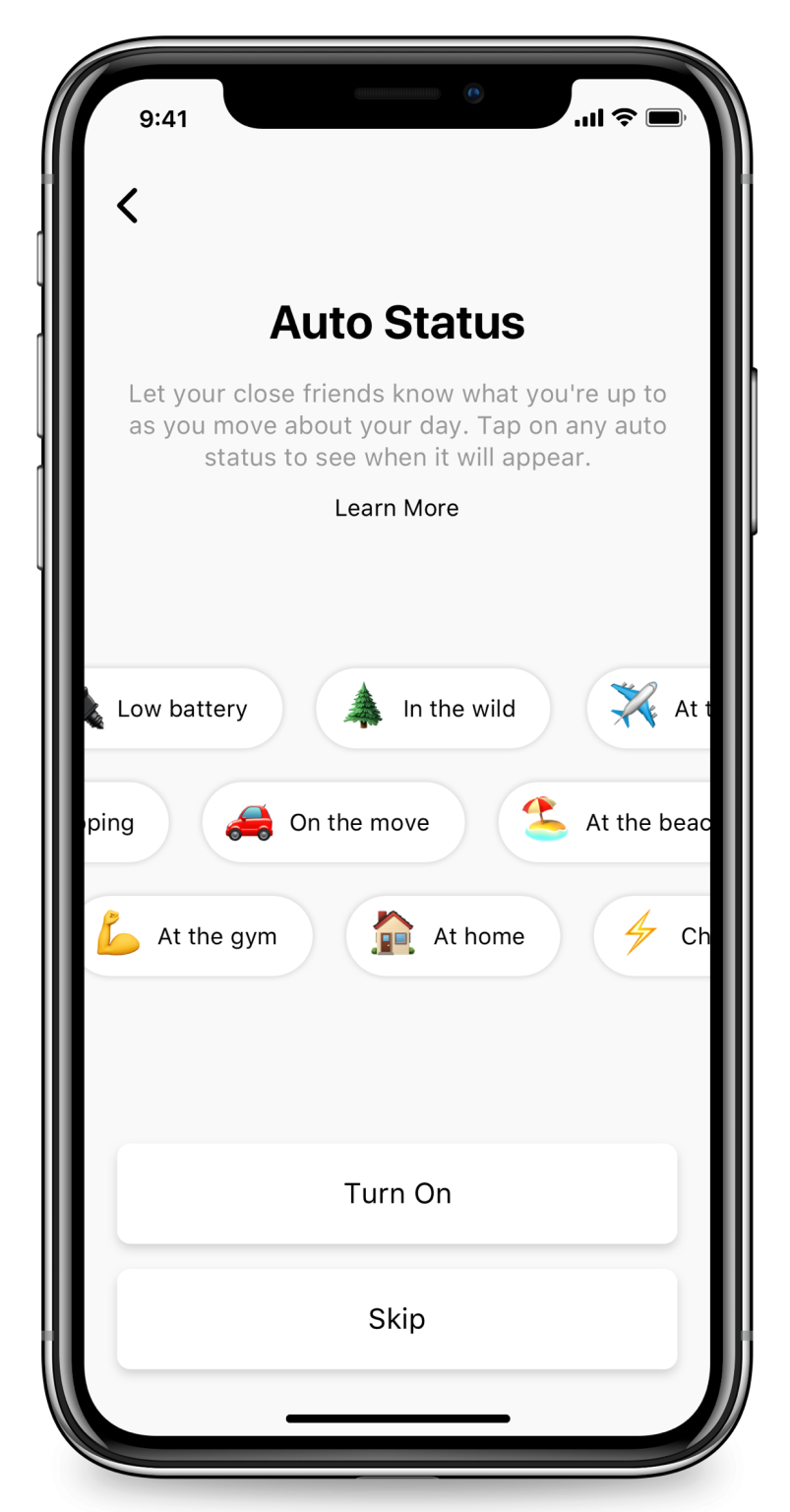
Some users were initially creeped out by the idea of Facebook relaying battery status. But Instagram director of Product Management Robby Stein explained to me that since you might not respond to a message if your phone goes dead or is left on the charger, it’s useful info to relay to friends who might be wondering what you’re doing.
 Then earlier this month, reverse engineering master and constant TechCrunch tipster Jane Manchun Wong revealed a new, unreleased version of Emoji Status hidden in Messenger’s Android code. Then today, Wong showed off how she similarly spotted Facebook trying to port Auto Status to Messenger. That would bring the feature to over one billion monthly users compared to the relatively small base for Threads.
With Auto Status, you can “Let specific freidns see what you’re up to as you go about your day. Share location info, weather, and more, even when you’re not in the app.” Auto Status is only visible to a special list of friends you can change at any time, similar to Instagram Close Friends. And the feature shares “no addresses or place names. Just types of locations, like “at a cafe”. Movement (driving, biking, walking), venue (at the movies, airport), cities (in Tokyo), and battery status (low battery, charging), are some of categories of what Auto Status shares.
A Facebook Messenger communications representative confirmed to TechCrunch that the Auto Status feature was being prototyped by Messenger, noting that “We’re always exploring new features to improve your Messenger experience. This feature is still in early development and not externally testing.” The company also tweeted the statement.
One of the biggest unsolved problems in social networking and messaging remains knowing whether friends are free to chat or hang out without having to ask them directly. Reaching out at the wrong time only to be ignored or rejected can feel awkward, intimidating, and discourage connection later. But if you have a vague idea of what a close friend is up to, you can more deftly plan when to message them, and be more likely to get to spend time together in person or just online.
That could be a cure to the loneliness that endless feed scrolling by ourselves can leave us feeling.


from Mobile – TechCrunch https://ift.tt/2UI9H8I
ORIGINAL CONTENT FROM: https://techcrunch.com/
TECH Solutions - Facebook Messenger preps Auto Status location type sharing
Facebook Messenger could soon automatically tell your closest friends you’re at the gym, driving, or in Tokyo. Messenger has been spotted prototyping a ported version of the Instagram close friends-only Threads app’s Auto Status option that launched in October.
The unreleased Messenger feature would use your location, accelerometer, and battery life to determine what you’re up to and share it with a specific subset of your friends. But instead of sharing your exact coordinates, it overlays an emoji on your Messenger profile pic to indicate that you’re at the movies, biking, at the airport, or charging your phone.
It’s unclear if or when Messenger might launch Auto Status. But if released, the feature could become Facebook’s version of the AOL Away Message, allowing people to stay in closer touch without the creepiness of exact location sharing. It might also help people coordinate online or offline meetups by revealing what friends are up to. Auto Status creates an ice breaker, so if it says a close friend is “at a cafe”, or “chilling” you could ask to hang out.
Back in 2016, I wrote about how exact location sharing had failed to become mainstream because knowing where someone is doesn’t tell you their intention. What matters is whether they’re free to interact with you, which none of the social networks offered.
A few products like Down To Lunch and Free have came and went in the meantime. Snapchat’s Snap Map and its acquisition Zenly both doubled down on precise location sharing, yet still we’re often stuck home wondering if anyone we care about is similarly bored and might want to hang out.
Facebook has been experimenting in this space since at least early 2018, when its manual Emoji Status was spotted. That allowed you to append an emoji of your choosing to your Messenger profile pic. Then in October Facebook introduced Auto Status, but only in the Instagram side-app Threads.
Some users were initially creeped out by the idea of Facebook relaying battery status. But Instagram director of Product Management Robby Stein explained to me that since you might not respond to a message if your phone goes dead or is left on the charger, it’s useful info to relay to friends who might be wondering what you’re doing.
Then earlier this month, reverse engineering master and constant TechCrunch tipster Jane Manchun Wong revealed a new, unreleased version of Emoji Status hidden in Messenger’s Android code. Then today, Wong showed off how she similarly spotted Facebook trying to port Auto Status to Messenger. That would bring the feature to over one billion monthly users compared to the relatively small base for Threads.
With Auto Status, you can “Let specific freidns see what you’re up to as you go about your day. Share location info, weather, and more, even when you’re not in the app.” Auto Status is only visible to a special list of friends you can change at any time, similar to Instagram Close Friends. And the feature shares “no addresses or place names. Just types of locations, like “at a cafe”. Movement (driving, biking, walking), venue (at the movies, airport), cities (in Tokyo), and battery status (low battery, charging), are some of categories of what Auto Status shares.
A Facebook Messenger communications representative confirmed to TechCrunch that the Auto Status feature was being prototyped by Messenger, noting that “We’re always exploring new features to improve your Messenger experience. This feature is still in early development and not externally testing.” The company also tweeted the statement.
One of the biggest unsolved problems in social networking and messaging remains knowing whether friends are free to chat or hang out without having to ask them directly. Reaching out at the wrong time only to be ignored or rejected can feel awkward, intimidating, and discourage connection later. But if you have a vague idea of what a close friend is up to, you can more deftly plan when to message them, and be more likely to get to spend time together in person or just online.
That could be a cure to the loneliness that endless feed scrolling by ourselves can leave us feeling.

from Social – TechCrunch https://ift.tt/2UI9H8I
Original Content From: https://techcrunch.com
TECH Solutions - WeWork sells off social network Meetup to AlleyCorp and other investors
Meetup, the social networking platform designed to connect people in person, is being spun out from shared office space provider WeWork, the company confirmed on Monday. The site is being sold to AlleyCorp and other private investors for an undisclosed sum, but one that’s reportedly far less than the $156 million acquisition price WeWork paid for the social network back in 2017.
Fortune (paywalled) was first to break the news of Meetup’s sale. The company has also now put out a press release with further details.
Meetup, which has operated for two-and-a-half years as a WeWork subsidiary, will divest itself from its parent company and continue to operate, it says. The site today serves 49 million registered members and more than 230,000 organizers who create an average of 15,000 in-person events per day.
Even before the COVID-19 pandemic, Meetup had been struggling. The company in November announced a round of layoffs amid other cost-cutting measures. And these had followed earlier cuts of 10% of staff during acquisition negotiations.
With the COVID-19 pandemic now in full force, fewer people than ever are willing and able to meet in-person, leading to Meetup to position itself today as a place for groups to meet “online during times of crisis,” its release said. That remains to be seen.
The investor groups in Meetup’s latest acquisition are led by Kevin Ryan’s AlleyCorp and also include other “mission-driven private funds” and “accomplished technology executives,” the company claims.
The deal will see Ryan joining Meetup as chairman of the Board. David Siegel will remain Meetup CEO and board member, and will continue to lead the company.
Meetup groups will continue to operate, as will Meetup’s enterprise business solution, Meetup Pro, which has been used by over 1,500 clients to date, including Adobe, Google, Microsoft Azure, IBM, Twitter and Looker, among others.
“This acquisition provides the long-term capital to ensure that Meetup focuses on what is most important: the organizers who make Meetup successful, our passionate members, and our dedicated employees,” said David Siegel, CEO of Meetup, in a statement. “We are excited to continue on our mission of empowering personal growth through real human connections, and I’m happy to have brought in a team of smart investors who share and support the same values,” he said.
WeWork’s intention to sell off Meetup was previously known. Unfortunately for the longtime social network, it was one of several casualties arising from WeWork’s larger troubles.
It’s unclear, however, what the future holds for Meetup. Though the government lockdown policies may eventually end, consumers’ appetite for getting together in real-life groups with people they first met online may not be as strong as it was before. Meetup may have to shift more of its focus to supporting online-only groups — a market that’s today dominated by Facebook Groups, or niche apps catering to specific categories, like Peanut for moms or Nextdoor for neighbors, for instance.
“We are confident in the enormous potential of the business and Meetup’s mission of bringing people together in substantive ways,” said AlleyCorp’s Ryan, in a statement. “We are very excited to collectively serve and grow Meetup’s extensive and incredibly engaged user base.”

from Social – TechCrunch https://ift.tt/3bO5gjN
Original Content From: https://techcrunch.com