Platforms are increasing efforts to block false information as the outbreak spreads and fear grows.
from BBC News - Technology https://ift.tt/2RK6QM9
Original Content From: http://bbci.co.uk

This Blog is created to share Technical Solutions for public interest. The Content is related with IT solutions, SEO tips, Online Earning, online marketing, website developement, CSS, java, C++, python, C sharp Languages.
Friday, January 31, 2020
Tech Solutions -Bilal Asif, Faheem Ashraf back in Pakistan Test squad
Usman Shinwari and Kashif Bhatti left out for Test series opener against Bangladesh in Rawalpindi
from Pakistan news from ESPN Cricinfo.com https://ift.tt/38VaXe7
Original Content From : https://ift.tt/Ti8aBD
from Pakistan news from ESPN Cricinfo.com https://ift.tt/38VaXe7
Original Content From : https://ift.tt/Ti8aBD
Carriers ‘violated federal law’ by selling your location data, FCC tells Congress
More than a year and a half after wireless carriers were caught red-handed selling the real-time location data of their customers to anyone willing to pay for it, the FCC has determined that they committed a crime. An official documentation of exactly how these companies violated the law is forthcoming.
FCC Chairman Ajit Pai shared his finding in a letter to Congressman Frank Pallone (D-NJ), who chairs the Energy and Commerce Committee that oversees the agency. Rep. Pallone has been active on this and prodded the FCC for updates late last year, prompting today’s letter. (I expect a comment from his office shortly and will add it when they respond.)
“I wish to inform you that the FCC’s Enforcement Bureau has completed its extensive investigation and that it has concluded that one or more wireless carriers apparently violated federal law,” Pai wrote.
Extensive it must have been, since we first heard of this egregious breach of privacy in May of 2018, when multiple reports showed that every major carrier (including TechCrunch’s parent company Verizon) was selling precise location data wholesale to resellers who then either resold it or gave it away. It took nearly a year for the carriers to follow through on their promises to stop the practice. And now, 18 months later, we get the first real indication that regulators took notice.
“It’s a shame that it took so long for the FCC to reach a conclusion that was so obvious,” said Commissioner Jessica Rosenworcel in a statement issued alongside the Chairman’s letter. She has repeatedly brought up the issue in the interim, seemingly baffled that such a large-scale and obvious violation was going almost completely unacknowledged by the agency.
Commissioner Brendan Starks echoed her sentiment in his own statement: “These pay-to-track schemes violated consumers’ privacy rights and endangered to their safety. I’m glad we may finally act on these egregious allegations. My question is: what took so long?”
Chairman Pai’s letter explains that “in the coming days” he will be proposing a “Notice of Apparent Liability for Forfeiture,” or several of them. This complicated-sounding document is basically the official declaration, with evidence and legal standing, that someone has violated FCC rules and may be subject to a “forfeiture,” essentially a fine.
Right now that is all the information anyone has, including the other Commissioners, but the arrival of the notice will no doubt make things much clearer — and may help show exactly how seriously the agency took this problem and when it began to take action.
Disclosure: TechCrunch is owned by Verizon Media, a subsidiary of Verizon Wireless, but this has no effect on our coverage.


from Mobile – TechCrunch https://ift.tt/2GJBgrw
ORIGINAL CONTENT FROM: https://techcrunch.com/
TECH Solutions - WhatsApp to stop working on millions of phones
The messaging app will become obsolete on older operating systems from 1 Feb.
from BBC News - Technology https://ift.tt/37MbcIm
Original Content From: http://bbci.co.uk
from BBC News - Technology https://ift.tt/37MbcIm
Original Content From: http://bbci.co.uk
TECH Solutions - MEPs vote for universal charging cable for mobiles
The decision will anger Apple which has argued against such a decision.
from BBC News - Technology https://ift.tt/36QlW7n
Original Content From: http://bbci.co.uk
from BBC News - Technology https://ift.tt/36QlW7n
Original Content From: http://bbci.co.uk
TECH Solutions - 5 Best Tools And Apps For YouTube Creator 2020
5 Best Tools And Apps For YouTube Creator 2020
Hi Friends: This is my Blog Technical Solutions created to share videos and content of technical solutions with the world. At this blog you can find videos about Free Search Engine Optimization Course, how to develope Android Applications and What is Computer hardware and software, you would be able to increse your channel views, or boost your website. so guys keep visiting my blog for learning technical things. Thank You!
Hi Friends: This is my Blog Technical Solutions created to share videos and content of technical solutions with the world. At this blog you can find videos about Free Search Engine Optimization Course, how to develope Android Applications and What is Computer hardware and software, you would be able to increse your channel views, or boost your website. so guys keep visiting my blog for learning technical things. Thank You!
TECH Solutions - How Dubsmash revived itself as #2 to TikTok
Lip-syncing app Dubsmash was on the brink of death. After a brief moment of virality in 2015 alongside Vine (R.I.P), Dubsmash was bleeding users faster than it could recruit them. The app let you choose an audio track like a rap song or movie quote and shoot a video of you pretending to say the words. But there was nowhere in the app to post the videos. It was a creation tool like Hipstamatic, not a network like Instagram. There’s a reason we’re only using one of those today.
So in 2017 Dubsmash‘s three executives burned down the 30-person company and rebuilt something social from the ashes with the rest of the $15.4 million it’d raised from Lowercase Capital and Index Ventures. They ditched its Berlin headquarters and resettled in Brooklyn, closer to the one demographic still pushing Dubsmashes to the Instagram Explore page: African-American teenagers posting dances and lip-syncs to indie hip-hop songs on the rise.
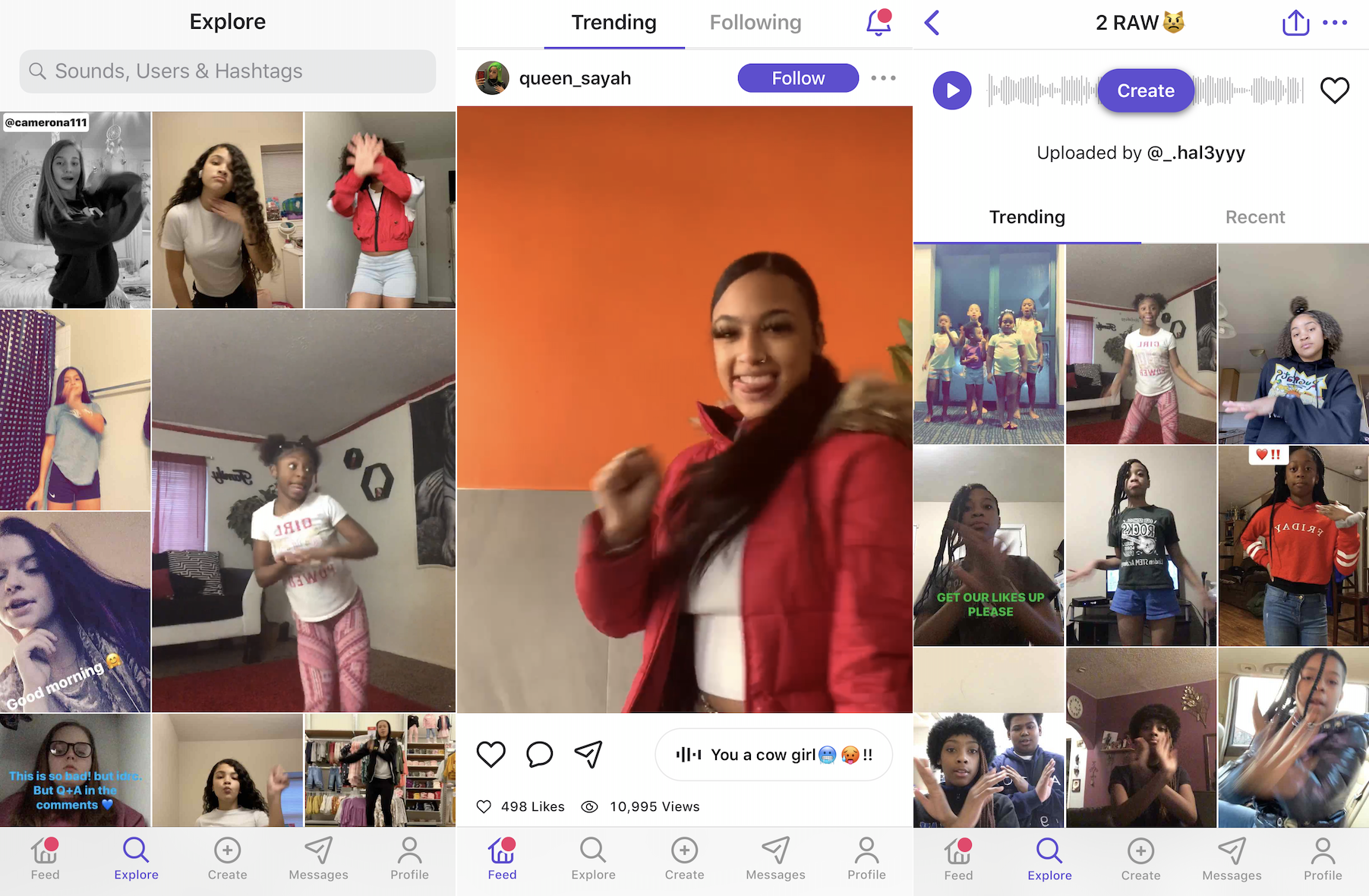
Dubsmash stretched its funding to rehire a whole new team of 15. They spent a year coding a new version of Dubsmash centered around Following and Trending feeds, desperately trying to match the core features of Musically, which by then had been bought by China’s ByteDance. It’s got chat but still lacks the augmented reality filters, cut transitions, and photo slideshows of TikTok. But Dubsmash has the critical remix option for soundtracking your clip with the audio of any other video that sets it apart from Instagram and Snapchat.
“We realized to build a great product, we needed a depth of expertise that we just didn’t have access to in Berlin” Dubsmash co-founder and CEO Jonas Druppel tells me. “It was a risky move and we felt the weight of it acutely. But we also knew there was no other way forward, given the scale and pace of the other players in the market.”
Few social apps have ever pulled off a real comeback. Even Snapchat had only lost 5 million of its 191 million users before it started growing again. But in the case of Dubsmash, its biggest competitor was also its savior.

The pre-relaunch version of Dubsmash
In August 2018, ByteDance merged Musically into TikTok to form a micro-entertainment phenomenon. Instead of haphazardly sharing auto-biographical Stories shot with little forethought, people began storyboarding skits and practicing dances. The resulting videos were denser and more compelling than content on Snapchat and Instagram. The new Dubsmash, launched two months later, rode along with the surge of interest in short-form video like a Lilliputian in a giant’s shirt pocket. The momentum helped Dubsmash raise a secret round of funding last year to keep up the chase.
Now Dubsmash has 1 billion video views per month.
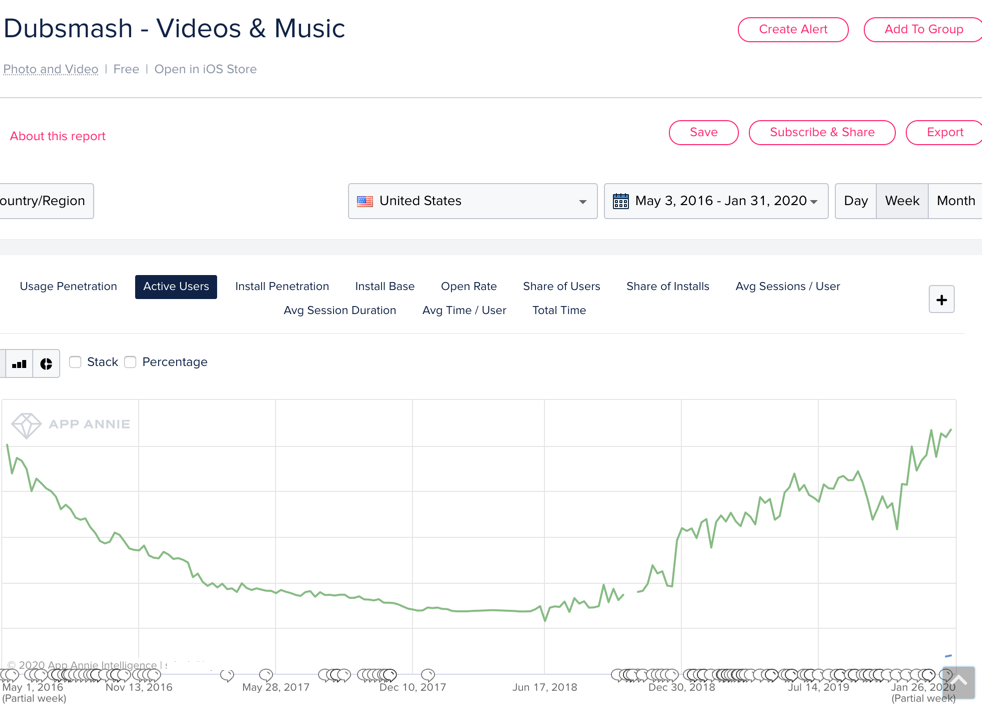
Dubsmash rebuilt its app and revived its usage
“The turnaround that we executed hasn’t been done in recent memory by a consumer app in such a competitive marketplace. Most of them fade to oblivion or shut down” Dubsmash co-founder and President Suchit Dash tells me. “By moving the company to the United States, hiring a brand new all-star team & relaunching the product, we gave this company & product a second life. Through that journey, we obsessed only on one metric: retention.”
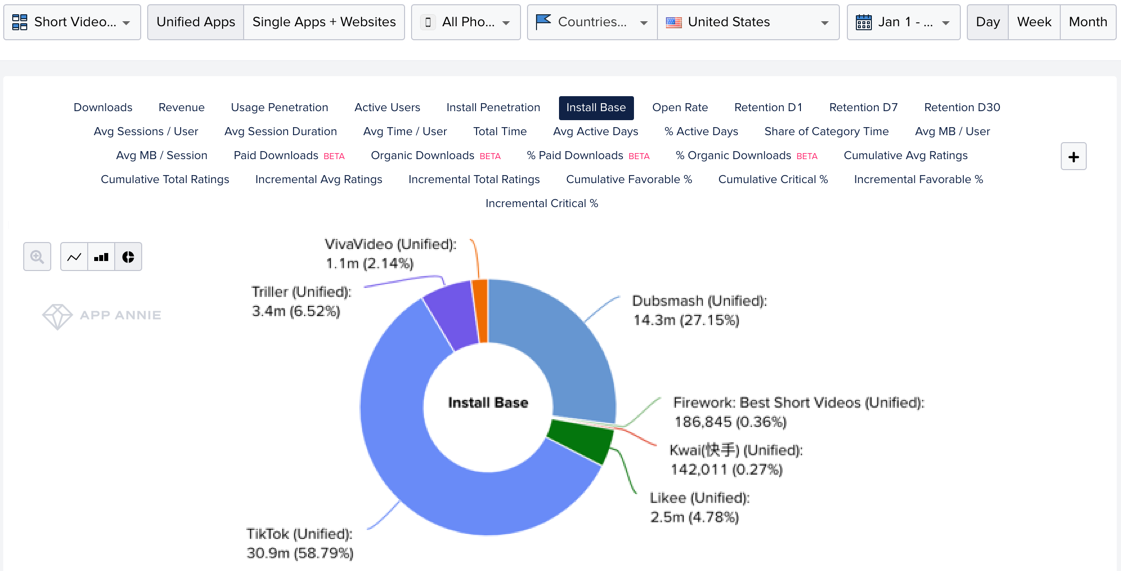
Now the app has pulled 27% of the US short-form video market share by installs, second only to TikTok’s 59%, according to AppAnnie. Sensor Tower tells TechCrunch that TikTok has about 3X as many US lifetime installs as Dubsmash, and 11X more between when Musically became TikTok in August 2018 and now.
In terms of active users outside of TikTok, Dubsmash has 73% of the US market, compared to just 23% on Triller, 3.6% on Firework, and an embarrassing 0% on Facebook’s Lasso. And while Triller began surpassing Dubsmash in downloads per month in October, Dubsmash has 3X as many active users and saw 38% more first-time downloads in 2018 than 2019. Dubsmash now sees 30% retention after a month, and 30% of its daily users are creating content.
It’s that stellar rate of participation that’s brought Dubsmash back to life. It also attracted a previously unannounced round of $6.75 million in the Spring of 2019, largely from existing investors. While TikTok’s superstars and huge visibility could be scaring some users away from shooting videos while a long-tail of recent downloaders watch passively, Dubsmash has managed to make people feel comfortable on camera.
“Dubsmash is ground zero for culture creation in America—it’s where the newest, most popular hip-hop and dance challenges on the Internet originate” Dash declares. “Members of the community are developing content that will make them the superstars of tomorrow.”
Being #2 might not be so bad, given how mobile video viewing is growing massively thanks to better cameras, bigger screens, faster networks, and cheaper data. Right now, Dubsmash doesn’t make any money. It hopes to one day generate revenue while helping its creators earn a living too, perhaps through ad revenue shares, tipping, subscriptions, merchandise, or offline meetups.

One advantage of not being TikTok is that the app feels less crowded by semi-pro creators and influencers. That gives users the vibe that they’re more likely to hit the Trending or Explore page on Dubsmash. The Trending page is dominated by hot new songs and flashy dances, even if they’re shot with a lower production quality that feels accessible.
Dubsmash tries to stoke that sense of opportunity by making Explore about discovering accounts and all the content they’ve made rather than specific videos. While popular clips might have tens of thousands of views rather than the hundred-thousand or multi-million counts on TikTok’s top content, there’s enough visibility to make shooting Dubsmashes worth it.
TikTok has already taken notice. Shown in a leak of its moderation guidelines from Netzpolitik, the company’s policy is to downrank the visibility of any video referencing or including a watermark from direct competitors including Dubsmash, Triller, Lasso, Snapchat, and WhatsApp. That keeps Dubsmash videos, which you can save to your camera roll, from going viral on TikTok and luring users away.
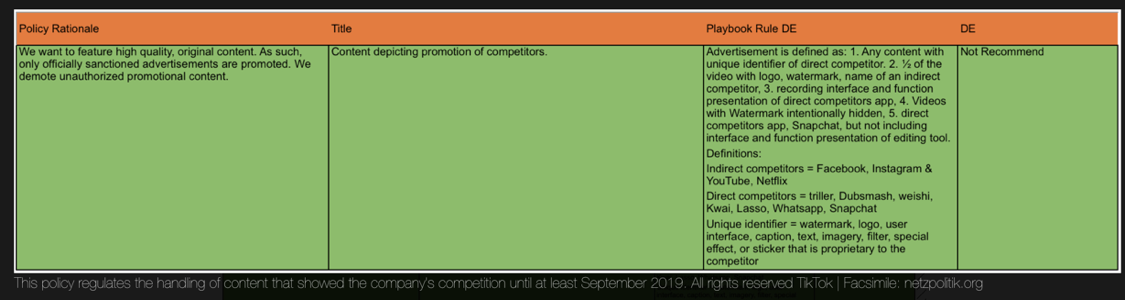
TikTok’s content moderation guidelines show it downranks content featuring the watermarks of competitors like Dubsmash
TikTok also continues to aggressively buy users via ads on competing apps like Facebook thanks to the billions in funding raked in by its parent ByteDance. In contast, Dash says Dubsmash has never spent a dollar on user acquisition, influencer marketing, or any other source of growth. That makes it achieving even half to a third of as many installs as TikTok in the US an impressive fete.
Why would creators choose Dubsmash over TikTok? Dash clinically explains that its a “decoupled audio and video platform that enables producers and tastemakers to upload fresh, original tracks that are utilized by creators and influencers alike” but that it’s also about “Its role as a welcoming home for a community that’s underrepresented on social platforms.”
If Dubsmash keeps growing, though, it will encounter the inevitable content moderation problems that come with scale. It’s already doing a solid job of requiring users to sign up with their birthdate to watch or post videos, and it blocks those under 13. Only users who follow each other can chat.
Any piece of content that’s flagged by users is hidden from the network until it passes a review by its human moderation team that works around the clock, and it does proactive takedowns too. However, brigading and malicious takedown reports could be used by trolls to silence their enemies. Dubsmash is working off of a common sense model of what’s allowed rather than firm guidelines, which will be tough to keep consistent at scale.
“Being a social media app in 2020 means you need to take greater responsibility for the well being of the community” says Dash. “We decided upon relaunch to take a strict perspective. Our goal is to be intentional and proactive early, and invest in safety and healthy growth rather than growth at all costs. This may not be the most popular approach amongst the market, but we believe this is the most effective way to build a social platform.”

Dubsmash proves that short-form video is so compelling to teens that the market can sustain multiple apps. That will have to be the case given Instagram is preparing to release its TikTok clone Reels, and Vine’s co-founder Dom Hofmann just launched his successor Byte. The breakdown could look like:
- TikTok: A slightly longer-form combo of comedy, dance, and absurdity
- Dubsmash: Mid-length dance and music videos with a diverse community
- Byte: Super short-form comedy featuring slightly older ex-Vine stars
- Triller: Mid-length life blogging clips from Hollywood celebrities
- Instagram Reels: International influencers making videos for a mainstream audience
Perhaps we’ll eventually see consolidation in the market, with giants like TikTok and Instagram acquiring smaller players to grow their content network effect with more fodder for remixes. But fragmentation could breed creativity. Different tools and audiences beg for different types of videos. Make something special, and there’s an app out there to enter your into pop culture cannon.
For more on the short-form video wars and the future of micro-entertainment, read:

from Social – TechCrunch https://ift.tt/2RL0j44
Original Content From: https://techcrunch.com
How Dubsmash revived itself as #2 to TikTok
Lip-syncing app Dubsmash was on the brink of death. After a brief moment of virality in 2015 alongside Vine (R.I.P), Dubsmash was bleeding users faster than it could recruit them. The app let you choose an audio track like a rap song or movie quote and shoot a video of you pretending to say the words. But there was nowhere in the app to post the videos. It was a creation tool like Hipstamatic, not a network like Instagram. There’s a reason we’re only using one of those today.
So in 2017 Dubsmash‘s three executives burned down the 30-person company and rebuilt something social from the ashes with the rest of the $15.4 million it’d raised from Lowercase Capital and Index Ventures. They ditched its Berlin headquarters and resettled in Brooklyn, closer to the one demographic still pushing Dubsmashes to the Instagram Explore page: African-American teenagers posting dances and lip-syncs to indie hip-hop songs on the rise.
Dubsmash stretched its funding to rehire a whole new team of 15. They spent a year coding a new version of Dubsmash centered around Following and Trending feeds, desperately trying to match the core features of Musically, which by then had been bought by China’s ByteDance. It’s got chat but still lacks the augmented reality filters, cut transitions, and photo slideshows of TikTok. But Dubsmash has the critical remix option for soundtracking your clip with the audio of any other video that sets it apart from Instagram and Snapchat.
“We realized to build a great product, we needed a depth of expertise that we just didn’t have access to in Berlin” Dubsmash co-founder and CEO Jonas Druppel tells me. “It was a risky move and we felt the weight of it acutely. But we also knew there was no other way forward, given the scale and pace of the other players in the market.”
Few social apps have ever pulled off a real comeback. Even Snapchat had only lost 5 million of its 191 million users before it started growing again. But in the case of Dubsmash, its biggest competitor was also its savior.
The pre-relaunch version of Dubsmash
In August 2018, ByteDance merged Musically into TikTok to form a micro-entertainment phenomenon. Instead of haphazardly sharing auto-biographical Stories shot with little forethought, people began storyboarding skits and practicing dances. The resulting videos were denser and more compelling than content on Snapchat and Instagram. The new Dubsmash, launched two months later, rode along with the surge of interest in short-form video like a Lilliputian in a giant’s shirt pocket. The momentum helped Dubsmash raise a secret round of funding last year to keep up the chase.
Now Dubsmash has 1 billion video views per month.
Dubsmash rebuilt its app and revived its usage
“The turnaround that we executed hasn’t been done in recent memory by a consumer app in such a competitive marketplace. Most of them fade to oblivion or shut down” Dubsmash co-founder and President Suchit Dash tells me. “By moving the company to the United States, hiring a brand new all-star team & relaunching the product, we gave this company & product a second life. Through that journey, we obsessed only on one metric: retention.”
Now the app has pulled 27% of the US short-form video market share by installs, second only to TikTok’s 59%, according to AppAnnie. Sensor Tower tells TechCrunch that TikTok has about 3X as many US lifetime installs as Dubsmash, and 11X more between when Musically became TikTok in August 2018 and now.
In terms of active users outside of TikTok, Dubsmash has 73% of the US market, compared to just 23% on Triller, 3.6% on Firework, and an embarrassing 0% on Facebook’s Lasso. And while Triller began surpassing Dubsmash in downloads per month in October, Dubsmash has 3X as many active users and saw 38% more first-time downloads in 2018 than 2019. Dubsmash now sees 30% retention after a month, and 30% of its daily users are creating content.
It’s that stellar rate of participation that’s brought Dubsmash back to life. It also attracted a previously unannounced round of $6.75 million in the Spring of 2019, largely from existing investors. While TikTok’s superstars and huge visibility could be scaring some users away from shooting videos while a long-tail of recent downloaders watch passively, Dubsmash has managed to make people feel comfortable on camera.
“Dubsmash is ground zero for culture creation in America—it’s where the newest, most popular hip-hop and dance challenges on the Internet originate” Dash declares. “Members of the community are developing content that will make them the superstars of tomorrow.”
Being #2 might not be so bad, given how mobile video viewing is growing massively thanks to better cameras, bigger screens, faster networks, and cheaper data. Right now, Dubsmash doesn’t make any money. It hopes to one day generate revenue while helping its creators earn a living too, perhaps through ad revenue shares, tipping, subscriptions, merchandise, or offline meetups.
One advantage of not being TikTok is that the app feels less crowded by semi-pro creators and influencers. That gives users the vibe that they’re more likely to hit the Trending or Explore page on Dubsmash. The Trending page is dominated by hot new songs and flashy dances, even if they’re shot with a lower production quality that feels accessible.
Dubsmash tries to stoke that sense of opportunity by making Explore about discovering accounts and all the content they’ve made rather than specific videos. While popular clips might have tens of thousands of views rather than the hundred-thousand or multi-million counts on TikTok’s top content, there’s enough visibility to make shooting Dubsmashes worth it.
TikTok has already taken notice. Shown in a leak of its moderation guidelines from Netzpolitik, the company’s policy is to downrank the visibility of any video referencing or including a watermark from direct competitors including Dubsmash, Triller, Lasso, Snapchat, and WhatsApp. That keeps Dubsmash videos, which you can save to your camera roll, from going viral on TikTok and luring users away.
TikTok’s content moderation guidelines show it downranks content featuring the watermarks of competitors like Dubsmash
TikTok also continues to aggressively buy users via ads on competing apps like Facebook thanks to the billions in funding raked in by its parent ByteDance. In contast, Dash says Dubsmash has never spent a dollar on user acquisition, influencer marketing, or any other source of growth. That makes it achieving even half to a third of as many installs as TikTok in the US an impressive fete.
Why would creators choose Dubsmash over TikTok? Dash clinically explains that its a “decoupled audio and video platform that enables producers and tastemakers to upload fresh, original tracks that are utilized by creators and influencers alike” but that it’s also about “Its role as a welcoming home for a community that’s underrepresented on social platforms.”
If Dubsmash keeps growing, though, it will encounter the inevitable content moderation problems that come with scale. It’s already doing a solid job of requiring users to sign up with their birthdate to watch or post videos, and it blocks those under 13. Only users who follow each other can chat.
Any piece of content that’s flagged by users is hidden from the network until it passes a review by its human moderation team that works around the clock, and it does proactive takedowns too. However, brigading and malicious takedown reports could be used by trolls to silence their enemies. Dubsmash is working off of a common sense model of what’s allowed rather than firm guidelines, which will be tough to keep consistent at scale.
“Being a social media app in 2020 means you need to take greater responsibility for the well being of the community” says Dash. “We decided upon relaunch to take a strict perspective. Our goal is to be intentional and proactive early, and invest in safety and healthy growth rather than growth at all costs. This may not be the most popular approach amongst the market, but we believe this is the most effective way to build a social platform.”
Dubsmash proves that short-form video is so compelling to teens that the market can sustain multiple apps. That will have to be the case given Instagram is preparing to release its TikTok clone Reels, and Vine’s co-founder Dom Hofmann just launched his successor Byte. The breakdown could look like:
- TikTok: A slightly longer-form combo of comedy, dance, and absurdity
- Dubsmash: Mid-length dance and music videos with a diverse community
- Byte: Super short-form comedy featuring slightly older ex-Vine stars
- Triller: Mid-length life blogging clips from Hollywood celebrities
- Instagram Reels: International influencers making videos for a mainstream audience
Perhaps we’ll eventually see consolidation in the market, with giants like TikTok and Instagram acquiring smaller players to grow their content network effect with more fodder for remixes. But fragmentation could breed creativity. Different tools and audiences beg for different types of videos. Make something special, and there’s an app out there to enter your into pop culture cannon.
For more on the short-form video wars and the future of micro-entertainment, read:


from Mobile – TechCrunch https://ift.tt/2RL0j44
ORIGINAL CONTENT FROM: https://techcrunch.com/
Tech Solutions -Pakistan set up semi-final clash against India after routing Afghanistan in Under-19 World Cup
Afghanistan Under-19s lost by six wickets, their standout performer Noor Ahmad, who mankaded opener Mohammad Huraira for 64, in Benoni
from Pakistan news from ESPN Cricinfo.com https://ift.tt/2tf3W8H
Original Content From : https://ift.tt/Ti8aBD
from Pakistan news from ESPN Cricinfo.com https://ift.tt/2tf3W8H
Original Content From : https://ift.tt/Ti8aBD
Tech Solutions -Noor Ahmad mankads Mohammad Huraira in Under-19 World Cup
Batsman was run out for 64, but Pakistan comfortably beat Afghanistan in the fourth Super League quarter-final
from Pakistan news from ESPN Cricinfo.com https://ift.tt/2Uc8UOz
Original Content From : https://ift.tt/Ti8aBD
from Pakistan news from ESPN Cricinfo.com https://ift.tt/2Uc8UOz
Original Content From : https://ift.tt/Ti8aBD
Technical Solutions - Tech Talks #1040 - Jio 2020 Cash Back, Instagram Hack, Coronavirus, 80W Charging, JioTV Camera
Tech Talks #1040 - Jio 2020 Cash Back, Instagram Hack, Coronavirus, 80W Charging, JioTV Camera
TG Deals@ https://tg.deals/ New Channel: https://goo.gl/Jz6p5K Namaskaar Dosto, Tech Talks ke is Episode mein maine aapse kuch interesting Tech News Share ki hai jaise Jio 2020 Cashback, Instagram Hack, Coronavirus problem, 80W Charging, JioTV Camera Launch aur bahut kuch. Mujhe umeed hai ki yeh video aapko pasand aayega. Share, Support, Subscribe!!! Subscribe: http://bit.ly/1Wfsvt4 Android App: https://ift.tt/2mrm9Gy Youtube: http://www.youtube.com/c/TechnicalGuruji Twitter: http://www.twitter.com/technicalguruji Facebook: https://ift.tt/1Pi5LDP Facebook Myself: https://goo.gl/zUfbUU Instagram: https://ift.tt/1OW2vue Google Plus: https://ift.tt/1Pi5LDS Website: https://ift.tt/2mcM6KV Merchandise: https://ift.tt/2lN4Vbu About : Technical Guruji is a YouTube Channel, where you will find technological videos in Hindi, New Video is Posted Everyday :)
TG Deals@ https://tg.deals/ New Channel: https://goo.gl/Jz6p5K Namaskaar Dosto, Tech Talks ke is Episode mein maine aapse kuch interesting Tech News Share ki hai jaise Jio 2020 Cashback, Instagram Hack, Coronavirus problem, 80W Charging, JioTV Camera Launch aur bahut kuch. Mujhe umeed hai ki yeh video aapko pasand aayega. Share, Support, Subscribe!!! Subscribe: http://bit.ly/1Wfsvt4 Android App: https://ift.tt/2mrm9Gy Youtube: http://www.youtube.com/c/TechnicalGuruji Twitter: http://www.twitter.com/technicalguruji Facebook: https://ift.tt/1Pi5LDP Facebook Myself: https://goo.gl/zUfbUU Instagram: https://ift.tt/1OW2vue Google Plus: https://ift.tt/1Pi5LDS Website: https://ift.tt/2mcM6KV Merchandise: https://ift.tt/2lN4Vbu About : Technical Guruji is a YouTube Channel, where you will find technological videos in Hindi, New Video is Posted Everyday :)
Tech Solutions -Iqbal Qasim appointed head of PCB cricket committee
Iqbal Qasim will take over the role as head of the PCB cricket committee, replacing Wasim Khan
from Pakistan news from ESPN Cricinfo.com https://ift.tt/2S7o2tT
Original Content From : https://ift.tt/Ti8aBD
from Pakistan news from ESPN Cricinfo.com https://ift.tt/2S7o2tT
Original Content From : https://ift.tt/Ti8aBD
TECH Solutions - Huduma Namba: Kenya court halts biometric ID over data fears
Judges says data protection laws need to be enacted to safeguard a wealth of sensitive information.
from BBC News - Technology https://ift.tt/2terfzu
Original Content From: http://bbci.co.uk
from BBC News - Technology https://ift.tt/2terfzu
Original Content From: http://bbci.co.uk
TECH Solutions - Tesla boss Elon Musk releases electronic dance track
Mr Musk posted a teaser picture of himself in a studio shortly before sharing the track, which he wrote.
from BBC News - Technology https://ift.tt/31dfh5Q
Original Content From: http://bbci.co.uk
from BBC News - Technology https://ift.tt/31dfh5Q
Original Content From: http://bbci.co.uk
TECH Solutions - Russia's use of facial recognition challenged in court
Moscow is rapidly expanding its use of live facial recognition technology.
from BBC News - Technology https://ift.tt/2UjAvO9
Original Content From: http://bbci.co.uk
from BBC News - Technology https://ift.tt/2UjAvO9
Original Content From: http://bbci.co.uk
Tech Solutions - OPPO F15 Full Review and Camera Comparison With Samsung
OPPO F15 Full Review and Camera Comparison With Samsung
Hi Friends: This is my Blog Technical Solutions created to share videos and content of technical solutions with the world. At this blog you can find videos about Free Search Engine Optimization Course, how to develope Android Applications and What is Computer hardware and software, you would be able to increse your channel views, or boost your website. so guys keep visiting my blog for learning technical things. Thank You!
Hi Friends: This is my Blog Technical Solutions created to share videos and content of technical solutions with the world. At this blog you can find videos about Free Search Engine Optimization Course, how to develope Android Applications and What is Computer hardware and software, you would be able to increse your channel views, or boost your website. so guys keep visiting my blog for learning technical things. Thank You!
TECH Solutions - Twitter suspends notorious UK hate preacher for violating abuse rules
Twitter has confirmed it has temporarily suspended the account of controversial rightwing commentator, Katie Hopkins. The move was reported earlier by the BBC.
Hopkins, a former MailOnline columnist and presenter on LBC radio, is a veteran of the social media platform, joining Twitter just under a decade ago — and using it amplify her brand of far-right leaning, liberal-baiting politics. She regularly tweets anti-immigration and anti-Islam sentiments, and has claimed that white British people are now a discriminated against minority.
It’s not clear which of Hopkins’ tweets led Twitter to finally pull the trigger, although she had recently targeted black British rapper Stormzy for a series of abusive tweets.
In a statement confirming the account suspension, Twitter told us:
Keeping Twitter safe is a top priority for us — abuse and harassment have no place on the service. We take enforcement action against any account that is violative of our rules – which includes violations of our hateful conduct policy and abusive behaviour policy. These rules apply to everyone using our service — regardless of the account involved.
At the time of writing Hopkins’ account is still visible — although all but one of her tweets has been deleted.
It is not clear whether Hopkins herself deleted the majority of her tweets. Twitter pointed out that users may choose to delete their own Tweets at any time, including by using third-party services which provide the option of deleting all tweets
Two non-visible tweets on Hopkins’ feed are listed as ‘no longer available’ for violating Twitter’s rules.
The remaining visible tweet is a retweet of another user accusing her of inciting racial hatred — which contains a screengrab of a number of abusive tweets Hopkins made targeting Stormzy.
Hopkins’ Twitter biog lists her as “Milo’s Mum” — a reference to Milo Yiannopoulos, another controversial rightwing troll who Twitter banned in 2016 after he incited his followers to harass Ghostbusters actress Leslie Jones.

from Social – TechCrunch https://ift.tt/2vyo2LW
Original Content From: https://techcrunch.com
Technical Solutions - Fact Friday #9 - 681 Crore Rs Custom iPhone - Crazy Smartphone Facts🔥🔥🔥
Fact Friday #9 - 681 Crore Rs Custom iPhone - Crazy Smartphone Facts🔥🔥🔥
Namaskaar Dosto, yeh hai aap sabhi viewers ke liye ek brand new episode Fact Friday ka jaha maine aapse share kiye hai 10 Interesting Tech Facts aur aisa har friday ko hone waala hai Fact Friday ke saath jaha hum baat karenge technology ki duniya ke kuch ajeebo gareeb facts ke baare mein. Mujhe umeed hai ki aapko Fact Friday ki yeh video jaroor pasand aayegi. Share, Support, Subscribe!!! Subscribe: http://bit.ly/1Wfsvt4 Android App: https://ift.tt/2mrm9Gy Youtube: http://www.youtube.com/c/TechnicalGuruji Twitter: http://www.twitter.com/technicalguruji Facebook: https://ift.tt/1Pi5LDP Facebook Myself: https://goo.gl/zUfbUU Instagram: https://ift.tt/1OW2vue Google Plus: https://ift.tt/1Pi5LDS Website: https://ift.tt/2mcM6KV Merchandise: https://ift.tt/2lN4Vbu About : Technical Guruji is a YouTube Channel, where you will find technological videos in Hindi, New Video is Posted Everyday :)
Namaskaar Dosto, yeh hai aap sabhi viewers ke liye ek brand new episode Fact Friday ka jaha maine aapse share kiye hai 10 Interesting Tech Facts aur aisa har friday ko hone waala hai Fact Friday ke saath jaha hum baat karenge technology ki duniya ke kuch ajeebo gareeb facts ke baare mein. Mujhe umeed hai ki aapko Fact Friday ki yeh video jaroor pasand aayegi. Share, Support, Subscribe!!! Subscribe: http://bit.ly/1Wfsvt4 Android App: https://ift.tt/2mrm9Gy Youtube: http://www.youtube.com/c/TechnicalGuruji Twitter: http://www.twitter.com/technicalguruji Facebook: https://ift.tt/1Pi5LDP Facebook Myself: https://goo.gl/zUfbUU Instagram: https://ift.tt/1OW2vue Google Plus: https://ift.tt/1Pi5LDS Website: https://ift.tt/2mcM6KV Merchandise: https://ift.tt/2lN4Vbu About : Technical Guruji is a YouTube Channel, where you will find technological videos in Hindi, New Video is Posted Everyday :)
TECH Solutions - Amazon: Christmas sales soar as other retailers struggle
Sales were up 20% over the festive season in sharp contrast to weakness at other retailers.
from BBC News - Technology https://ift.tt/2Ubwifk
Original Content From: http://bbci.co.uk
from BBC News - Technology https://ift.tt/2Ubwifk
Original Content From: http://bbci.co.uk
Thursday, January 30, 2020
TECH Solutions - Censorship claims emerge as TikTok gets political in India
A TikTok influencer says his videos on Hindu-Muslim unity have triggered censorship on the app.
from BBC News - Technology https://ift.tt/31axGQK
Original Content From: http://bbci.co.uk
from BBC News - Technology https://ift.tt/31axGQK
Original Content From: http://bbci.co.uk
TECH Solutions - Making beautiful colours without toxic chemicals
Dyeing clothes uses a lot of water and chemicals, but new tech is drawing on nature for colours.
from BBC News - Technology https://ift.tt/2RHL2kv
Original Content From: http://bbci.co.uk
from BBC News - Technology https://ift.tt/2RHL2kv
Original Content From: http://bbci.co.uk
TECH Solutions - Katie Hopkins' Twitter account suspended
The controversial commentator's account is suspended for violating the anti-hate policy.
from BBC News - Technology https://ift.tt/2uQgLqk
Original Content From: http://bbci.co.uk
from BBC News - Technology https://ift.tt/2uQgLqk
Original Content From: http://bbci.co.uk
TECH Solutions - Sonos apologises for revealing customer email addresses
It was writing to people who were unhappy about a decision to stop updates to the firm's older speakers.
from BBC News - Technology https://ift.tt/2RGhu6Q
Original Content From: http://bbci.co.uk
from BBC News - Technology https://ift.tt/2RGhu6Q
Original Content From: http://bbci.co.uk
TECH Solutions - Daily Crunch: Facebook’s profits disappoint
The Daily Crunch is TechCrunch’s roundup of our biggest and most important stories. If you’d like to get this delivered to your inbox every day at around 9am Pacific, you can subscribe here.
1. Facebook hits 2.5B users in Q4 but shares sink from slow profits
In its latest quarterly earnings report, Facebook said it now reaches 2.5 billion monthly users, up 2% from Q3 2019. And it brought in $21.08 billion in revenue, up 25% year-over-year.
But profits aren’t growing as quickly as Wall Street would like. One big source of those expenses? Headcount grew 26% year-over-year to 44,942, and Facebook now has over 1,000 engineers working on privacy.
2. Avast shuts down marketing analytics subsidiary Jumpshot amid controversy over selling user data
It was recently revealed that the Czech-based cybersecurity specialist was cultivating another controversial revenue stream: harvesting and selling user data, some of it amassed by way of its security tools.
3. Study of YouTube comments finds evidence of radicalization effect
The study, carried out by researchers at Switzerland’s Ecole polytechnique fédérale de Lausanne and the Federal University of Minas Gerais in Brazil, found evidence that users who engaged with “Alt-lite”/”Intellectual Dark Web” right-wing content migrated to commenting on the most fringe far-right content.
4. Microsoft shares rise after it beats revenue, profit expectations, Azure posts 62% growth
Microsoft reported its fiscal 2020 second quarter (calendar Q4 2019) results yesterday, including revenue of $36.9 billion (up 14%), net income of $11.6 billion (up 38%) and diluted earnings per share of $1.51.
5. Snapchat launches Bitmoji TV: zany 4-min cartoons of your avatar
Snapchat is betting that narcissism will drive viewership for its new weekly videos that put you and your friends’ customizable Bitmoji avatars into a flurry of silly animated situations. Bitmoji TV will premiere on Saturday morning.
6. Practice Fusion, once backed by top VCs, pushed doctors to prescribe opioids in kickback scheme
According to the U.S. Department of Justice, Practice Fusion solicited and received pay from an (unnamed for now) major opioid company in exchange for using its EHR software to influence doctors in the act of prescribing opioid pain medications.
7. Where top VCs are investing in travel, tourism and hospitality tech
To get a temperature check on the state of the travel market, the outlook for fundraising and which sub-sectors might present the most attractive opportunities for startups today, we asked five leading VCs at firms spanning early to growth stages to share what’s exciting them most and where they see opportunity in travel, tourism and hospitality tech. (Extra Crunch membership required.)


from Social – TechCrunch https://ift.tt/2S3t3Un
Original Content From: https://techcrunch.com
TECH Solutions - Artificial intelligence-created medicine to be used on humans for first time
A British start-up has developed a new drug much more quickly than traditional methods by using AI.
from BBC News - Technology https://ift.tt/2RJ8Zbb
Original Content From: http://bbci.co.uk
from BBC News - Technology https://ift.tt/2RJ8Zbb
Original Content From: http://bbci.co.uk
TECH Solutions - Social media boosting service exposed thousands of Instagram passwords
A social media boosting startup, which bills itself as a service to increase increase a user’s Instagram followers, has exposed thousands of Instagram account passwords.
The company, Social Captain, says it helps thousands of users to grow their Instagram follower counts by connecting their accounts to its platform. Users are asked to enter their Instagram username and password into the platform to get started.
But TechCrunch learned this week Social Captain was storing the passwords of linked Instagram accounts in unencrypted plaintext. Any user who viewed the web page source code on their Social Captain profile page could see their Instagram username and password in plain sight, so long as they had connected their account to the platform.
Making matters worse, a website bug allowed anyone access to any Social Captain user’s profile without having to log in — simply plugging in a user’s unique account ID into the company’s web address would grant access to their Social Captain account — and their Instagram login credentials.
Because the user account IDs were for the most part sequential, it was possible to access any user’s account and view their Instagram password and other account information with relative ease.
A security researcher, who asked not to be named, alerted TechCrunch to the vulnerability and provided a spreadsheet of about 10,000 scraped user accounts. (A recent court ruling found that scraping websites does not fall foul of U.S. computer hacking laws.) The spreadsheet contained about 4,700 complete sets of Instagram usernames and passwords. The rest of the records contained just the user’s name and their email address.
The data also showed if the accounts were free trial or paid premium accounts. Only about 70 accounts were paying customers, the data said, but many of those premium accounts also contained the customer’s billing addresses.
We verified the bug by creating a dummy Instagram account and connecting it to a new Social Captain account, and viewing the web page source code of our profile page on Social Captain.
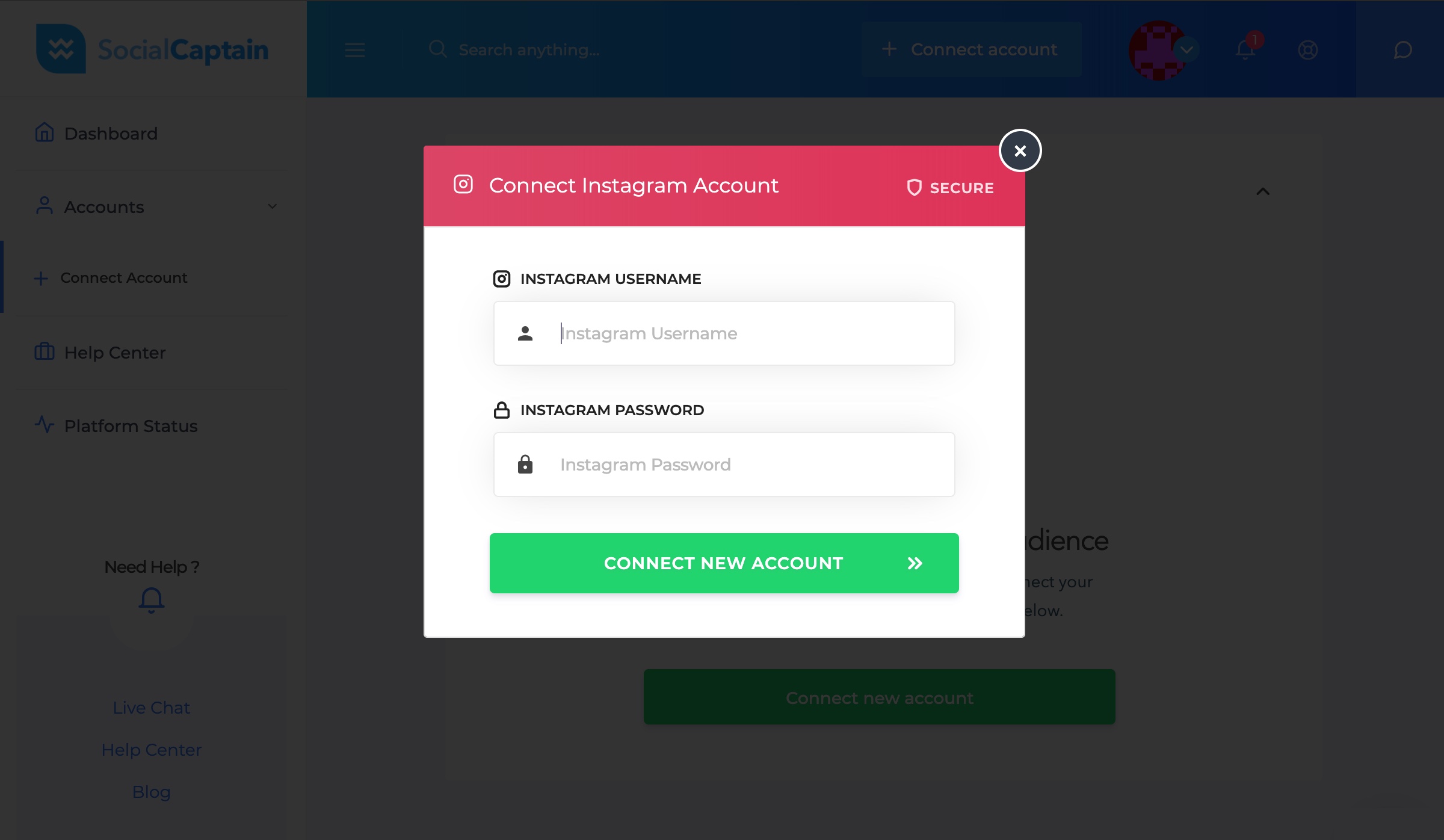
Users were asked to connect their Instagram accounts to the service by entering their username and password. Despite the claim it was “secure,” passwords were collected and stored in plaintext. (Image: TechCrunch)
After TechCrunch reached out, Social Captain confirmed it had fixed the vulnerability by preventing direct access to other users’ profiles.
But passwords and other account information are still visible in the web page source code of a user’s profile page.
“Early analysis indicates that the issue was introduced during the past weeks when the endpoint, meant to facilitate integration with a third-party email service, has been temporarily made accessible without token-based authentication,” said Anthony Rogers, chief executive at Social Captain.
“As soon as we finalize the internal investigation we will be alerting users that could have been affected in the event of a breach and prompt them to update the associated username and password combinations,” he said.
Rogers did not say how long that investigation would take.
Instagram said the service breached its terms of service by improperly storing login credentials.
“We are investigating and will take appropriate action. We strongly encourage people to never give their passwords to someone they don’t know or trust,” said an Instagram spokesperson.
Users who signed up to Social Captain should change their Instagram passwords immediately.
It’s the latest security incident to hit Instagram users, even if Facebook-owned social media giant was not directly culpable for the lapse. Last year, Instagram expanded its bug bounty to include misuse of account data just months after an Indian social media firm scraped the contact information of Instagram influencers on a massive scale. Instagram also last year cut off a trusted ad partner for secretly collecting and storing the locations and other data on millions of users.

from Social – TechCrunch https://ift.tt/2S3qSjO
Original Content From: https://techcrunch.com
EU lawmakers take fresh aim at Apple’s Lightning connector with latest e-waste push
The European parliament has voted overwhelmingly for tougher action to reduce e-waste, calling for the Commission to come up with beefed up rules by July 2020.
Specifically, the parliament wants the Commission to adopt the delegated act foreseen in the 2014 Radio Equipment Directive by that deadline — or else table a legislative measure by the same date, at the latest.
The resolution, which was approved by 582 votes to 40, points out that MEPs have been calling for a single charger for mobile devices for more than a decade now. But the Commission has repeatedly postponed taking steps to force an industry-wide shift. Subtext: We’re tired of the ongoing charging cable nightmare.
The parliament says there is now “an urgent need” for EU regulatory action on the issue — to shrink e-waste, empower consumers to make sustainable choices, and allow EU citizens to “fully participate in an efficient and well-functioning internal market”.
The resolution notes that around 50 million metric tons of e-waste is generated globally per year, with an average of more than 6 kg per person.
While, in Europe in 2016, the figure for total e-waste generated was 12.3 million metric tonnes, equivalent to 16.6 kg on average per inhabitant — with the parliament asserting this represents “an unnecessary environmental footprint that can be reduced”.
To date, the Commission’s approach to the charger e-waste issue has been to lean on industry to take voluntary steps to reduce unnecessary variety. Which has resulted in a reduction of the number of charger types on the market — down from 30+ in 2009 to just three today — but still no universal charger which works across brands and device types (phones, tablets, e-readers etc).
Most notably, Apple continues to use its own Lightning port charger standard — while other device makers have switched to USB-based charging (such as the newest, USB-C standard).
When news emerged earlier this month of the parliament’s intention to vote on tougher measures to standardize mobile chargers Apple attacked the plan — arguing that regulation would ‘stifle innovation’.
But the tech giant has had plenty of years to chew over clever ways to switch from the proprietary charging port only it uses to one of two USB standards used by everyone else. So the ‘innovation’ argument seems a pretty stale one.
Meanwhile Apple has worked around previous EU attempts to push device makers to standardize charging on Micro USB by expanding its revenue-generating dongle collection — and selling Europeans a Lighting to Micro USB adaptor. Thereby necessitating even more e-waste.
Perhaps picking up on Apple’s ‘innovation’ framing sidestep, i.e. to try to duck the e-waste issue, the parliament also writes:
… that the Commission, without hampering innovation, should ensure that the legislative framework for a common charger will be scrutinised regularly in order to take into account technical progress; reiterates the importance of research and innovation in this domain to improve existing technologies and come up with new ones;
It also wants the Commission to grapple with the issue of wireless chargers — and take steps to ensure interoperability there too, so that wireless chargers aren’t locked to only one brand or device type.
Consumers should not be obliged to buy new chargers with each new device, per the resolution, with the parliament calling on the Commission to introduce strategies to decouple the purchase of chargers from a new device alongside a common charger solution — while making sure any decoupling measures do not result in higher prices for consumers.
It also wants the Commission to look at legislative options for increasing the volume of cables and chargers that are collected and recycled in EU member states.
We’ve reached out to the Commission for comment.
Per Reuters, officials in the executive are in agreement that the voluntary approach is not working and have said they plan to introduce legislation for a common charger this year.


from Mobile – TechCrunch https://ift.tt/315EyPc
ORIGINAL CONTENT FROM: https://techcrunch.com/
Technical Solutions - Tech Talks #1039 - POCO X2 14,999Rs, Robotic Finger, Social Media Phone Number, Apple Airpods 3
Tech Talks #1039 - POCO X2 14,999Rs, Robotic Finger, Social Media Phone Number, Apple Airpods 3
TG Deals@ https://tg.deals/ New Channel: https://goo.gl/Jz6p5K Namaskaar Dosto, Tech Talks ke is Episode mein maine aapse kuch interesting Tech News Share ki hai jaise POCO X2 14,999Rs, Robotic Finger, Social Media Phone Number, Apple Airpods 3 Leaks aur bahut kuch. Mujhe umeed hai ki yeh video aapko pasand aayega. Share, Support, Subscribe!!! Subscribe: http://bit.ly/1Wfsvt4 Android App: https://ift.tt/2mrm9Gy Youtube: http://www.youtube.com/c/TechnicalGuruji Twitter: http://www.twitter.com/technicalguruji Facebook: https://ift.tt/1Pi5LDP Facebook Myself: https://goo.gl/zUfbUU Instagram: https://ift.tt/1OW2vue Google Plus: https://ift.tt/1Pi5LDS Website: https://ift.tt/2mcM6KV Merchandise: https://ift.tt/2lN4Vbu About : Technical Guruji is a YouTube Channel, where you will find technological videos in Hindi, New Video is Posted Everyday :)
TG Deals@ https://tg.deals/ New Channel: https://goo.gl/Jz6p5K Namaskaar Dosto, Tech Talks ke is Episode mein maine aapse kuch interesting Tech News Share ki hai jaise POCO X2 14,999Rs, Robotic Finger, Social Media Phone Number, Apple Airpods 3 Leaks aur bahut kuch. Mujhe umeed hai ki yeh video aapko pasand aayega. Share, Support, Subscribe!!! Subscribe: http://bit.ly/1Wfsvt4 Android App: https://ift.tt/2mrm9Gy Youtube: http://www.youtube.com/c/TechnicalGuruji Twitter: http://www.twitter.com/technicalguruji Facebook: https://ift.tt/1Pi5LDP Facebook Myself: https://goo.gl/zUfbUU Instagram: https://ift.tt/1OW2vue Google Plus: https://ift.tt/1Pi5LDS Website: https://ift.tt/2mcM6KV Merchandise: https://ift.tt/2lN4Vbu About : Technical Guruji is a YouTube Channel, where you will find technological videos in Hindi, New Video is Posted Everyday :)
TECH Solutions - Nintendo Switch overtakes 1990s SNES console in sales
The Switch is now Nintendo's third best-selling console after overtaking the SNES of the '90s.
from BBC News - Technology https://ift.tt/37GXp5E
Original Content From: http://bbci.co.uk
from BBC News - Technology https://ift.tt/37GXp5E
Original Content From: http://bbci.co.uk
Tech Solutions -Hashim Amla appointed Peshawar Zalmi batting mentor
The former South Africa captain will join Darren Sammy in a mentoring capacity for the upcoming season of the PSL
from Pakistan news from ESPN Cricinfo.com https://ift.tt/2GNinnT
Original Content From : https://ift.tt/Ti8aBD
from Pakistan news from ESPN Cricinfo.com https://ift.tt/2GNinnT
Original Content From : https://ift.tt/Ti8aBD
TECH Solutions - Facebook settles facial recognition dispute
The tech giant makes a $550m settlement to users over storing biometric data without user consent.
from BBC News - Technology https://ift.tt/3aXI16X
Original Content From: http://bbci.co.uk
from BBC News - Technology https://ift.tt/3aXI16X
Original Content From: http://bbci.co.uk
TECH Solutions - Snapchat launches Bitmoji TV: zany 4-min cartoons of your avatar
If you were the star of every show, would you watch more mobile television? Snapchat is betting that narcissism drives resonance for its new weekly videos that put you and your friends’ customizable Bitmoji avatars into a flurry of silly animated situations. Bitmoji TV premieres on Saturday morning, and it’s remarkably funny, exciting, and addictive. Think cartoon SNL on fast-forward with you playing a secret agent, a zombie president, or a Moonlympics athlete.
It’s a style of content only Snapchat could pull off that relies on ubiquitous personalized avatars only Snapchat owns. The company says 70% of its daily active users, or 147 million of its 210 million, have made themselves a Bitmoji. Snapchat bought Bitmoji’s parent company Bitstrips in 2016 for a steal at $62.5 million, and it’s paying off. Amidst a sea of premium video and haphazard Stories that blur together across streaming services and social apps, Snapchat finally found something Facebook can’t copy.
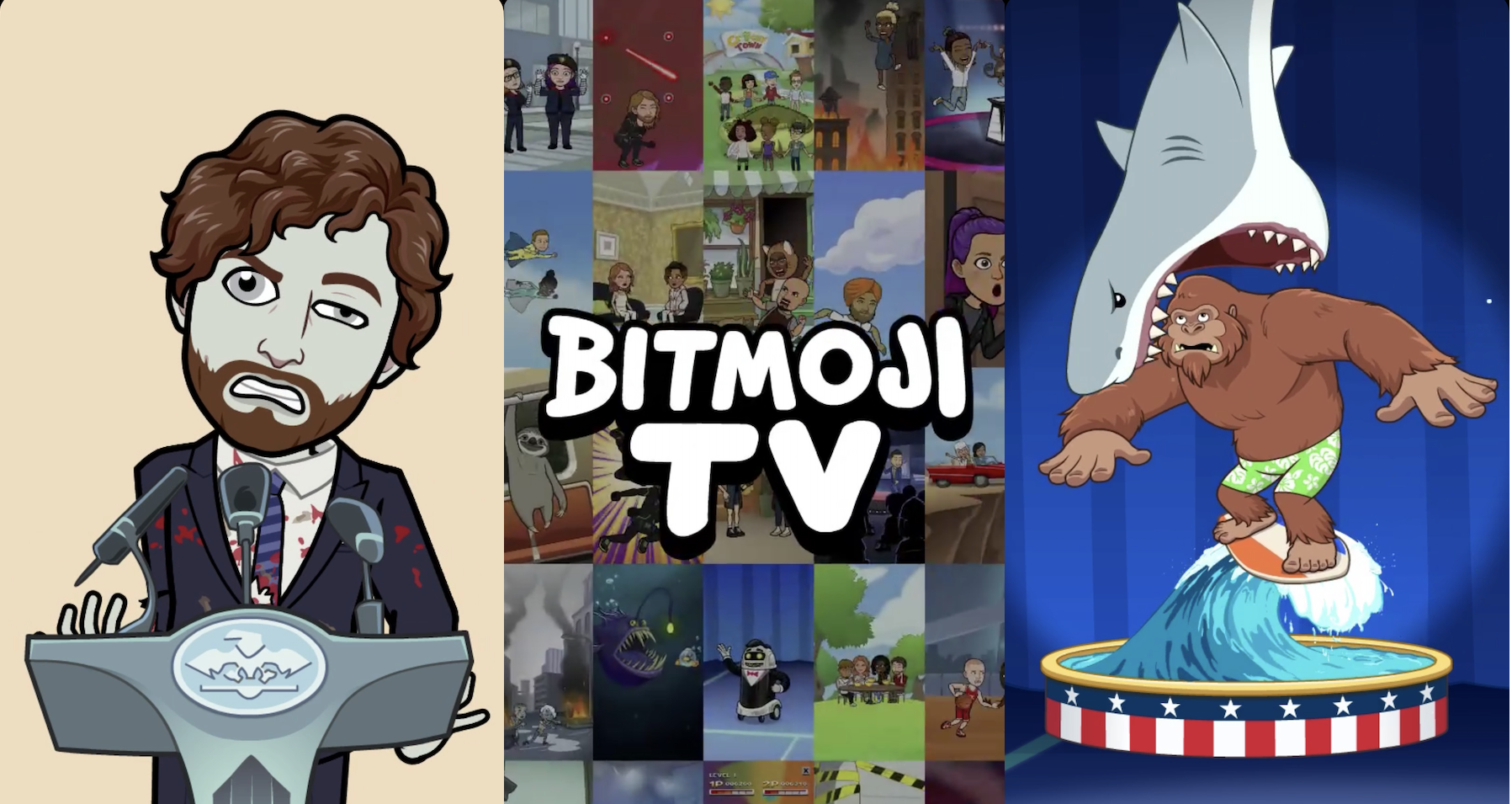
“We really believe that we have invented a new category of entertainment. It’s scripted but it’s personalized. You could take that in a million directions” says Bitmoji co-founder and CEO Ba Blackstock who wrote and directed Bitmoji TV. “First and foremost, I hope that everyone who watches this has kind of a mind blowing experience that they’ve never had before.”
Bitmoji TV, which TechCrunch was first to report Snapchat was building last month, will have its own Snapchat Show page where users can subscribe to get notifications and see new episodes on the Discover Page. Users can visit this page on mobile or tap and hold on the Snapcode below while pointing at it with the Snapchat camera to open Bitmoji TV.

The show is designed to be PG-13 with some bleeped out swearing and a little bloody violence. The shows are made out of Bitmoji’s Toronto office and are based on North American TV, film, and advertising. Each episode cuts away and back to a main story, with the first two centered around an America’s Best Bitmoji game show and a Mime Cops hostage negotiation. Interspersed are ‘channel flips’ between shorter single-gag clips that take your avatar into sit-coms, soap operas, action movies, and informercials.
The gags are ridiculous. At the basketball “Moonlympics”, a player jumps up for a dunk, but low gravity causes him to crash through the glass dome and suck all the other players into space. At Cannibal High, an school announcement says “Attention students, we’re all deeply saddened by the sudden passing of Vice Principal Schneider. To honor his legacy, today the cafeteria will be serving Vice Principal Schneider.”
You’re not alone it Bitmoji TV. There’ll be occassional celebrity guests like Randy Jackson, Andy Richter, and Jon Lovitz. But your co-star in these segments is the Bitmoji of whichever person you last interacted with on Snapchat. That lets you control whether you want your best friend, your significant other, or some rando alongside you. That decision will change the way you interpret the jokes and scenes. Your Bitmoji won’t talk, but their’s will.
Getting philosophical, Blackstock explains that “When you say words to me, it’s not just your words in a vacuum. They’re coming from you. You’re the medium . . . In any narrative fiction you learn about the characters, they have a back story, they have relationships that exist under the story that color it.” Who you make your supporting actor lends personal subtext that enriches each story. That’s one reason you can’t download or easily share clips of your version of Bitmoji TV, and Snap instead just lets you share a link to watch the real thing. Blackstock says it just doesn’t have the same effect if you’re not in the spotlight.
One thing you won’t find in Bitmoji TV, at least at first, are advertisements. The initial 10 episode season won’t have them. But that does seem to be the plan. When I asked Blackstock about monetizing the show, he said “You can imagine. Discover has a business model of showing ads.” Since it make Bitmoji TV, Snapchat would get to keep that ad money rather than paying it out with revenue shares to partners or by buying content. Just as we’ve seen music and video streaming apps move to cut royalty expenses by creating content in-house, Snap seems to have the same idea.
Snapchat has yet to monetize Bitmoji directly beyond its merchandise store where you can get yours on t-shirts and mugs. Surprisingly, it doesn’t sell premium or branded clothes and looks for Bitmoji, nor does it allow brands to pay to have their apparel featured.
Snap did recently start letting people mix-and-match clothes for their Bitmoji, and when asked if that could foreshadow a revenue opportunity, Blackstock said “You gotta build the store before you start selling the clothes . . . this was a foundational evolution designed to not only improve the experience for users but to set the stage for things to come.” You and your friends seeing your avatar’s fresh outfit on Bitmoji TV might make people care more about what their digital mini-mes wear.

Having watched the first three episodes, I’m pretty certain Bitmoji TV is going to be a hit. The show embodies the whimsy of Snapchat and the youth culture of the community who uses it. It’s rare to see something so premium but so unabashedly kooky. It’s remininscent of the Rick & Morty ‘Interdimensional Cable’ episodes that similarly feature rapid-fire snippets of fake and absurd TV shows.
Yet “the idea for Bitmoji TV actually precedes Bitmoji. It’s something I’ve been thinking about since those days [before Snapchat acquired it.] In a way it precedes Bitstrips. I’ve been making comics and cartoons since I was a little kid” Blackstock tells me. “How I met two of the co-founders of Bitstrips was passing them comics in class. Even after school when we had jobs I would draw comics of my co-founder that were very compromising and I would fax them to his office to try to get him fired” he recalls with a hearty laugh. Now he has the budget to make them TV-worthy but just as crazy.
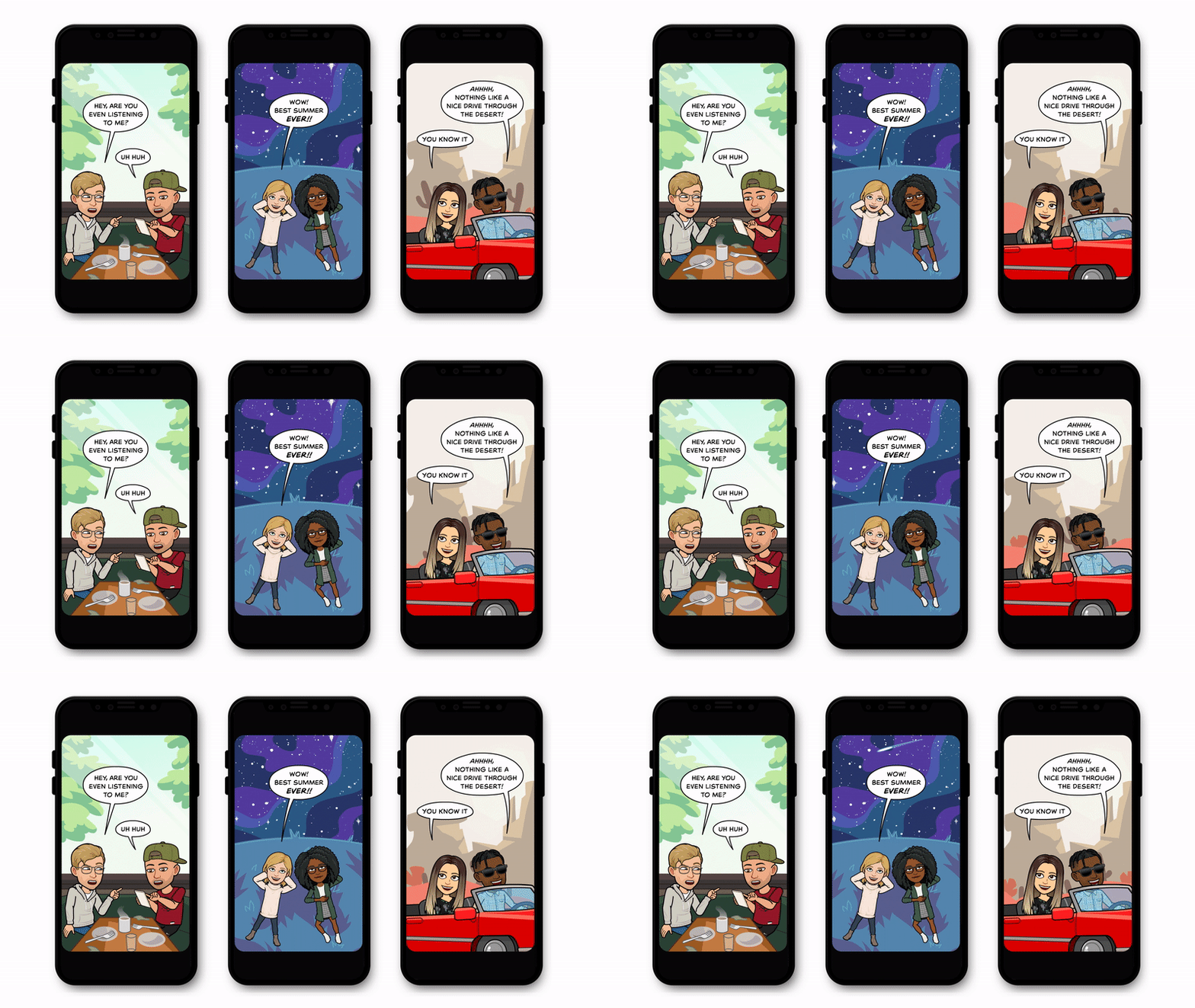
Snapchat has a good hunch it’s going to work because it’s been testing a comic-stripped down version called Bitmoji Stories. These still or lightly-animated slide shows use the same idea of starring the avatars of you and your friends, but without full-motion video or constant audio. 130 million people have watched Bitmoji Stories since they launched in late 2018.
Blackstock tells me “They were easier to make at a high volume and release ongoingly, which we could put out as a prelude to get our audience ready for personalized content — but also for us to learn from and see how people responded and figure out our own processes in terms of production.” Snapchat had animators and engineers work hand in hand to build a rendering system for Bitmoji Stories and TV. That helps it rapidly produce the personalizable content that can flex to accomodate any shaped avatar without them clipping into their surroundings.
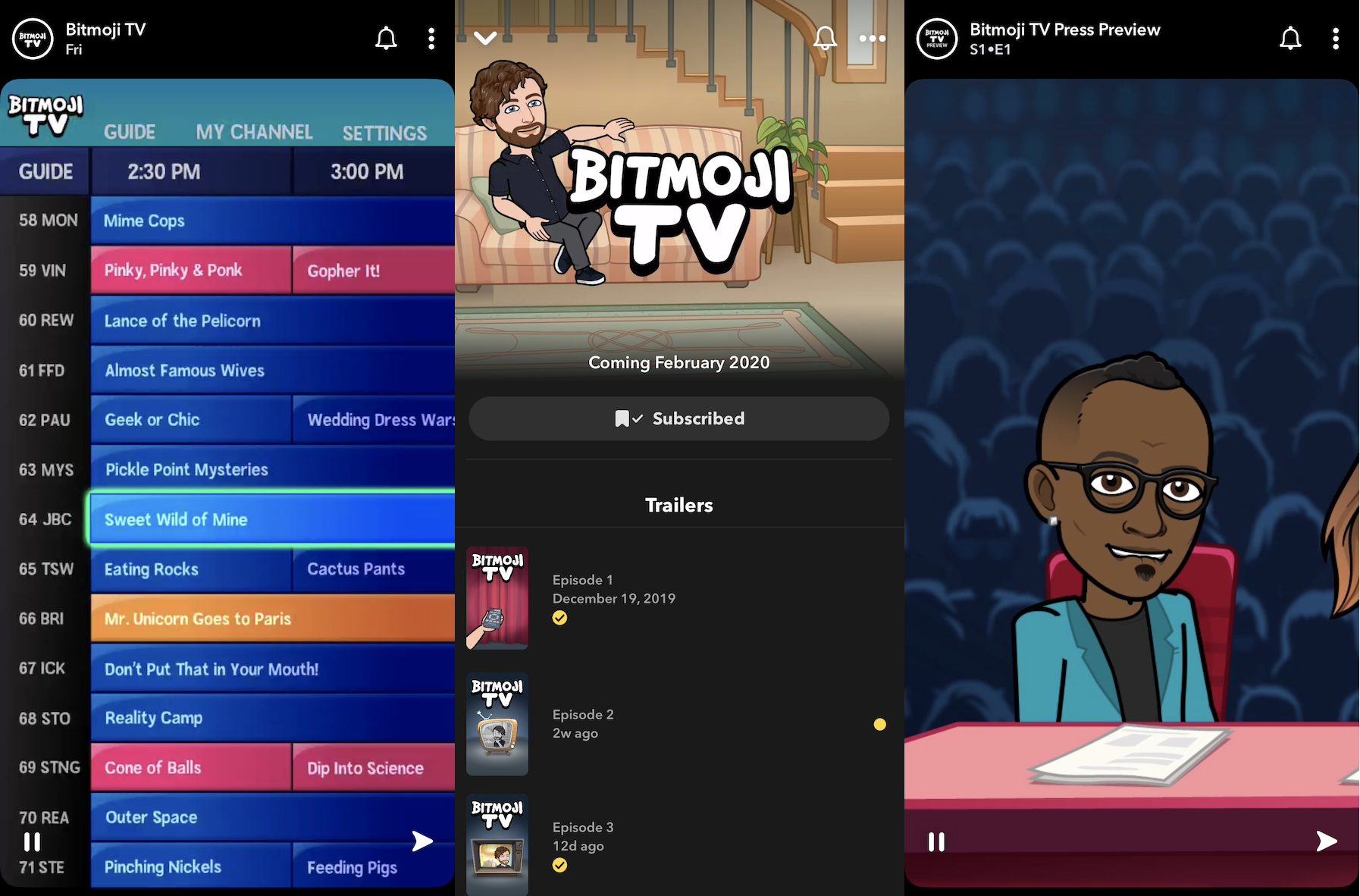
Tonight, Bitmoji TV will receive an in-person ‘silent disco-style’ premiere at Los Angeles’ Soho House. Guests will scan a code on the big screen, don headphones, and each watch on their own phone with themselves as the star.
Snapchat’s head of original content Sean Mills tells me that “New technology will unlock new kinds of storytelling” citing “the power of bringing a user into the experience with their best friends.” Bitmoji TV has certainly found a way to turn vanity into engagement. It’s more compelling than the mediocre originals on Facebook Watch. And it’s technologically innovative, unlike the planned lineup for Quibi.
If the modern era of visual communication began with the selfie, Snap honed it into a messaging tool. A few words were more interesting with a friend’s face behind it. The original Bitmoji chat stickers let your face say whatever you wanted even without having to get on camera. Snapchat’s new Cameo feature grafts your face into GIFs to express even more complex feelings. And now with Bitmoji TV, an animated version of your face can live out your wildest fantasies or weirdest dreams. That’s something worth tuning into.

from Social – TechCrunch https://ift.tt/2uMrUbK
Original Content From: https://techcrunch.com
Snapchat launches Bitmoji TV: zany 4-min cartoons of your avatar
If you were the star of every show, would you watch more mobile television? Snapchat is betting that narcissism drives resonance for its new weekly videos that put you and your friends’ customizable Bitmoji avatars into a flurry of silly animated situations. Bitmoji TV premieres on Saturday morning, and it’s remarkably funny, exciting, and addictive. Think cartoon SNL on fast-forward with you playing a secret agent, a zombie president, or a Moonlympics athlete.
It’s a style of content only Snapchat could pull off that relies on ubiquitous personalized avatars only Snapchat owns. The company says 70% of its daily active users, or 147 million of its 210 million, have made themselves a Bitmoji. Snapchat bought Bitmoji’s parent company Bitstrips in 2016 for a steal at $62.5 million, and it’s paying off. Amidst a sea premium video and haphazard Stories that blur together across streaming services and social apps, Snapchat finally found something Facebook can’t copy.
“We really believe that we have invented a new category of entertainment. It’s scripted but it’s personalized. You could take that in a million directions” says Bitmoji co-founder and CEO Ba Blackstock who wrote and directed Bitmoji TV. “First and foremost, I hope that everyone who watches this has kind of a mind blowing experience that they’ve never had before.”
Bitmoji TV, which TechCrunch was first to report Snapchat was building last month, will have its own Snapchat Show page where users can subscribe to get notifications and see new episodes on the Discover Page. Users can visit this page on mobile or tap and hold on the Snapcode below while pointing at it with the Snapchat camera.
They’re designed to be PG-13 with some bleeped out swearing and a little bloody violence. The shows are made out of Bitmoji’s Toronto office and are based on North American TV, film, and advertising. Each episode cuts away and back to a main story, with the first two centered around an America’s Best Bitmoji game show and a Mime Cops hostage negotiation. Interspersed are ‘channel flips’ between shorter single-gag clips that take your avatar into sit-coms, soap operas, action movies, and informercials.
But you’re not alone it Bitmoji TV. There’ll be occassional celebrity guests like Randy Jackson, Andy Richter, and Jon Lovitz. But your co-star in these segments is the Bitmoji of whichever person you last interacted with on Snapchat. That lets you control whether you want your best friend, your significant other, or some rando alongside you. That decision will change the way you interpret the jokes and scenes. Your Bitmoji won’t talk, but their’s will.
Getting philosophical, Blackstock explains that “When you say words to me, it’s not just your words in a vacuum. They’re coming from you. You’re the medium . . . In any narrative fiction you learn about the characters, they have back story, they have relationships that exist under the story that color it.” Who you make your supporting actor lends personal subtext that enriches each story. That’s one reason you can’t download or easily share clips of your version of Bitmoji TV, and Snap instead just lets you share a link to watch the real thing. Blackstock says it just doesn’t have the same effect if you’re not in the spotlight.
One thing you won’t find in Bitmoji TV, at least at first, are advertisements. The initial 10 episode season won’t have them. But that does seem to be the plan. When I asked Blackstock about monetizing the show, he said “You can imagine. Discover has a business model of showing ads.” Snapchat would get to keep that ad money since it makes Bitmoji TV rather than paying it out with revenue shares or by buying content. Just as we’ve seen music and video streaming apps move to cut royalty expenses by creating content in-house, Snap seems to have the same idea.
Snapchat has yet to monetize Bitmoji directly beyond its merchandise store where you can get yours on t-shirts and mugs. Surprisingly, it doesn’t sell premium or branded clothes and looks for Bitmoji, nor allow brands to pay to have their apparel featured. Snap did recently start letting people mix-and-match clothes for their Bitmoji, and when asked if that could foreshadow a revenue opportunity, Blackstock said “You gotta build the store before you start selling the clothes . . . this was a foundational evolution designed to not only improve the experience for users but to set the stage for things to come.”
Having watched the first three episodes, I’m pretty certain Bitmoji TV is going to be a hit. The show embodies the whimsy of Snapchat and the youth culture of the community who uses it. It’s rare to see something so premium but so unabashedly weird. It’s remininscent of the Rick & Morty ‘Interdimensional Cable’ episodes that similarly features rapid-fire snippets of fake and absurd TV shows.
Yet “the idea for Bitmoji TV actually precedes Bitmoji. It’s something I’ve been thinking about since those days [before Snapchat acquired it.] In a way it preceding Bitstrips. I’ve been making comics and cartoons since I was a little kid” Blackstock tells me. “That’s how I met two of the co-fodners of Bitstrips was passing them comics in class. Even after school when we had jobs I would draw comics of my co-founder that were very compromising and I would fax them to his office to try to get him fired” he recalls with a hearty laugh. Now he has the budget to make them TV-worthy but meant for your phone.
Snapchat has a good hunch it’s going to work because it’s been testing a comic-stripped down version called Bitmoji Stories. These still or lightly-animated slide shows use the same idea of starring the avatars of you and your friends, but without full-motion video or constant audio. 130 million people have watched Bitmoji Stories since they launched in late 2018.
Blackstock tells me “They were easier to make at a high volume and release ongoingly, which we could put out as a prelude to get our audience ready for personalized content — but also for us to learn from and see how people responded and figure out our own processes in terms of production.” Snapchat had animators and engineers work hand in hand to build a rendering system for Bitmoji Stories and TV. That helps it rapidly produce the personalizable content than can flex to accomodate any shaped avatar without them clipping into their surroundings.
Tonight, Bitmoji TV will receive an in-person ‘silent disco-style’ premiere at Los Angeles’ Soho House. Guests will scan a code on the big screen, don headphones, and each watch on their own phone with themselves as the star.
Snapchat’s head of original content Sean Mills tells me that “New technology will unlock new kinds of storytelling” citing “the power of bringing a user into the experience with their best friends.” Bitmoji TV has certainly found a way to turn vanity into engagement. It’s certainly more compelling than the mediocre originals on Facebook Watch. And it’s technologically innovative, unlike the planned lineup for Quibi.
If the modern era of visual communication began with the selfie, Snap honed it into a messaging tool. A few words were more interesting with a friend’s face behind it. The original Bitmoji chat stickers let your face say whatever you wanted even without having to get on camera. Snapchat’s new Cameo feature grafts that face into GIFs to express even more complex feelings. And now with Bitmoji TV, an animated version of your face can live out your wildest fantasies or weirdest dreams. That’s something worth tuning into.


from Mobile – TechCrunch https://ift.tt/2uMrUbK
ORIGINAL CONTENT FROM: https://techcrunch.com/