Indian Air Force Game - Gameplay iOS & Android - IAF A Cut Above - Proud 🇮🇳🔥
Namaskaar Dosto, yeh ek bahut hi khaas video hai jaha maine aapse baat ki hai Indian Air Force ke official game ke baare mein jo hai Indian Air Force A Cut Above, yeh Android aur iOS dono pe hi available hai aur maine aapse baat ki hai isi game ke gameplay aur misions ke baare mein, yaha aap Wing Commander Abhinandan ki bhi ek jhalak dekh payenge aur yaha pe Surgical Strike ka mission bhi hai. Mujhe umeed hai ki aapko yeh video pasand aayegi. Download Links: iOS: https://ift.tt/2YE2udG Android: https://ift.tt/2yoGOUb Share, Support, Subscribe!!! Subscribe: http://bit.ly/1Wfsvt4 Android App: https://ift.tt/2mrm9Gy Youtube: http://www.youtube.com/c/TechnicalGuruji Twitter: http://www.twitter.com/technicalguruji Facebook: https://ift.tt/1Pi5LDP Facebook Myself: https://goo.gl/zUfbUU Instagram: https://ift.tt/1OW2vue Google Plus: https://ift.tt/1Pi5LDS Website: https://ift.tt/2mcM6KV Merchandise: https://ift.tt/2lN4Vbu About : Technical Guruji is a YouTube Channel, where you will find technological videos in Hindi, New Video is Posted Everyday :)

This Blog is created to share Technical Solutions for public interest. The Content is related with IT solutions, SEO tips, Online Earning, online marketing, website developement, CSS, java, C++, python, C sharp Languages.
Wednesday, July 31, 2019
Calling all hardware startups! Apply to Hardware Battlefield @ TC Shenzhen
Got hardware? Well then, listen up, because our search continues for boundary-pushing, early-stage hardware startups to join us in Shenzhen, China for an epic opportunity; launch your startup on a global stage and compete in Hardware Battlefield at TC Shenzhen on November 11-12.
Apply here to compete in TC Hardware Battlefield 2019. Why? It’s your chance to demo your product to the top investors and technologists in the world. Hardware Battlefield, cousin to Startup Battlefield, focuses exclusively on innovative hardware because, let’s face it, it’s the backbone of technology. From enterprise solutions to agtech advancements, medical devices to consumer product goods — hardware startups are in the international spotlight.
If you make the cut, you’ll compete against 15 of the world’s most innovative hardware makers for bragging rights, plenty of investor love, media exposure and $25,000 in equity-free cash. Just participating in a Battlefield can change the whole trajectory of your business in the best way possible.
We chose to bring our fifth Hardware Battlefield to Shenzhen because of its outstanding track record of supporting hardware startups. The city achieves this through a combination of accelerators, rapid prototyping and world-class manufacturing. What’s more, TC Hardware Battlefield 2019 takes place as part of the larger TechCrunch Shenzhen that runs November 9-12.
Creativity and innovation no know boundaries, and that’s why we’re opening this competition to any early-stage hardware startup from any country. While we’ve seen amazing hardware in previous Battlefields — like robotic arms, food testing devices, malaria diagnostic tools, smart socks for diabetics and e-motorcycles, we can’t wait to see the next generation of hardware, so bring it on!
Meet the minimum requirements listed below, and we’ll consider your startup:
- Submit your application to TC Hardware Battlefield 2019 by August 14th
- You must have a minimally viable product to demo onstage
- Your product has received little if any, press coverage to date
- Your product must have a hardware device or component
Here’s how Hardware Battlefield works. TechCrunch editors vet every qualified application and pick 15 startups to compete. Those startups receive six rigorous weeks of free coaching. Forget stage fright. You’ll be prepped and ready to step into the spotlight.
Teams have six minutes to pitch and demo their products, which is immediately followed by an in-depth Q&A with the judges. If you make it to the final round, you’ll repeat the process in front of a new set of judges.
The judges will name one outstanding startup the Hardware Battlefield champion. Hoist the Battlefield Cup, claim those bragging rights and the $25,000. This nerve-wracking thrill-ride takes place in front of a live audience, and we capture the entire event on video and post it to our global audience on TechCrunch.
Hardware Battlefield at TC Shenzhen takes place on November 11-12. Don’t hide your hardware or miss your chance to show us — and the entire tech world — your startup magic. Apply to compete in TC Hardware Battlefield 2019, and join us in Shenzhen!
Is your company interested in sponsoring or exhibiting at Hardware Battlefield at TC Shenzhen? Contact our sponsorship sales team by filling out this form.


from Mobile – TechCrunch https://ift.tt/33dKjv4
ORIGINAL CONTENT FROM: https://techcrunch.com/
Tech Solutions - WARP VS VOOC VS SONIC Charging Test | Who is faster??
WARP VS VOOC VS SONIC Charging Test | Who is faster??
Hi Friends: This is my Blog Technical Solutions created to share videos and content of technical solutions with the world. At this blog you can find videos about Free Search Engine Optimization Course, how to develope Android Applications and What is Computer hardware and software, you would be able to increse your channel views, or boost your website. so guys keep visiting my blog for learning technical things. Thank You!
Hi Friends: This is my Blog Technical Solutions created to share videos and content of technical solutions with the world. At this blog you can find videos about Free Search Engine Optimization Course, how to develope Android Applications and What is Computer hardware and software, you would be able to increse your channel views, or boost your website. so guys keep visiting my blog for learning technical things. Thank You!
TECH Solutions - Taking Nasa's space buggies for a spin
BBC Click's Spencer Kelly takes a ride in some in some of Nasa's latest vehicles.
from BBC News - Technology https://ift.tt/2STBh1q
Original Content From: http://bbci.co.uk
from BBC News - Technology https://ift.tt/2STBh1q
Original Content From: http://bbci.co.uk
Aspire raises $32.5M to help SMEs secure fast finance in Southeast Asia
Aspire, a Singapore-based startup that helps SMEs secure working capital, has raised $32.5 million in a new financing round to expand its presence in several Southeast Asian markets.
The Series A round for the one-and-a-half-year old startup was funded by MassMutual Ventures Southeast Asia. Arc Labs and existing investors Y Combinator — Aspire graduated from YC last year — Hummingbird, and Picus Capital also participated in the round. Aspire has raised about $41.5 million to date.
Aspire operates a neo-banking-like platform to help small and medium-sized enterprises (SMEs) quickly and easily secure working capital of up to about $70,000.
AspireAccount, the startup’s flagship product, provides merchants and startups with instant credit limit for daily business expenses, as well as a business-to-business acceptance and other tools to help them manage their cash flow.
“I saw the problem while trying to rally small businesses trying to grow in the digital economy,” Andrea Baronchelli, founder and CEO of Aspire told TechCrunch last year. “The problem is really about providing working capital to small business owners,” said Baronchelli, who served as a CMO for Alibaba’s Lazada platform for four years.
Aspire currently operates in Thailand, Indonesia, Singapore, and Vietnam. The startup said it will use the fresh capital to scale its footprints in those markets. Additionally, Aspire is building a scalable marketplace banking infrastructure that will use third-party financial service providers to “create a unique digital banking experience for its SME customers.”
The startup is also working on a business credit card that will be linked to each business account by as early as this year, it said.
Baronchelli did not reveal how many business customers Aspire has, but said the startup has seen “30% month-on-month growth” since beginning operations in January 2018. Additionally, Aspire expects to amass more than 100,000 business accounts by next year.
Southeast Asia’s digital economy is slated to grow more than six-fold to reach more than $200 billion per year, according to a report co-authored by Google. But for many emerging startups and businesses, getting financial services from a bank and securing working capital have become major pain points.
A growing number of startups are beginning to address these SMEs’ needs. In India, for instance, NiYo Bank and Open have amassed millions of businesses through their neo-banking platforms. Both of these startups have raised tens of millions of dollars in recent months. Drip Capital, which helps businesses in developing markets secure working capital, raised $25 million last week.


from Mobile – TechCrunch https://ift.tt/2Kem8nw
ORIGINAL CONTENT FROM: https://techcrunch.com/
Technical Solutions - Tech Talks #882 - Poco F2 Launch, Whatsapp 1000GB Free, Vivo Z5, Redmi K20 Series Discount
Tech Talks #882 - Poco F2 Launch, Whatsapp 1000GB Free, Vivo Z5, Redmi K20 Series Discount
TG Deals@ https://tg.deals/ New Channel: https://goo.gl/Jz6p5K Namaskaar Dosto, Tech Talks ke is Episode mein maine aapse kuch interesting Tech News Share ki hai jaise Poco F2 Launch, Whatsapp 1000GB Free Data, Jio Fiber Fake Activation, Chinese Livestreamer Fake face, Vivo Z5, Redmi K20 Series Discount aur bahut kuch. Mujhe umeed hai ki yeh video aapko pasand aayega. Share, Support, Subscribe!!! Subscribe: http://bit.ly/1Wfsvt4 Android App: https://ift.tt/2mrm9Gy Youtube: http://www.youtube.com/c/TechnicalGuruji Twitter: http://www.twitter.com/technicalguruji Facebook: https://ift.tt/1Pi5LDP Facebook Myself: https://goo.gl/zUfbUU Instagram: https://ift.tt/1OW2vue Google Plus: https://ift.tt/1Pi5LDS Website: https://ift.tt/2mcM6KV Merchandise: https://ift.tt/2lN4Vbu About : Technical Guruji is a YouTube Channel, where you will find technological videos in Hindi, New Video is Posted Everyday :)
TG Deals@ https://tg.deals/ New Channel: https://goo.gl/Jz6p5K Namaskaar Dosto, Tech Talks ke is Episode mein maine aapse kuch interesting Tech News Share ki hai jaise Poco F2 Launch, Whatsapp 1000GB Free Data, Jio Fiber Fake Activation, Chinese Livestreamer Fake face, Vivo Z5, Redmi K20 Series Discount aur bahut kuch. Mujhe umeed hai ki yeh video aapko pasand aayega. Share, Support, Subscribe!!! Subscribe: http://bit.ly/1Wfsvt4 Android App: https://ift.tt/2mrm9Gy Youtube: http://www.youtube.com/c/TechnicalGuruji Twitter: http://www.twitter.com/technicalguruji Facebook: https://ift.tt/1Pi5LDP Facebook Myself: https://goo.gl/zUfbUU Instagram: https://ift.tt/1OW2vue Google Plus: https://ift.tt/1Pi5LDS Website: https://ift.tt/2mcM6KV Merchandise: https://ift.tt/2lN4Vbu About : Technical Guruji is a YouTube Channel, where you will find technological videos in Hindi, New Video is Posted Everyday :)
Luna Labs creates playable ads, directly from Unity
It seems obvious that the best way to advertise a game is to let people play the game itself — and we’ve covered other startups tackling this problem, such as AppOnboard and mNectar.
But Luna Labs co-founder and CEO Steven Chard said that for most developers, the creation of these ads involves outsourcing: “It might take weeks to make an ad, and the quality of the content at the end could be limited.”
The problem, Chard said, is that most games are built on the Unity engine, while the ads need to be in HTML5, which means that developers often have to build playable ads from scratch — hence the outsourcing.
“There’s this huge demand for playables, but the tech hasn’t caught up with it,” he said. “Our view — and I think why it’s really resonating with developers — we’re saying to developers: Use that same [Unity] editor to create a playable ad. You’re going to give the user a playable ad which genuinely feels like the game.”
In fact, while Luna is officially launching its service to developers this week, it’s already been working with a few partners like Kwalee and Voodoo. Luna says that in Kwalee’s case, the results were good enough that the company spent 60% more than they did on other playable ads, and the Luna playables drove more than 250,000 installs per day.
“Luna is solving a real pain point for our studio, and the initial results have been tremendous,” said Kwalee CRO Jason Falcus in a statement. “Integrating the Luna service has allowed us to significantly scale our campaigns by a comfortable margin, to the best results so far.”

Luna’s investors include Ben Holmes (formerly of Index Ventures, backer of King and Playfish) and Chris Lee (who also invested in Space Ape and Hello Games).
Chard said the startup is currently focused on providing tools to developers, rather than getting involved in the ad-buying process. More generally, he said the company has been focused on the technology rather than the business model.
“We’re an early company with a very, very complex piece of technology — it’s taken a lot of time to get where we are,” he said. “We’re not doing it for free, but the focus isn’t on short-term profitability. It is, in the longer term, on creating a scalable product which can be used by developers.”
Chard added that eventually, he’s hoping Luna can become more involved in “at the content creation level.” For example, he suggested that developers could use the technology to test out playable concepts and see what resonates, before building a full game.
You can test it out for yourself on the Luna Labs website.


from Mobile – TechCrunch https://ift.tt/33cMH5g
ORIGINAL CONTENT FROM: https://techcrunch.com/
Verizon adds Washington DC, Atlanta, Detroit and Indianapolis to list of 5G cities
This morning Verizon (TechCrunch’s parent company) flipped the 5G switch on four additional cities. Washington DC, Atlanta, Detroit and Indianapolis join Chicago, Denver, Minneapolis/St. Paul and Providence in getting coverage for the carrier’s growing next-generation network.
All of the usual caveats apply here. While the list of cities continues to grow, coverage varies from city to city to such a point where Verizon currently includes specific neighborhoods in these announcements. Here’s the break down,
In Washington DC, consumers, businesses and government agencies can initially access Verizon’s 5G Ultra Wideband service in areas of Foggy Bottom, Dupont Circle, Cardozo / U Street, Adams Morgan, Columbia Heights, Le Droit Park, Georgetown Waterfront, Judiciary Square, Shaw, Eckington, NOMA, National Mall and the Smithsonian, Gallery Place / Chinatown, Mt. Vernon Square, Downtown, Penn Quarter, Brentwood, Southwest Waterfront, Navy Yard, and nearby Crystal City, VA, as well as around landmarks such as the Ronald Reagan National Airport, United States Botanical Gardens, Hart Senate Building, National Gallery of Art, Lafayette Square, The White House, Freedom Plaza, Farragut Square, George Washington University, Capital One Arena, Union Station, Howard University Hospital, George Washington University Hospital, and Georgetown Waterfront Park.
In Atlanta, 5G Ultra Wideband service will initially be concentrated in parts of the following neighborhoods: Downtown, Midtown, Tech Square, and around such landmarks as The Fox Theater, Emory University Hospital Midtown, Mercedes Benz Stadium, Home Depot Backyard, Centennial Olympic Park, Georgia Aquarium, World of Coca Cola, and parts of Renaissance Park.
In Detroit, 5G Ultra Wideband service will initially be concentrated in parts of the following areas: Dearborn, Livonia, and Troy, including areas around the Oakland-Troy Airport.
In Indianapolis, 5G Ultra Wideband service is initially available in parts of the following neighborhoods, Arsenal Heights, Bates Hendricks, Castleton, Crown Hill, Fountain Square, Grace Tuxedo Park, Hawthorne, Historic Meridian Park, Lockerbie Square, Ransom Place, Renaissance Place, St. Joseph Historic Neighborhood, Upper Canal and Woodruff Place and around such landmarks and public spaces as Garfield Park, and Indiana University School of Medicine.
The carrier adds that service will be expanded within the above cities “in the months to come.” But hey, the White House is covered, which means even more rapid tweet storms. Verizon is adding a bunch more cities by the end of the year, including Boston, Charlotte, Cincinnati, Cleveland, Columbus, Dallas, Des Moines, Houston, Kansas City, Little Rock, Memphis, Phoenix, San Diego and Salt Lake City.
That will bring the total up to 30 for 2019.
The device selection is still limited, too for the moment. Verizon currently offers the LG V50 ThinQ 5G, Samsung Galaxy S10 5G and the Moto Z, which has an option 5G mod. There’s a 5G MiFi from Inseego available, as well.


from Mobile – TechCrunch https://ift.tt/2GEfFkD
ORIGINAL CONTENT FROM: https://techcrunch.com/
Tech Solutions - #876 Realme 846% Growth, NO PUBG, Only IAF Game, Samsung A 2020 Series,GigaFiber Scam
#876 Realme 846% Growth, NO PUBG, Only IAF Game, Samsung A 2020 Series,GigaFiber Scam
Hi Friends: This is my Blog Technical Solutions created to share videos and content of technical solutions with the world. At this blog you can find videos about Free Search Engine Optimization Course, how to develope Android Applications and What is Computer hardware and software, you would be able to increse your channel views, or boost your website. so guys keep visiting my blog for learning technical things. Thank You!
Hi Friends: This is my Blog Technical Solutions created to share videos and content of technical solutions with the world. At this blog you can find videos about Free Search Engine Optimization Course, how to develope Android Applications and What is Computer hardware and software, you would be able to increse your channel views, or boost your website. so guys keep visiting my blog for learning technical things. Thank You!
TECH Solutions - Snapchat launches ‘instant’ tool for creating vertical ads
Snapchat is hoping to attract new advertisers (and make advertising easier for the ones already on the platform) with the launch of a new tool called Instant Create.
Some of these potential advertisers may not be used to creating ads in the smartphone-friendly vertical format that Snapchat has popularized, so Instant Create is to designed to make the process as simple as possible.
Executives at parent organization Snap discussed the tool during last week’s earnings call (in which the company reported that its daily active users increased to 203 million).
“Just this month we started testing our new Instant Create on-boarding flow, which generates ads for businesses in three simple steps from their existing assets, be it their app or their ecommerce storefront,” said CEO Evan Spiegel.
Now the product is moving from testing to availability for all advertisers using Snapchat’s self-serve Ads Manager.
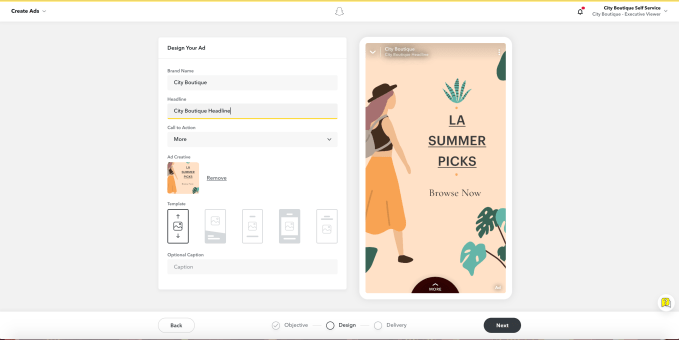
Those three steps that Spiegel mentioned involve identifying the objective of a campaign (website visits, app installs or app visits), entering you website address and finalizing you audience targeting.
You can upload your creative assets if you want, but that’s not required since Instant Create will also import images from your website. And Snap notes that you won’t need to do any real design work, because there’s “a streamlined ad creation flow that leverages our most popular templates and simplified ad detail options, enabling you to publish engaging creative without additional design resources.”
The goal is to make Snapchat advertisers accessible to smaller advertisers who may not have the time or resources to try to understand new ad formats. After all, on that same earnings call, Chief Business Officer Jeremi Gorman said, “We believe the single biggest driver for our revenue in the short to medium term will be increasing the number of active advertisers using Snapchat.”
Instant Create is currently focused Snapchat’s main ad format, Snap Ads. You can read more in the company’s blog post.

from Social – TechCrunch https://ift.tt/2OvkiEh
Original Content From: https://techcrunch.com
Snapchat launches ‘instant’ tool for creating vertical ads
Snapchat is hoping to attract new advertisers (and make advertising easier for the ones already on the platform) with the launch of a new tool called Instant Create.
Some of these potential advertisers may not be used to creating ads in the smartphone-friendly vertical format that Snapchat has popularized, so Instant Create is to designed to make the process as simple as possible.
Executives at parent organization Snap discussed the tool during last week’s earnings call (in which the company reported that its daily active users increased to 203 million).
“Just this month we started testing our new Instant Create on-boarding flow, which generates ads for businesses in three simple steps from their existing assets, be it their app or their ecommerce storefront,” said CEO Evan Spiegel.
Now the product is moving from testing to availability for all advertisers using Snapchat’s self-serve Ads Manager.
Those three steps that Spiegel mentioned involve identifying the objective of a campaign (website visits, app installs or app visits), entering you website address and finalizing you audience targeting.
You can upload your creative assets if you want, but that’s not required since Instant Create will also import images from your website. And Snap notes that you won’t need to do any real design work, because there’s “a streamlined ad creation flow that leverages our most popular templates and simplified ad detail options, enabling you to publish engaging creative without additional design resources.”
The goal is to make Snapchat advertisers accessible to smaller advertisers who may not have the time or resources to try to understand new ad formats. After all, on that same earnings call, Chief Business Officer Jeremi Gorman said, “We believe the single biggest driver for our revenue in the short to medium term will be increasing the number of active advertisers using Snapchat.”
Instant Create is currently focused Snapchat’s main ad format, Snap Ads. You can read more in the company’s blog post.


from Mobile – TechCrunch https://ift.tt/2OvkiEh
ORIGINAL CONTENT FROM: https://techcrunch.com/
Tech Solutions -FAQs - What happens if World Test Championship final ends in a draw or tie?
We get two winners. Here's everything you need to know about the tournament that will bring new meaning and context to bilateral Test cricket
from Pakistan news from ESPN Cricinfo.com https://ift.tt/2OouSNb
Original Content From : https://ift.tt/Ti8aBD
from Pakistan news from ESPN Cricinfo.com https://ift.tt/2OouSNb
Original Content From : https://ift.tt/Ti8aBD
TECH Solutions - Facebook funds AI mind-reading experiment
Machine-learning algorithms interpret speech from brain signals, in a study funded by the social network.
from BBC News - Technology https://ift.tt/2YvgmqB
Original Content From: http://bbci.co.uk
from BBC News - Technology https://ift.tt/2YvgmqB
Original Content From: http://bbci.co.uk
TECH Solutions - Russia denies OneWeb's satellite internet request
OneWeb, which is based in the UK, was seeking to use a certain band of radio frequencies in Russia.
from BBC News - Technology https://ift.tt/3354cUP
Original Content From: http://bbci.co.uk
from BBC News - Technology https://ift.tt/3354cUP
Original Content From: http://bbci.co.uk
TECH Solutions - The Lion King - how VR brought the animals to life
Director Jon Favreau explains how technology allowed the film to obtain a documentary look.
from BBC News - Technology https://ift.tt/2Yg6Vfj
Original Content From: http://bbci.co.uk
from BBC News - Technology https://ift.tt/2Yg6Vfj
Original Content From: http://bbci.co.uk
Tuesday, July 30, 2019
Technical Solutions - World's Smallest Wireless Mic - Rode Wireless GO Unboxing & First Look 🔥🎤
World's Smallest Wireless Mic - Rode Wireless GO Unboxing & First Look 🔥🎤
Namaskaar Dosto, yeh ek bahut hi khaas video hai jaha maine aapse baat ki hai Rode ke latest mic ki jo hai Rode Wireless Go, yeh World's smallest wireless mic hai jaha hume kaafi interesting option milte hai, yaha maine Rode Wireless Go ki unboxing ki hai aur share kiya hai ek first look isi Wireless Mic ka aur saath mein audio quality ka sample bhi record kiya hai aur saath mein, compare kiya hai Rode VideoMic Pro+ se. Mujhe umeed hai ki aapko yeh video pasand aayegi. Share, Support, Subscribe!!! Subscribe: http://bit.ly/1Wfsvt4 Android App: https://ift.tt/2mrm9Gy Youtube: http://www.youtube.com/c/TechnicalGuruji Twitter: http://www.twitter.com/technicalguruji Facebook: https://ift.tt/1Pi5LDP Facebook Myself: https://goo.gl/zUfbUU Instagram: https://ift.tt/1OW2vue Google Plus: https://ift.tt/1Pi5LDS Website: https://ift.tt/2mcM6KV Merchandise: https://ift.tt/2lN4Vbu About : Technical Guruji is a YouTube Channel, where you will find technological videos in Hindi, New Video is Posted Everyday :)
Namaskaar Dosto, yeh ek bahut hi khaas video hai jaha maine aapse baat ki hai Rode ke latest mic ki jo hai Rode Wireless Go, yeh World's smallest wireless mic hai jaha hume kaafi interesting option milte hai, yaha maine Rode Wireless Go ki unboxing ki hai aur share kiya hai ek first look isi Wireless Mic ka aur saath mein audio quality ka sample bhi record kiya hai aur saath mein, compare kiya hai Rode VideoMic Pro+ se. Mujhe umeed hai ki aapko yeh video pasand aayegi. Share, Support, Subscribe!!! Subscribe: http://bit.ly/1Wfsvt4 Android App: https://ift.tt/2mrm9Gy Youtube: http://www.youtube.com/c/TechnicalGuruji Twitter: http://www.twitter.com/technicalguruji Facebook: https://ift.tt/1Pi5LDP Facebook Myself: https://goo.gl/zUfbUU Instagram: https://ift.tt/1OW2vue Google Plus: https://ift.tt/1Pi5LDS Website: https://ift.tt/2mcM6KV Merchandise: https://ift.tt/2lN4Vbu About : Technical Guruji is a YouTube Channel, where you will find technological videos in Hindi, New Video is Posted Everyday :)
TECH Solutions - Samsung profits tumble as it warns of 'challenges' ahead
It comes as a trade row between Seoul and Tokyo creates fresh uncertainty for the electronics giant.
from BBC News - Technology https://ift.tt/2Kg4Y8W
Original Content From: http://bbci.co.uk
from BBC News - Technology https://ift.tt/2Kg4Y8W
Original Content From: http://bbci.co.uk
TECH Solutions - Pregnant Jemma Lucy's 'irresponsible' Instagram post banned
The Advertising Standards Authority banned reality star's ad for making claims about weight loss.
from BBC News - Technology https://ift.tt/2SYKWE4
Original Content From: http://bbci.co.uk
from BBC News - Technology https://ift.tt/2SYKWE4
Original Content From: http://bbci.co.uk
TECH Solutions - Apple sales rise while iPhone revenues dip
Third quarter sales rose 1% to $53.8bn, but net profit dropped 13% to $10bn.
from BBC News - Technology https://ift.tt/32ZZo39
Original Content From: http://bbci.co.uk
from BBC News - Technology https://ift.tt/32ZZo39
Original Content From: http://bbci.co.uk
LG’s smartphone sales dropped another 21%
Let’s start with the good news. LG actually had a pretty good quarter (on the strength of appliance sales). The LG Home Appliance & Air Solution division made $5.23 billion for Q2. Anyone who’s been following the company for the past several years can guess where the bad news comes.
Smartphone sales dipped 21.3% year over year for the South Korean company. The culprits are as you’d expect: an overall slowing of the smartphone market, coupled with aggressive undercutting from Chinese manufacturers. Huawei seems to lead the pack on that front, with a big increase in sales, in spite of a confluence of external factors.
The smartphone unit saw an operating loss of $268.4 million, in spite of a 6.8% increase in sales from the quarter prior. LG chalks up the loss to higher marketing on new models and April’s move from Seoul to Vietnam for smartphone production for longer-term cost cutting.
In spite of this, the company says it’s still bullish about smartphone sales for Q3. “The introduction of competitive mass-tier smartphones and growing demand for 5G products are expected to contribute to improved performance in the third quarter,” it writes in an earnings release.
LG is, of course, among the first companies to release a 5G handset, with the V50 ThinQ. The next-gen wireless technology is expected to increase stagnating global smartphone sales, though much of that will depend on the speed with which carriers are able to roll it out. It seems unlikely that 5G in and of itself will be a quick or even longer-term fix for a struggling category.


from Mobile – TechCrunch https://ift.tt/2LMWnxX
ORIGINAL CONTENT FROM: https://techcrunch.com/
Technical Solutions - Tech Talks #881 - Xiaomi G90T, Honor 20i Phantom RED, Sony A9G, PUBG Lite, Google Fake CEO
Tech Talks #881 - Xiaomi G90T, Honor 20i Phantom RED, Sony A9G, PUBG Lite, Google Fake CEO
TG Deals@ https://tg.deals/ New Channel: https://goo.gl/Jz6p5K Namaskaar Dosto, Tech Talks ke is Episode mein maine aapse kuch interesting Tech News Share ki hai jaise Xiaomi G90T Gaming Phone, Honor 20i Phantom RED Color, MediaTek G90 Processor, Sony A9G OLED TV, PUBG Lite Downloads, Google Fake CEO Job aur bahut kuch. Mujhe umeed hai ki yeh video aapko pasand aayega. Share, Support, Subscribe!!! Subscribe: http://bit.ly/1Wfsvt4 Android App: https://ift.tt/2mrm9Gy Youtube: http://www.youtube.com/c/TechnicalGuruji Twitter: http://www.twitter.com/technicalguruji Facebook: https://ift.tt/1Pi5LDP Facebook Myself: https://goo.gl/zUfbUU Instagram: https://ift.tt/1OW2vue Google Plus: https://ift.tt/1Pi5LDS Website: https://ift.tt/2mcM6KV Merchandise: https://ift.tt/2lN4Vbu About : Technical Guruji is a YouTube Channel, where you will find technological videos in Hindi, New Video is Posted Everyday :)
TG Deals@ https://tg.deals/ New Channel: https://goo.gl/Jz6p5K Namaskaar Dosto, Tech Talks ke is Episode mein maine aapse kuch interesting Tech News Share ki hai jaise Xiaomi G90T Gaming Phone, Honor 20i Phantom RED Color, MediaTek G90 Processor, Sony A9G OLED TV, PUBG Lite Downloads, Google Fake CEO Job aur bahut kuch. Mujhe umeed hai ki yeh video aapko pasand aayega. Share, Support, Subscribe!!! Subscribe: http://bit.ly/1Wfsvt4 Android App: https://ift.tt/2mrm9Gy Youtube: http://www.youtube.com/c/TechnicalGuruji Twitter: http://www.twitter.com/technicalguruji Facebook: https://ift.tt/1Pi5LDP Facebook Myself: https://goo.gl/zUfbUU Instagram: https://ift.tt/1OW2vue Google Plus: https://ift.tt/1Pi5LDS Website: https://ift.tt/2mcM6KV Merchandise: https://ift.tt/2lN4Vbu About : Technical Guruji is a YouTube Channel, where you will find technological videos in Hindi, New Video is Posted Everyday :)
Tech Solutions - #875 Redmi Note8, Helio G90T, vivo S1 Price, Note10 Rose, Pixel4 Face Unlock, JioGigaFiber Launch
#875 Redmi Note8, Helio G90T, vivo S1 Price, Note10 Rose, Pixel4 Face Unlock, JioGigaFiber Launch
Hi Friends: This is my Blog Technical Solutions created to share videos and content of technical solutions with the world. At this blog you can find videos about Free Search Engine Optimization Course, how to develope Android Applications and What is Computer hardware and software, you would be able to increse your channel views, or boost your website. so guys keep visiting my blog for learning technical things. Thank You!
Hi Friends: This is my Blog Technical Solutions created to share videos and content of technical solutions with the world. At this blog you can find videos about Free Search Engine Optimization Course, how to develope Android Applications and What is Computer hardware and software, you would be able to increse your channel views, or boost your website. so guys keep visiting my blog for learning technical things. Thank You!
TECH Solutions - Chinese vlogger who used filter to look younger caught in live-stream glitch
Chinese vlogger caught using filter to make herself look younger upsets fans.
from BBC News - Technology https://ift.tt/2KgVVVe
Original Content From: http://bbci.co.uk
from BBC News - Technology https://ift.tt/2KgVVVe
Original Content From: http://bbci.co.uk
Mobile messaging financial advisory service Stackin’ adds banking features and raises cash
When Stackin’ initially pitched itself as part of Techstars Los Angeles accelerator program two years ago, the company was a video platform for financial advice targeting a millennial audience too savvy for traditional advisory services.
Now, nearly two years later, the company has pivoted from video to text-based financial advice for its millennial audience and is offering a new spin on lead generation for digital banks.
The company has launched a new, no-fee, checking and savings account feature in partnership with Radius Bank, which offers users a 1% annual percentage yield on deposits.
And Stackin has raised $4 million in new cash from Experian Ventures, Dig Ventures and Cherry Tree Investments, along with supplemental commitments from new and previous investors including Social Leverage, Wavemaker Partners, and Mucker Capital.
“Stackin’ has a unique and highly effective approach to connect and communicate with an entire generation of younger consumers around finance,” said Ty Taylor, Group President of Global Consumer Services at Experian, in a statement.
Founded two years ago by Scott Grimes, the former founder of Uproxx Media, and Kyle Arbaugh, who served as a senior vice president at Uproxx, Stackin initially billed itself as the Uproxx of personal finance.
It turns out that consumers didn’t want another video platform.
“Stackin’ is fundamentally changing the shape and context of what a financial relationship means by creating a fun, inclusive and judgement free environment that empowers our users to learn and take action through messaging,” said Scott Grimes, CEO and co-founder of Stackin’, in a statement. “This funding allows us to build out new features around banking and investing that will enhance the relationship with our customers.”
Later this fall the company said it would launch a new investment feature that will encourage Stackin users to participate in the stock market. It’s likely that this feature will look something like the Acorns model, which encourages users to invest in diversified financial vehicles to get them acquainted with the stock market before enabling individual trades on stocks.
According to Grimes, the company made the switch from video to text in March 2018 and built a custom messaging platform on Twilio to service the company’s 500,000 users.
“In a short time, we have built a large customer base with a demographic that is typically hard to reach. Having financial institutions like Experian come on board as an investor is a testament that this model is working,” Grimes wrote in an email.


from Mobile – TechCrunch https://ift.tt/2Ziy2D2
ORIGINAL CONTENT FROM: https://techcrunch.com/
TECH Solutions - Brittany Kaiser dumps more evidence of Brexit’s democratic trainwreck
A UK parliamentary committee has published new evidence fleshing out how membership data was passed from UKIP, a pro-Brexit political party, to Leave.EU, a Brexit supporting campaign active in the 2016 EU referendum — via the disgraced and now defunct data company, Cambridge Analytica.
In evidence sessions last year, during the DCMS committee’s enquiry into online disinformation, it was told by both the former CEO of Cambridge Analytica, and the main financial backer of the Leave.EU campaign, the businessman Arron Banks, that Cambridge Analytica did no work for the Leave.EU campaign.
Documents published today by the committee clearly contradict that narrative — revealing internal correspondence about the use of a UKIP dataset to create voter profiles to carry out “national microtargeting” for Leave.EU.
They also show CA staff raising concerns about the legality of the plan to model UKIP data to enable Leave.EU to identify and target receptive voters with pro-Brexit messaging.
The UK’s 2016 in-out EU referendum saw the voting public narrowing voting to leave — by 52:48.
New evidence from Brittany Kaiser
The evidence, which includes emails between key Cambridge Analytica, employees of Leave.EU and UKIP, has been submitted to the DCMS committee by Brittany Kaiser — a former director of CA (who you may just have seen occupying a central role in Netflix’s The Great Hack documentary, which digs into links between the Trump campaign and the Brexit campaign).
“As you can see with the evidence… chargeable work was completed for UKIP and Leave.EU, and I have strong reasons to believe that those datasets and analysed data processed by Cambridge Analytica as part of a Phase 1 payable work engagement… were later used by the Leave.EU campaign without Cambridge Analytica’s further assistance,” writes Kaiser in a covering letter to committee chair, Damian Collins, summarizing the submissions.
Kaiser gave oral evidence to the committee at a public hearing in April last year.
At the time she said CA had been undertaking parallel pitches for Leave.EU and UKIP — as well as for two insurance brands owned by Banks — and had used membership survey data provided by UKIP to built a model for pro-brexit voter personality types, with the intention of it being used “to benefit Leave.EU”.
“We never had a contract with Leave.EU. The contract was with the UK Independence party for the analysis of this data, but it was meant to benefit Leave.EU,” she said then.
The new emails submitted by Kaiser back up her earlier evidence. They also show there was discussion of drawing up a contract between CA, UKIP and Leave.EU in the fall before the referendum vote.
In one email — dated November 10, 2015 — CA’s COO & CFO, Julian Wheatland, writes that: “I had a call with [Leave.EU’s] Andy Wigmore today (Arron’s right hand man) and he confirmed that, even though we haven’t got the contract with the Leave written up, it’s all under control and it will happen just as soon as [UKIP-linked lawyer] Matthew Richardson has finished working out the correct contract structure between UKIP, CA and Leave.”
Another item Kaiser has submitted to the committee is a separate November email from Wigmore, inviting press to a briefing by Leave.EU — entitled “how to win the EU referendum” — an event at which Kaiser gave a pitch on CA’s work. In this email Wigmore describes the firm as “the worlds leading target voter messaging campaigners”.
In another document, CA’s Wheatland is shown in an email thread ahead of that presentation telling Wigmore and Richardson “we need to agree the line in the presentations next week with regards the origin of the data we have analysed”.
“We have generated some interesting findings that we can share in the presentation, but we are certain to be asked where the data came from. Can we declare that we have analysed UKIP membership and survey data?” he then asks.
UKIP’s Richardson replies with a negative, saying: “I would rather we didn’t, to be honest” — adding that he has a meeting with Wigmore to discuss “all of this”, and ending with: “We will have a plan by the end of that lunch, I think”.
In another email, dated November 10, sent to multiple recipients ahead of the presentation, Wheatland writes: “We need to start preparing Brittany’s presentation, which will involve working with some of the insights David [Wilkinson, CA’s chief data scientist] has been able to glean from the UKIP membership data.”
He also asks Wilkinson if he can start to “share insights from the UKIP data” — as well as asking “when are we getting the rest of the data?”. (In a later email, dated November 16, Wilkinson shares plots of modelled data with Kaiser — apparently showing the UKIP data now segmented into four blocks of brexit supporters, which have been named: ‘Eager activist’; ‘Young reformer’; ‘Disaffected Tories’; and ‘Left behinds’.)
In the same email Wheatland instructs Jordanna Zetter, an employee of CA’s parent company SCL, to brief Kaiser on “how to field a variety of questions about CA and our methodology, but also SCL. Rest of the world, SCL Defence etc” — asking her to liaise with other key SCL/CA staff to “produce some ‘line to take’ notes”.
Another document in the bundle appears to show Kaiser’s talking points for the briefing. These make no mention of CA’s intention to carry out “national microtargeting” for Leave.EU — merely saying it will conduct “message testing and audience segmentation”.
“We will be working with the campaign’s pollsters and other vendors to compile all the data we have available to us,” is another of the bland talking points Kaiser was instructed to feed to the press.
“Our team of data scientists will conduct deep-dive analysis that will enable us to understand the electorate better than the rival campaigns,” is one more unenlightening line intended for public consumption.
But while CA was preparing to present the UK media with a sanitized false narrative to gloss over the individual voter targeting work it actually intended to carry out for Leave.EU, behind the scenes concerns were being raised about how “national microtargeting” would conflict with UK data protection law.
Another email thread, started November 19, highlights internal discussion about the legality of the plan — with Wheatland sharing “written advice from Queen’s Counsel on the question of how we can legally process data in the UK, specifically UKIP’s data for Leave.eu and also more generally”. (Although Kaiser has not shared the legal advice itself.)
Wilkinson replies to this email with what he couches as “some concerns” regarding shortfalls in the advice, before going into detail on how CA is intending to further process the modelled UKIP data in order to individually microtarget brexit voters — which he suggests would not be legal under UK data protection law “as the identification of these people would constitute personal data”.
He writes:
I have some concerns about what this document says is our “output” – points 22 to 24. Whilst it includes what we have already done on their data (clustering and initial profiling of their members, and providing this to them as summary information), it does not say anything about using the models of the clusters that we create to extrapolate to new individuals and infer their profile. In fact it says that our output does not identify individuals. Thus it says nothing about our microtargeting approach typical in the US, which I believe was something that we wanted to do with leave eu data to identify how each their supporters should be contacted according to their inferred profile.
For example, we wouldn’t be able to show which members are likely to belong to group A and thus should be messaged in this particular way – as the identification of these people would constitute personal data. We could only say “group A typically looks like this summary profile”.
Wilkinson ends by asking for clarification ahead of a looming meeting with Leave.EU, saying: “It would be really useful to have this clarified early on tomorrow, because I was under the impression it would be a large part of our product offering to our UK clients.” [emphasis ours]
Wheatland follows up with a one line email, asking Richardson to “comment on David’s concern” — who then chips into the discussion, saying there’s “some confusion at our end about where this data is coming from and going to”.
He goes on to summarize the “premises” of the advice he says UKIP was given regarding sharing the data with CA (and afterwards the modelled data with Leave.EU, as he implies is the plan) — writing that his understanding is that CA will return: “Analysed Data to UKIP”, and then: “As the Analysed Dataset contains no personal data UKIP are free to give that Analysed Dataset to anyone else to do with what they wish. UKIP will give the Analysed Dataset to Leave.EU”.
“Could you please confirm that the above is correct?” Richardson goes on. “Do I also understand correctly that CA then intend to use the Analysed Dataset and overlay it on Leave.EU’s legitimately acquired data to infer (interpolate) profiles for each of their supporters so as to better control the messaging that leave.eu sends out to those supporters?
“Is it also correct that CA then intend to use the Analysed Dataset and overlay it on publicly available data to infer (interpolate) which members of the public are most likely to become Leave.EU supporters and what messages would encourage them to do so?
“If these understandings are not correct please let me know and I will give you a call to discuss this.”
About half an hour later another SCL Group employee, Peregrine Willoughby-Brown, joins the discussion to back up Wilkinson’s legal concerns.
“The [Queen’s Counsel] opinion only seems to be an analysis of the legality of the work we have already done for UKIP, rather than any judgement on whether or not we can do microtargeting. As such, whilst it is helpful to know that we haven’t already broken the law, it doesn’t offer clear guidance on how we can proceed with reference to a larger scope of work,” she writes without apparent alarm at the possibility that the entire campaign plan might be illegal under UK privacy law.
“I haven’t read it in sufficient depth to know whether or not it offers indirect insight into how we could proceed with national microtargeting, which it may do,” she adds — ending by saying she and a colleague will discuss it further “later today”.
It’s not clear whether concerns about the legality of the microtargeting plan derailed the signing of any formal contract between Leave.EU and CA — even though the documents imply data was shared, even if only during the scoping stage of the work.
“The fact remains that chargeable work was done by Cambridge Analytica, at the direction of Leave.EU and UKIP executives, despite a contract never being signed,” writes Kaiser in her cover letter to the committee on this. “Despite having no signed contract, the invoice was still paid, not to Cambridge Analytica but instead paid by Arron Banks to UKIP directly. This payment was then not passed onto Cambridge Analytica for the work completed, as an internal decision in UKIP, as their party was not the beneficiary of the work, but Leave.EU was.”
Kaiser has also shared a presentation of the UKIP survey data, which bears the names of three academics: Harold Clarke, University of Texas at Dallas & University of Essex; Matthew Goodwin, University of Kent; and Paul Whiteley, University of Essex, which details results from the online portion of the membership survey — aka the core dataset CA modelled for targeting Brexit voters with the intention of helping the Leave.EU campaign.
(At a glance, this survey suggests there’s an interesting analysis waiting to be done of the choice of target demographics for the current blitz of campaign message testing ads being run on Facebook by the new (pro-brexit) UK prime minister Boris Johnson and the core UKIP demographic, as revealed by the survey data… )
[gallery ids="1862050,1862051,1862052"]
Call for Leave.EU probe to be reopened
Ian Lucas, MP, a member of the DCMS committee has called for the UK’s Electoral Commission to re-open its investigation into Leave.EU in view of “additional evidence” from Kaiser.
We reached out to the Electoral Commission to ask if it will be revisiting the matter.
An Electoral Commission spokesperson told us: “We are considering this new information in relation to our role regulating campaigner activity at the EU referendum. This relates to the 10 week period leading up to the referendum and to campaigning activity specifically aimed at persuading people to vote for a particular outcome.
“Last July we did impose significant penalties on Leave.EU for committing multiple offences under electoral law at the EU Referendum, including for submitting an incomplete spending return.”
Last year the Electoral Commission also found that the official Vote Leave Brexit campaign broke the law by breaching election campaign spending limits. It channelled money to a Canadian data firm linked to Cambridge Analytica to target political ads on Facebook’s platform, via undeclared joint working with a youth-focused Brexit campaign, BeLeave.
Six months ago the UK’s data watchdog also issued fines against Leave.EU and Banks’ insurance company, Eldon Insurance — having found what it dubbed as “serious” breaches of electronic marketing laws, including the campaign using insurance customers’ details to unlawfully to send almost 300,000 political marketing messages.
A spokeswoman for the ICO told us it does not have a statement on Kaiser’s latest evidence but added that its enforcement team “will be reviewing the documents released by DCMS”.
The regulator has been running a wider enquiry into use of personal data for social media political campaigning. And last year the information commissioner called for an ethical pause on its use — warning that trust in democracy risked being undermined.
And while Facebook has since applied a thin film of ‘political ads’ transparency to its platform (which researches continue to warn is not nearly transparent enough to quantify political use of its ads platform), UK election campaign laws have yet to be updated to take account of the digital firehoses now (il)liberally shaping political debate and public opinion at scale.
It’s now more than three years since the UK’s shock vote to leave the European Union — a vote that has so far delivered three years of divisive political chaos, despatching two prime ministers and derailing politics and policymaking as usual.
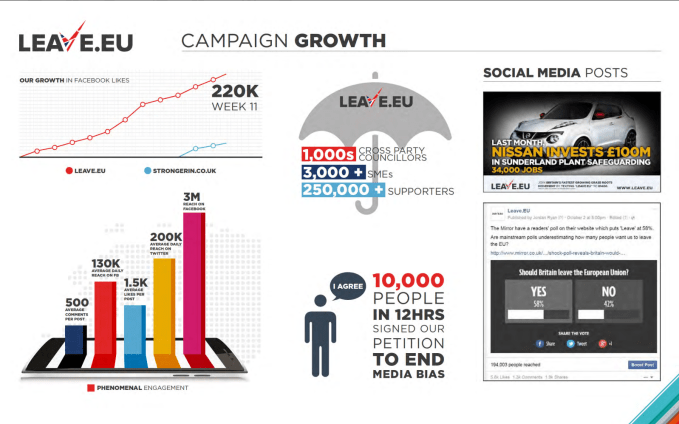
Many questions remain over a referendum that continues to be dogged by scandals — from breaches of campaign spending; to breaches of data protection and privacy law; and indeed the use of unregulated social media — principally Facebook’s ad platform — as the willing conduit for distributing racist dogwhistle attack ads and political misinformation to whip up anti-EU sentiment among UK voters.
Dark money, dark ads — and the importing of US style campaign tactics into UK, circumventing election and data protection laws by the digital platform backdoor.
This is why the DCMS committee’s preliminary report last year called on the government to take “urgent action” to “build resilience against misinformation and disinformation into our democratic system”.
The very same minority government, struggling to hold itself together in the face of Brexit chaos, failed to respond to the committee’s concerns — and has now been replaced by a cadre of the most militant Brexit backers, who are applying their hands to the cheap and plentiful digital campaign levers.
The UK’s new prime minister, Boris Johnson, is demonstrably doubling down on political microtargeting: Appointing no less than Dominic Cummings, the campaign director of the official Vote Leave campaign, as a special advisor.
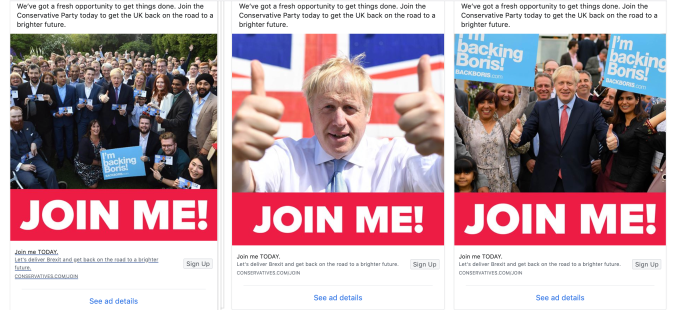
At the same time Johnson’s team is firing out a flotilla of Facebook ads — including ads that appear intended to gather voter sentiment for the purpose of crafting individually targeted political messages for any future election campaign.
So it’s full steam ahead with the Facebook ads…
Yet this ‘democratic reset’ is laid right atop the Brexit trainwreck. It’s coupled to it, in fact.
Cummings worked for the self same Vote Leave campaign that the Electoral Commission found illegally funnelled money — via Cambridge Analytica-linked Canadian data firm AggregateIQ — into a blitz of microtargeted Facebook ads intended to sway voter opinion.
Vote Leave also faced questions over its use of Facebook-run football competition promising a £50M prize-pot to fans in exchange for handing over a bunch of personal data ahead of the referendum, including how they planned to vote. Another data grab wrapped in fancy dress — much like GSR’s thisisyourlife quiz app that provided the foundational dataset for CA’s psychological voter profiling work on the Trump campaign.
The elevating of Cummings to be special adviser to the UK PM represents the polar opposite of an ‘ethical pause’ in political microtargeting.
Make no mistake, this is the Brexit campaign playbook — back in operation, now with full-bore pedal to the metal. (With his hands now on the public purse, Johnson has pledged to spend £100M on marketing to sell a ‘no deal Brexit’ to the UK public.)
Kaiser’s latest evidence may not contain a smoking bomb big enough to blast the issue of data-driven and tech giant-enabled voter manipulation into a mainstream consciousness, where it might have the chance to reset the political conscience of a nation — but it puts more flesh on the bones of how the self-styled ‘bad boys of Brexit’ pulled off their shock win.
In The Great Hack the Brexit campaign is couched as the ‘petri dish’ for the data-fuelled targeting deployed by the firm in the 2016 US presidential election — which delivered a similarly shock victory for Trump.
If that’s so, these latest pieces of evidence imply a suggestively close link between CA’s experimental modelling of UKIP supporter data, as it shifted gears to apply its dark arts closer to home than usual, and the models it subsequently built off of US citizens’ data sucked out of Facebook. And that in turn goes some way to explaining the cosiness between Trump and UKIP founder Nigel Farage…
So Donald Trump wants Nigel Farage on any trade negotiating team?
Maybe this is how #Brexit will end?
Not with a bang, not with a cliff edge, but with a great Tory shriek of revulsion?#nodealbrexit #ridge #marr #bbcbh #farage pic.twitter.com/iCn6hd9eka— carol hedges (@carolJhedges) July 28, 2019

Kaiser ends her letter to DCMS writing: “Given the enormity of the implications of earlier inaccurate conclusions by different investigations, I would hope that Parliament reconsiders the evidence submitted here in good faith. I hope that these ten documents are helpful to your research and furthering the transparency and truth that your investigations are seeking, and that the people of the UK and EU deserve”.
Banks and Wigmore have responded to the publication in their usual style, with a pair of dismissive tweets — questioning Kaiser’s motives for wanting the data to be published and throwing shade on how the evidence was obtained in the first place.
Desperate stuff @DamianCollins lol
know one cares – oh and are those emails obtained illegally – computer misuse act – tut tut stolen data, oh the irony https://t.co/BNWxUJmwoQ
— Andy Wigmore (@andywigmore) July 30, 2019

from Social – TechCrunch https://ift.tt/315tAbu
Original Content From: https://techcrunch.com
Tech Solutions -Mohammad Amir set for Essex return after visa application approved
Pakistan seamer had missed first four Vitality Blast games after a hold-up stalled the progress of his visa application
from Pakistan news from ESPN Cricinfo.com https://ift.tt/2K4hcCH
Original Content From : https://ift.tt/Ti8aBD
from Pakistan news from ESPN Cricinfo.com https://ift.tt/2K4hcCH
Original Content From : https://ift.tt/Ti8aBD
Huawei is shipping a lot more phones in spite of it all
There are a lot reasons to assume Huawei’s numbers would be on the decline. Even without getting caught smack in the middle of increasing trade tensions between two superpowers, the smartphone market has been trending down for some time now. A confluence of factors, including slowed upgrade cycles and stagnate economies in both China and abroad have contributed.
The market continues to “soften” in China as early adopters await the launch of 5G before jumping on with new handset. In spite of everything, however, Huawei appears to be the one company currently bucking the trend. And not just by a little bit, either. New numbers from Canalys put the company at a 31 percent year on year grown for the second quarter — a stark contrast to the six percent global decline for the category.
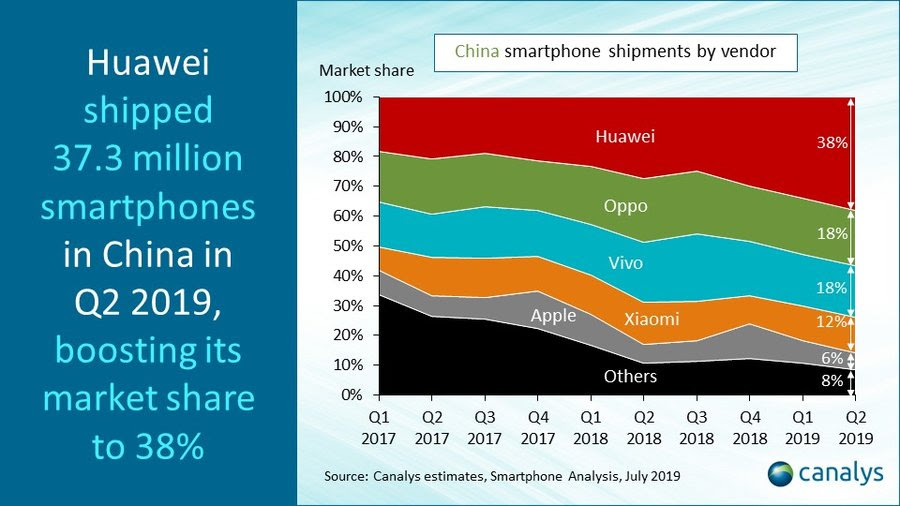
The company shipped 37.3 million handsets for Q2, with China accounting for 64 percent of that number. Unsurprisingly, its home market has become an increasingly important sales driver as trade blacklists and the like have barred in from sales in some overseas markets.
An interesting, if unsurprising factor in that growth is a kind of hometown pride for the embattled brand, which sported a 38 percent market share for the quarter.
“[T]he US-China trade war is also creating new opportunities. Huawei’s retail partners are rolling out advertisements to link Huawei with being the patriotic choice, to appeal to a growing demographic of Chinese consumers willing to take political factors into account when making a purchase decision,” Canalys’ Mo Jia said in a release tied to the news. “Huawei itself has also been eager to give more exposure to its founder and CEO, Ren Zhengfei, to enhance its brand appeal to local consumers. At the same time, Huawei’s internal chipset and modem technologies will give it an edge over its competitors as 5G is commercialized by Chinese operators.”
That last bit means that Huawei will almost certainly see more growth in the coming years as 5G begins to roll out in China, starting this fall. This is, of course, as long as a ban on the use of American software and components don’t hamper the company entirely in the meantime.
Huawei was cautiously optimistic reporting its quarterly earnings this week. “Given the foundation we laid in the first half of the year, we continue to see growth even after we were added to the entity list,” Chairman Liang Hua said on a call. “That’s not to say we don’t have difficulties ahead. We do, and they may affect the pace of our growth in the short term.”


from Mobile – TechCrunch https://ift.tt/2Kr0jkT
ORIGINAL CONTENT FROM: https://techcrunch.com/
TECH Solutions - Drones grounded after crash near playing children
Drones carrying lab samples between hospitals in Switzerland have been grounded.
from BBC News - Technology https://ift.tt/2YxPxxY
Original Content From: http://bbci.co.uk
from BBC News - Technology https://ift.tt/2YxPxxY
Original Content From: http://bbci.co.uk
TECH Solutions - Google reveals fistful of flaws in Apple's iMessage app
The security researchers involved say that Apple has yet to fix all of the discovered flaws.
from BBC News - Technology https://ift.tt/2ylMj66
Original Content From: http://bbci.co.uk
from BBC News - Technology https://ift.tt/2ylMj66
Original Content From: http://bbci.co.uk
TECH Solutions - Fire Emblem: Nintendo cuts voice actor over emotional abuse
Chris Niosi is being removed from Fire Emblem: Three Houses, days after the game's release.
from BBC News - Technology https://ift.tt/2YBdj02
Original Content From: http://bbci.co.uk
from BBC News - Technology https://ift.tt/2YBdj02
Original Content From: http://bbci.co.uk
Technical Solutions - Google Pixel 4 with RADAR??🔥📡
Google Pixel 4 with RADAR??🔥📡
Namaskaar Dosto, is video mein maine aapse baat ki hai Google ke Pixel 4 ke baare mein jaha Google ne hume kuch details ke baare mein bataya hai inhi upcoming Pixel phones ke baare mein aur yaha pe baat hai Project Soli ki aur saath mein Face Unlock system ki jaha pe Project Soli ka matlab ek mini RADAR hai movements ko detect karne ke liye, jiske baad aap gestures se kaam kar payenge phone mein. Mujhe umeed hai ki aapko yeh video pasand aayegi. Share, Support, Subscribe!!! Subscribe: http://bit.ly/1Wfsvt4 Android App: https://ift.tt/2mrm9Gy Youtube: http://www.youtube.com/c/TechnicalGuruji Twitter: http://www.twitter.com/technicalguruji Facebook: https://ift.tt/1Pi5LDP Facebook Myself: https://goo.gl/zUfbUU Instagram: https://ift.tt/1OW2vue Google Plus: https://ift.tt/1Pi5LDS Website: https://ift.tt/2mcM6KV Merchandise: https://ift.tt/2lN4Vbu About : Technical Guruji is a YouTube Channel, where you will find technological videos in Hindi, New Video is Posted Everyday :)
Namaskaar Dosto, is video mein maine aapse baat ki hai Google ke Pixel 4 ke baare mein jaha Google ne hume kuch details ke baare mein bataya hai inhi upcoming Pixel phones ke baare mein aur yaha pe baat hai Project Soli ki aur saath mein Face Unlock system ki jaha pe Project Soli ka matlab ek mini RADAR hai movements ko detect karne ke liye, jiske baad aap gestures se kaam kar payenge phone mein. Mujhe umeed hai ki aapko yeh video pasand aayegi. Share, Support, Subscribe!!! Subscribe: http://bit.ly/1Wfsvt4 Android App: https://ift.tt/2mrm9Gy Youtube: http://www.youtube.com/c/TechnicalGuruji Twitter: http://www.twitter.com/technicalguruji Facebook: https://ift.tt/1Pi5LDP Facebook Myself: https://goo.gl/zUfbUU Instagram: https://ift.tt/1OW2vue Google Plus: https://ift.tt/1Pi5LDS Website: https://ift.tt/2mcM6KV Merchandise: https://ift.tt/2lN4Vbu About : Technical Guruji is a YouTube Channel, where you will find technological videos in Hindi, New Video is Posted Everyday :)
Tech Solutions -FAQs: All you need to know about the 2019-21 World Test Championship
Nine teams will contest a total of 27 bilateral series in the inaugural World Test Championship between 2019 to 2021
from Pakistan news from ESPN Cricinfo.com https://ift.tt/2k7FgXP
Original Content From : https://ift.tt/Ti8aBD
from Pakistan news from ESPN Cricinfo.com https://ift.tt/2k7FgXP
Original Content From : https://ift.tt/Ti8aBD
TECH Solutions - Giffgaff fined £1.4m for overcharging mobile customers
Regulator Ofcom says "unacceptable" mistakes affected 2.6 million customers of the mobile phone group.
from BBC News - Technology https://ift.tt/2MpngHC
Original Content From: http://bbci.co.uk
from BBC News - Technology https://ift.tt/2MpngHC
Original Content From: http://bbci.co.uk
TECH Solutions - How to get visitors on to your home wi-fi easily
The tech hack that means visitors to your home will never have to ask for your wi-fi login again.
from BBC News - Technology https://ift.tt/2SPTcWA
Original Content From: http://bbci.co.uk
from BBC News - Technology https://ift.tt/2SPTcWA
Original Content From: http://bbci.co.uk
TECH Solutions - Huawei sees trouble ahead despite revenue rise
The Chinese tech giant has been under global scrutiny for allegedly posing a security risk.
from BBC News - Technology https://ift.tt/2LLosWp
Original Content From: http://bbci.co.uk
from BBC News - Technology https://ift.tt/2LLosWp
Original Content From: http://bbci.co.uk
Monday, July 29, 2019
TECH Solutions - Capital One data breach: Arrest after details of 100m US individuals stolen
The hacker gained access to individuals' date of birth, addresses and phone numbers.
from BBC News - Technology https://ift.tt/2SPh1xM
Original Content From: http://bbci.co.uk
from BBC News - Technology https://ift.tt/2SPh1xM
Original Content From: http://bbci.co.uk
TECH Solutions - Grindr: Chinese parent company plans to list gay dating app
Grindr's Chinese owner said US authorities no longer object to a public listing of the dating app.
from BBC News - Technology https://ift.tt/2OsdgQk
Original Content From: http://bbci.co.uk
from BBC News - Technology https://ift.tt/2OsdgQk
Original Content From: http://bbci.co.uk
TECH Solutions - Is routine genetic profiling coming closer?
Genome sequencing projects around the world are revealing promising new health insights.
from BBC News - Technology https://ift.tt/2YvuiAR
Original Content From: http://bbci.co.uk
from BBC News - Technology https://ift.tt/2YvuiAR
Original Content From: http://bbci.co.uk
TECH Solutions - A guide to Virtual Beings and how they impact our world
Money from big tech companies and top VC firms is flowing into the nascent “virtual beings” space. Mixing the opportunities presented by conversational AI, generative adversarial networks, photorealistic graphics, and creative development of fictional characters, “virtual beings” envisions a near-future where characters (with personalities) that look and/or sound exactly like humans are part of our day-to-day interactions.
Last week in San Francisco, entrepreneurs, researchers, and investors convened for the first Virtual Beings Summit, where organizer and Fable Studio CEO Edward Saatchi announced a grant program. Corporates like Amazon, Apple, Google, and Microsoft are pouring resources into conversational AI technology, chip-maker Nvidia and game engines Unreal and Unity are advancing real-time ray tracing for photorealistic graphics, and in my survey of media VCs one of the most common interests was “virtual influencers”.
The term “virtual beings” gets used as a catch-all categorization of activities that overlap here. There are really three separate fields getting conflated though:
- Virtual Companions
- Humanoid Character Creation
- Virtual Influencers
These can overlap — there are humanoid virtual influencers for example — but they represent separate challenges, separate business opportunities, and separate societal concerns. Here’s a look at these fields, including examples from the Virtual Beings Summit, and how they collectively comprise this concept of virtual beings:
Virtual companions
Virtual companions are conversational AI that build a unique 1-to-1 relationship with us, whether to provide friendship or utility. A virtual companion has personality, gauges the personality of the user, retains memory of prior conversations, and uses all that to converse with humans like a fellow human would. They seem to exist as their own being even if we rationally understand they are not.
Virtual companions can exist across 4 formats:
- Physical presence (Robotics)
- Interactive visual media (social media, gaming, AR/VR)
- Text-based messaging
- Interactive voice
While pop culture depictions of this include Her and Ex Machina, nascent real-world examples are virtual friend bots like Hugging Face and Replika as well as voice assistants like Amazon’s Alexa and Apple’s Siri. The products currently on the market aren’t yet sophisticated conversationalists or adept at engaging with us as emotional creatures but they may not be far off from that.

from Social – TechCrunch https://ift.tt/2K7D1QI
Original Content From: https://techcrunch.com
TECH Solutions - Facebook and YouTube’s moderation failure is an opportunity to deplatform the platforms
Facebook, YouTube, and Twitter have failed their task of monitoring and moderating the content that appears on their sites; what’s more, they failed to do so well before they knew it was a problem. But their incidental cultivation of fringe views is an opportunity to recast their role as the services they should be rather than the platforms they have tried so hard to become.
The struggles of these juggernauts should be a spur to innovation elsewhere: While the major platforms reap the bitter harvest of years of ignoring the issue, startups can pick up where they left off. There’s no better time to pass someone up as when they’re standing still.
Asymmetrical warfare: Is there a way forward?
At the heart of the content moderation issue is a simple cost imbalance that rewards aggression by bad actors while punishing the platforms themselves.
To begin with, there is the problem of defining bad actors in the first place. This is a cost that must be borne from the outset by the platform: With the exception of certain situations where they can punt (definitions of hate speech or groups for instance), they are responsible for setting the rules on their own turf.
That’s a reasonable enough expectation. But carrying it out is far from trivial; you can’t just say “here’s the line; don’t cross it or you’re out.” It is becoming increasingly clear that these platforms have put themselves in an uncomfortable lose-lose situation.
If they have simple rules, they spend all their time adjudicating borderline cases, exceptions, and misplaced outrage. If they have more granular ones, there is no upper limit on the complexity and they spend all their time defining it to fractal levels of detail.
Both solutions require constant attention and an enormous, highly-organized and informed moderation corps, working in every language and region. No company has shown any real intention to take this on — Facebook famously contracts the responsibility out to shabby operations that cut corners and produce mediocre results (at huge human and monetary cost); YouTube simply waits for disasters to happen and then quibbles unconvincingly.

from Social – TechCrunch https://ift.tt/2K4XcjD
Original Content From: https://techcrunch.com
TECH Solutions - Dark web criminal bought 'quadrillions of Zimbabwe bank notes'
Richard Castro used part of his proceeds to buy Zimbabwe's defunct currency.
from BBC News - Technology https://ift.tt/2YcZpSA
Original Content From: http://bbci.co.uk
from BBC News - Technology https://ift.tt/2YcZpSA
Original Content From: http://bbci.co.uk
Technical Solutions - Tech Talks #880 - Realme Project X, Free WiFi India, TikTok Smartphone, Xiaomi Microwave, Whatsapp
Tech Talks #880 - Realme Project X, Free WiFi India, TikTok Smartphone, Xiaomi Microwave, Whatsapp
TG Deals@ https://tg.deals/ New Channel: https://goo.gl/Jz6p5K Namaskaar Dosto, Tech Talks ke is Episode mein maine aapse kuch interesting Tech News Share ki hai jaise Realme Project X, Free WiFi in India, TikTok Smartphone, Xiaomi Microwave and Juicer, Whatsapp Web, Samsung Triple Display, Oppo waterfall Display, 5G iPhone aur bahut kuch. Mujhe umeed hai ki yeh video aapko pasand aayega. Share, Support, Subscribe!!! Subscribe: http://bit.ly/1Wfsvt4 Android App: https://ift.tt/2mrm9Gy Youtube: http://www.youtube.com/c/TechnicalGuruji Twitter: http://www.twitter.com/technicalguruji Facebook: https://ift.tt/1Pi5LDP Facebook Myself: https://goo.gl/zUfbUU Instagram: https://ift.tt/1OW2vue Google Plus: https://ift.tt/1Pi5LDS Website: https://ift.tt/2mcM6KV Merchandise: https://ift.tt/2lN4Vbu About : Technical Guruji is a YouTube Channel, where you will find technological videos in Hindi, New Video is Posted Everyday :)
TG Deals@ https://tg.deals/ New Channel: https://goo.gl/Jz6p5K Namaskaar Dosto, Tech Talks ke is Episode mein maine aapse kuch interesting Tech News Share ki hai jaise Realme Project X, Free WiFi in India, TikTok Smartphone, Xiaomi Microwave and Juicer, Whatsapp Web, Samsung Triple Display, Oppo waterfall Display, 5G iPhone aur bahut kuch. Mujhe umeed hai ki yeh video aapko pasand aayega. Share, Support, Subscribe!!! Subscribe: http://bit.ly/1Wfsvt4 Android App: https://ift.tt/2mrm9Gy Youtube: http://www.youtube.com/c/TechnicalGuruji Twitter: http://www.twitter.com/technicalguruji Facebook: https://ift.tt/1Pi5LDP Facebook Myself: https://goo.gl/zUfbUU Instagram: https://ift.tt/1OW2vue Google Plus: https://ift.tt/1Pi5LDS Website: https://ift.tt/2mcM6KV Merchandise: https://ift.tt/2lN4Vbu About : Technical Guruji is a YouTube Channel, where you will find technological videos in Hindi, New Video is Posted Everyday :)
Tech Solutions -'Amir could have managed those five years better' - Mickey Arthur
The Pakistan coach believes Amir could have managed his workload better had he looked after his body during the banned period
from Pakistan news from ESPN Cricinfo.com https://ift.tt/2GyXmxq
Original Content From : https://ift.tt/Ti8aBD
from Pakistan news from ESPN Cricinfo.com https://ift.tt/2GyXmxq
Original Content From : https://ift.tt/Ti8aBD
TECH Solutions - TikTok owner ByteDance developing smartphone
Chinese social media company ByteDance has made a deal with device-maker Smartisan to develop a smartphone.
from BBC News - Technology https://ift.tt/2ZfL5Fu
Original Content From: http://bbci.co.uk
from BBC News - Technology https://ift.tt/2ZfL5Fu
Original Content From: http://bbci.co.uk
Google’s Pixel 4 smartphone will have motion control and face unlock
Google’s Pixel 4 is coming out later this year, and it’s getting the long reveal treatment thanks to a decision this year from Google to go ahead and spill some of the beans early, rather than saving everything for one big final unveiling closer to availability. A new video posted by Google today about the forthcoming Pixel 4 (which likely won’t actually be available until fall) shows off some features new to this generation: Motion control and face unlock.
The new “Motion Sense” feature in the Pixel 4 will detect waves of your hand and translate them into software control, including skipping songs, snoozing alarms and quieting incoming phone call alerts, with more planned features to come, according to Google. It’s based on Soli, a radar-based fine motion detection technology that Google first revealed at its I/O annual developer conference in 2016. Soli can detect very fine movements, including fingers pinched together to mimic a watch-winding motion, and it got approval from the FCC in January, hinting it would finally be arriving in production devices this year.
Pixel 4 is the first shipping device to include Soli, and Google says it’ll be available in “select Pixel countries” at launch (probably due to similar approvals requirements wherever it rolls out to consumers).
Google also teased “Face unlock,” something it has supported in Android previously – but Google is doing it very differently than it has been handled on Android in the past with the Pixel 4. Once again, Soli is part of its implementation, turning on the face unlock sensors in the device as it detects your hand reaching to pick up the device. Google says this should mean that the phone will be unlocked by the time you’re ready to use it, since it does this all on the fly, and works from pretty much any authentication.
Face unlock will be supported for authorizing payments and logging into Android apps, as well, and all of the facial recognition processing done for face unlock will occur on the device – a privacy-oriented feature that’s similar to how Apple handles its own Face ID. In fact, Google will also be storing all the facial recognition data securely in its own dedicated on-device Titan M security chip, another move similar to Apple’s own approach.
Google made the Pixel 4 official and tweeted photos (or maybe photorealistic renders) of the new smartphone back in June, bucking the trend of keeping things unconfirmed until an official reveal closer to release. Based on this update, it seems likely we can expect to learn more about the new smartphone ahead of its availability, which is probably going to happen sometime around October based on past behavior.


from Mobile – TechCrunch https://ift.tt/2GxuYvu
ORIGINAL CONTENT FROM: https://techcrunch.com/
Huawei’s first 5G phone goes on sale in China next month
Huawei on Friday announced the upcoming release of its first 5G handset in its home market. Following on the heels of its UK debut, the Mate 20 X is currently up for pre-order, with an expected China arrival of August 16.
The handset beats the foldable Mate X to market, in spite of that handset having made its debut way back at Mobile World Congress in February. Of course, companies are understandably cautious about foldable in the wake of the mess with the Samsung Galaxy Fold, which finally got an approximate release date last week.
China Mobile flipped the switch on its Huawei-powered 5G transport network late last month, with commercial rollout expected to begin in October. In June, China Telecom and China Unicom were also granted licenses to operate commercial 5G networks, after some delay. Last week, ZTE’s Axon 10 Pro 5G went up for presale in its native China, as well.
Until rollout begins, those purchasing 5G handsets will have to rely on older networks like the rest of us, putting the U.S. and China in similar boats on that front. Of course, security concerns have put both Huawei and ZTE in the crosshairs internationally, particularly North America.
Huawei has reportedly been looking to build much of its own hardware and software in house, particularly in the wake of a ban on its use offerings from U.S. companies. Notably it also announced a $436 million investment in building out an ecosystem around its Arm-based Kunpeng server chip.


from Mobile – TechCrunch https://ift.tt/316uvsb
ORIGINAL CONTENT FROM: https://techcrunch.com/