Top Upcoming Smartphones - June 2019 🔥🔥🔥
Namaskar Dosto, is video mein maine aapse baat ki hai June 2019 mein launch hone waale phones ke baare mein. Yaha pe is saal 2019 mein hume bahut se phones dekhne ko milenge aur kuch phones bahut interesting hai. Yaha mein baat ki hai Realme X, Redmi K20 aur Redmi K20 ke baare mein, Asus Zenfone 6, Redmi 7A, Galaxy A80, Galaxy M40, Honor 20, Nubia Red Magic 3, Nubia Alpha, Nokia 9, Vivo Z5x aur bahut se phones ke baare mein. Mujhe umeed hai ki aapko Upcoming Smartphones ke baare mein yeh video pasand aayegi. Share, Support, Subscribe!!! Subscribe: http://bit.ly/1Wfsvt4 Android App: http://bit.ly/2mrm9Gy Youtube: http://www.youtube.com/c/TechnicalGuruji Twitter: http://www.twitter.com/technicalguruji Facebook: http://bit.ly/1Pi5LDP Facebook Myself: https://goo.gl/zUfbUU Instagram: http://bit.ly/1OW2vue Google Plus: http://bit.ly/1Pi5LDS Website: http://bit.ly/2mcM6KV Merchandise: http://bit.ly/2lN4Vbu About : Technical Guruji is a YouTube Channel, where you will find technological videos in Hindi, New Video is Posted Everyday :)

This Blog is created to share Technical Solutions for public interest. The Content is related with IT solutions, SEO tips, Online Earning, online marketing, website developement, CSS, java, C++, python, C sharp Languages.
Friday, May 31, 2019
Tech Solutions -PCB hopeful of South Africa touring Pakistan within 12 months
The PCB managing director Wasim Khan has extended the invitation although it is understood South Africa have not committed to it just yet
from Pakistan news from ESPN Cricinfo.com https://es.pn/2MzVnhV
Original Content From : https://es.pn/Ti8aBD
from Pakistan news from ESPN Cricinfo.com https://es.pn/2MzVnhV
Original Content From : https://es.pn/Ti8aBD
TECH Solutions - Tech Tent: Why is 5G data capped?
On this week's podcast, we ask whether people will pay a premium for the benefits 5G promises.
from BBC News - Technology https://bbc.in/2I9xHv3
Original Content From: http://bbci.co.uk
from BBC News - Technology https://bbc.in/2I9xHv3
Original Content From: http://bbci.co.uk
Tech Solutions -ICC to give full refunds after Trent Bridge ticket delays
Queues of "1600-1700 people" caused some fans to miss the start of Pakistan-West Indies game
from Pakistan news from ESPN Cricinfo.com https://es.pn/2Wy4G5p
Original Content From : https://es.pn/Ti8aBD
from Pakistan news from ESPN Cricinfo.com https://es.pn/2Wy4G5p
Original Content From : https://es.pn/Ti8aBD
Technical Solutions - Tech Talks #830 - Death by PUBG, Macbook Pro on Fire, Oppo Rotating Camera, CWC 2019, Note 10
Tech Talks #830 - Death by PUBG, Macbook Pro on Fire, Oppo Rotating Camera, CWC 2019, Note 10
TG Deals@ https://tg.deals/ New Channel: https://goo.gl/Jz6p5K Namaskaar Dosto, Tech Talks ke is Episode mein maine aapse kuch interesting Tech News Share ki hai jaise Death by PUBG Gameplay, Macbook Pro on Fire with Battery Problem, Oppo Rotating Camera Patent, CWC 2019 Google Doodle, Galaxy Note 10 Headphone Jack, Skai Flying Taxi, Whatsapp Beta, Nokia Phone on June 6th, Flipkart Flipstart Days aur bahut kuch. Mujhe umeed hai ki yeh video aapko pasand aayega. Share, Support, Subscribe!!! Subscribe: http://bit.ly/1Wfsvt4 Android App: http://bit.ly/2mrm9Gy Youtube: http://www.youtube.com/c/TechnicalGuruji Twitter: http://www.twitter.com/technicalguruji Facebook: http://bit.ly/1Pi5LDP Facebook Myself: https://goo.gl/zUfbUU Instagram: http://bit.ly/1OW2vue Google Plus: http://bit.ly/1Pi5LDS Website: http://bit.ly/2mcM6KV Merchandise: http://bit.ly/2lN4Vbu About : Technical Guruji is a YouTube Channel, where you will find technological videos in Hindi, New Video is Posted Everyday :)
TG Deals@ https://tg.deals/ New Channel: https://goo.gl/Jz6p5K Namaskaar Dosto, Tech Talks ke is Episode mein maine aapse kuch interesting Tech News Share ki hai jaise Death by PUBG Gameplay, Macbook Pro on Fire with Battery Problem, Oppo Rotating Camera Patent, CWC 2019 Google Doodle, Galaxy Note 10 Headphone Jack, Skai Flying Taxi, Whatsapp Beta, Nokia Phone on June 6th, Flipkart Flipstart Days aur bahut kuch. Mujhe umeed hai ki yeh video aapko pasand aayega. Share, Support, Subscribe!!! Subscribe: http://bit.ly/1Wfsvt4 Android App: http://bit.ly/2mrm9Gy Youtube: http://www.youtube.com/c/TechnicalGuruji Twitter: http://www.twitter.com/technicalguruji Facebook: http://bit.ly/1Pi5LDP Facebook Myself: https://goo.gl/zUfbUU Instagram: http://bit.ly/1OW2vue Google Plus: http://bit.ly/1Pi5LDS Website: http://bit.ly/2mcM6KV Merchandise: http://bit.ly/2lN4Vbu About : Technical Guruji is a YouTube Channel, where you will find technological videos in Hindi, New Video is Posted Everyday :)
Tech Solutions -Russell's spell was the turning point - Sarfaraz Ahmed
The Pakistan captain refuted the idea that his batsmen couldn't handle West Indies' short-pitched bowling, and put their heavy defeat down to poor shot selection
from Pakistan news from ESPN Cricinfo.com https://es.pn/2EJpvRu
Original Content From : https://es.pn/Ti8aBD
from Pakistan news from ESPN Cricinfo.com https://es.pn/2EJpvRu
Original Content From : https://es.pn/Ti8aBD
Tech Solutions - #848 Zenfone6 India Launch Date, MI Band 4 Leak, Samsung A80 India Launch, Xiaomi Mi 9T
#848 Zenfone6 India Launch Date, MI Band 4 Leak, Samsung A80 India Launch, Xiaomi Mi 9T
Hi Friends: This is my Blog Technical Solutions created to share videos and content of technical solutions with the world. At this blog you can find videos about Free Search Engine Optimization Course, how to develope Android Applications and What is Computer hardware and software, you would be able to increse your channel views, or boost your website. so guys keep visiting my blog for learning technical things. Thank You!
Hi Friends: This is my Blog Technical Solutions created to share videos and content of technical solutions with the world. At this blog you can find videos about Free Search Engine Optimization Course, how to develope Android Applications and What is Computer hardware and software, you would be able to increse your channel views, or boost your website. so guys keep visiting my blog for learning technical things. Thank You!
TECH Solutions - Spotify is building shared queue Social Listening
Want to rock out together even when you’re apart? Spotify has prototyped an unreleased feature called “Social Listening” that lets multiple people add songs to a queue they can all listen to. You just all scan one friend’s QR-style Spotify Social Listening code, and then anyone can add songs to the real-time playlist. Spotify could potentially expand the feature to synchronize playback so you’d actually hear the same notes at the same time, but for now it’s a just a shared queue.
Social Listening could give Spotify a new viral growth channel, as users could urge friends to download the app to sync up. The intimate experience of co-listening might lead to longer sessions with Spotify, boosting ad plays or subscription retention. Plus it could differentiate Spotify from Apple Music, YouTube Music, Tidal, and other competing streaming services.
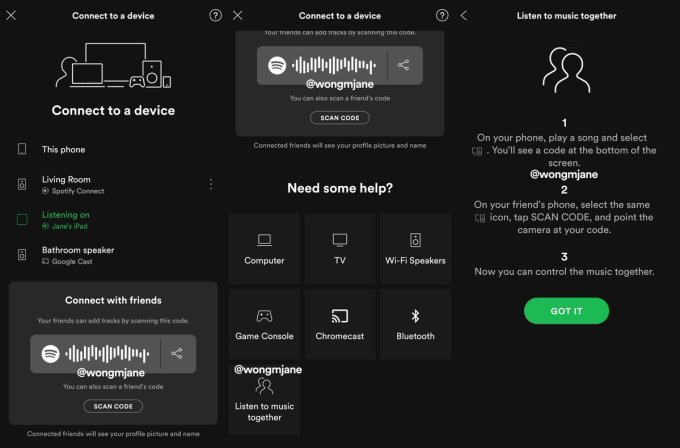
A Spotify spokesperson tells TechCrunch that “We’re always testing new products and experiences, but have no further news to share at this time.” Spotify already offers Collaborative Playlists friends can add to, but Social Listening is designed for real-time sharing. The company refused to provide further details on the prototype or when it might launch.
The feature is reminiscent of Turntable.fm, a 2011 startup that let people DJ in virtual rooms on their desktop that other people could join where they could chat, vote on the next song, and watch everyone’s avatars dance. But the company struggled to properly monetize through ad-free subscriptions and shut down in 2014. Facebook briefly offered its own version called “Listen With…” in 2012 that let Spotify or Rdio users synchronize music playback.
Spotify Social Listening was first spotted by reverse engineering sorceress and frequent TechCrunch tipster Jane Manchun Wong. She discovered code for the feature buried in Spotify’s Android app, but for now it’s only available to Spotify employees. Social Listening appears in the menu of connected devices you can open while playing a song beside nearby Wi-Fi and Bluetooth devices. “Connect with friends: Your friends can add tracks by scanning this code – You can also scan a friend’s code” the feature explains.
A help screen describes Social Listening as “Listen to music together. 1. On your phone, play a song and select (Connected Devices). You’ll see a code at the bottom of the screen. 2. On your friend’s phone, select the same (Connected Devices) icon, tap SCAN CODE, and point the camera at your code. 3. Now you can control the music together.” You’ll then see friends who are part of your Social Listening session listed in the Connected Devices menu. Users can also copy and share a link to join their Social Listening session that starts with the URL prefix https://spoti.fi/2HOWshq Note that Spotify never explicitly says that playback will be synchronized.

With streaming apps largely having the same music catalog and similar $9.99 per month premium pricing, they have to compete on discovery and user experience. Spotify has long been in the lead here with its algorithmically personalized Discover Weekly playlists that were promptly copied by Apple and SoundCloud.
Oddly, Spotify has stripped out some of its own social features over the years, eliminating the in-app messing inbox and instead pushing users to share songs over third-party messaging apps. The deemphasis in discovery through friends conveniently puts the focus on Spotify’s owned playlists. That gives it leverage over the record labels during their rate negotations since it’s who influences which songs will become hits, so if labels don’t play nice their artists might not get promoted via playlists.
That’s why it’s good to see Spotify remembering that music is an inherently social experience. Music physically touches us through its vibrations, and when people listen to the same songs and are literally moved by it at the same time, it creates a sense of togetherness we’re too often deprived of on the Internet.

from Social – TechCrunch https://tcrn.ch/2W5QlJk
Original Content From: https://techcrunch.com
Spotify is building shared queue Social Listening
Want to rock out together even when you’re apart? Spotify has prototyped an unreleased feature called “Social Listening” that lets multiple people add songs to a queue they can all listen to. You just all scan one friend’s QR-style Spotify Social Listening code, and then anyone can add songs to the real-time playlist. Spotify could potentially expand the feature to synchronize playback so you’d actually hear the same notes at the same time, but for now it’s a just a shared queue.
Social Listening could give Spotify a new viral growth channel, as users could urge friends to download the app to sync up. The intimate experience of co-listening might lead to longer sessions with Spotify, boosting ad plays or subscription retention. Plus it could differentiate Spotify from Apple Music, YouTube Music, Tidal, and other competing streaming services.
A Spotify spokesperson tells TechCrunch that “We’re always testing new products and experiences, but have no further news to share at this time.” Spotify already offers Collaborative Playlists friends can add to, but Social Listening is designed for real-time sharing. The company refused to provide further details on the prototype or when it might launch.
The feature is reminiscent of Turntable.fm, a 2011 startup that let people DJ in virtual rooms on their desktop that other people could join where they could chat, vote on the next song, and watch everyone’s avatars dance. But the company struggled to properly monetize through ad-free subscriptions and shut down in 2014. Facebook briefly offered its own version called “Listen With…” in 2012 that let Spotify or Rdio users synchronize music playback.
Spotify Social Listening was first spotted by reverse engineering sorceress and frequent TechCrunch tipster Jane Manchun Wong. She discovered code for the feature buried in Spotify’s Android app, but for now it’s only available to Spotify employees. Social Listening appears in the menu of connected devices you can open while playing a song beside nearby Wi-Fi and Bluetooth devices. “Connect with friends: Your friends can add tracks by scanning this code – You can also scan a friend’s code” the feature explains.
A help screen describes Social Listening as “Listen to music together. 1. On your phone, play a song and select (Connected Devices). You’ll see a code at the bottom of the screen. 2. On your friend’s phone, select the same (Connected Devices) icon, tap SCAN CODE, and point the camera at your code. 3. Now you can control the music together.” You’ll then see friends who are part of your Social Listening session listed in the Connected Devices menu. Users can also copy and share a link to join their Social Listening session that starts with the URL prefix https://spoti.fi/2HOWshq Note that Spotify never explicitly says that playback will be synchronized.
With streaming apps largely having the same music catalog and similar $9.99 per month premium pricing, they have to compete on discovery and user experience. Spotify has long been in the lead here with its algorithmically personalized Discover Weekly playlists that were promptly copied by Apple and SoundCloud.
Oddly, Spotify has stripped out some of its own social features over the years, eliminating the in-app messing inbox and instead pushing users to share songs over third-party messaging apps. The deemphasis in discovery through friends conveniently puts the focus on Spotify’s owned playlists. That gives it leverage over the record labels during their rate negotations since it’s who influences which songs will become hits, so if labels don’t play nice their artists might not get promoted via playlists.
That’s why it’s good to see Spotify remembering that music is an inherently social experience. Music physically touches us through its vibrations, and when people listen to the same songs and are literally moved by it at the same time, it creates a sense of togetherness we’re too often deprived of on the Internet.


from Mobile – TechCrunch https://tcrn.ch/2W5QlJk
ORIGINAL CONTENT FROM: https://techcrunch.com/
TECH Solutions - Extinction Rebellion plans Heathrow drone protest
Extinction Rebellion says it will stage a 10-day demonstration unless expansion plans are cancelled.
from BBC News - Technology https://bbc.in/2I8cO3w
Original Content From: http://bbci.co.uk
from BBC News - Technology https://bbc.in/2I8cO3w
Original Content From: http://bbci.co.uk
Tech Solutions -Oshane Thomas and Andre Russell keep it short and to the point as Pakistan are routed
West Indies lay a marker by crushing Pakistan with 36.2 overs to spare at Trent Bridge
from Pakistan news from ESPN Cricinfo.com https://es.pn/2I8lQgV
Original Content From : https://es.pn/Ti8aBD
from Pakistan news from ESPN Cricinfo.com https://es.pn/2I8lQgV
Original Content From : https://es.pn/Ti8aBD
TECH Solutions - The raspberry picking robot and other tech news
Kitty Knowles looks at some of the week's best technology stories.
from BBC News - Technology https://bbc.in/2XdfrHw
Original Content From: http://bbci.co.uk
from BBC News - Technology https://bbc.in/2XdfrHw
Original Content From: http://bbci.co.uk
TECH Solutions - Dating app scammers spotted by AI
Fakes on dating websites use emotional language, analysis of thousands of dating profiles reveals.
from BBC News - Technology https://bbc.in/2EKAWrX
Original Content From: http://bbci.co.uk
from BBC News - Technology https://bbc.in/2EKAWrX
Original Content From: http://bbci.co.uk
TECH Solutions - North Face apologises over Wikipedia 'hack'
Images on the encyclopaedia were swapped to feature North Face clothing as an advertising stunt.
from BBC News - Technology https://bbc.in/2QyLCyK
Original Content From: http://bbci.co.uk
from BBC News - Technology https://bbc.in/2QyLCyK
Original Content From: http://bbci.co.uk
TECH Solutions - Facebook's Mark Zuckerberg 'survives' leadership vote
Some shareholders wanted Facebook's chairman and chief executive to step down from one of his roles.
from BBC News - Technology https://bbc.in/2YVo5ej
Original Content From: http://bbci.co.uk
from BBC News - Technology https://bbc.in/2YVo5ej
Original Content From: http://bbci.co.uk
Tech Solutions -Live Report - Pakistan v West Indies
All the analyses, stats, tweets and chatter from the Pakistan v West Indies game
from Pakistan news from ESPN Cricinfo.com https://es.pn/2KlNN7s
Original Content From : https://es.pn/Ti8aBD
from Pakistan news from ESPN Cricinfo.com https://es.pn/2KlNN7s
Original Content From : https://es.pn/Ti8aBD
Technical Solutions - OnePlus 7 Unboxing & First Look - True Value Package🔥🔥🔥
OnePlus 7 Unboxing & First Look - True Value Package🔥🔥🔥
Namaskaar Dosto, is video mein maine aapse OnePlus 7 ke baare mein baat ki hai, aur maine aapke liye OnePlus 7 ki unboxing. OnePlus 7 2019 ka flagship phone hai OnePlus ki taraf se aur isme Snapdragon 855 Processor hai Adreno 640 Processor ke saath aur saath mein 6GB/8GB RAM options hai aur 128GB/256GB UFS 3.0 based storage options hai. OnePlus 7 mein 48MP + 5MP ka Dual rear camera setup hai jisme OIS aur EIS dono hai aur isme aap 4K 60FPS mein video record kar sakte hai aur 480 FPS ka Super Slow Motion Mode hai jisme aap 1 Minute tak Slow Motion videos record kar sakte hai. Isme 16MP ka front facing camera hai isme bhi EIS hai. Isme 6.41" ka FHD+ Optic AMOLED Display hai Gorilla Glass 6 ki protection. OnePlus 7 mein 3700mAh ki battery hai aur saath mein Dash Charging ka support. OnePlus 7 mein 2 color options mein available hai Mirror Grey aur Red. OnePlus 7 mein aapko Android 9 Pie Operating System milta hai aur yaha pe aapko In Display Fingerprint Scanner bhi milta hai. Main jaldi hi kuch aur videos leke aane waala hu OnePlus 7 ke liye aur planning hai kuch special surprise ki aapke liye. Mujhe umeed hai ki aapko OnePlus 7 ki yeh video pasand aayegi. Price of OnePlus 7 in India: 6GB + 128GB = 32,999 INR 8GB + 256GB = 37,999 INR Share, Support, Subscribe!!! Subscribe: http://bit.ly/1Wfsvt4 Android App: http://bit.ly/2mrm9Gy Youtube: http://www.youtube.com/c/TechnicalGuruji Twitter: http://www.twitter.com/technicalguruji Facebook: http://bit.ly/1Pi5LDP Facebook Myself: https://goo.gl/zUfbUU Instagram: http://bit.ly/1OW2vue Google Plus: http://bit.ly/1Pi5LDS Website: http://bit.ly/2mcM6KV Merchandise: http://bit.ly/2lN4Vbu About : Technical Guruji is a YouTube Channel, where you will find technological videos in Hindi, New Video is Posted Everyday :)
Namaskaar Dosto, is video mein maine aapse OnePlus 7 ke baare mein baat ki hai, aur maine aapke liye OnePlus 7 ki unboxing. OnePlus 7 2019 ka flagship phone hai OnePlus ki taraf se aur isme Snapdragon 855 Processor hai Adreno 640 Processor ke saath aur saath mein 6GB/8GB RAM options hai aur 128GB/256GB UFS 3.0 based storage options hai. OnePlus 7 mein 48MP + 5MP ka Dual rear camera setup hai jisme OIS aur EIS dono hai aur isme aap 4K 60FPS mein video record kar sakte hai aur 480 FPS ka Super Slow Motion Mode hai jisme aap 1 Minute tak Slow Motion videos record kar sakte hai. Isme 16MP ka front facing camera hai isme bhi EIS hai. Isme 6.41" ka FHD+ Optic AMOLED Display hai Gorilla Glass 6 ki protection. OnePlus 7 mein 3700mAh ki battery hai aur saath mein Dash Charging ka support. OnePlus 7 mein 2 color options mein available hai Mirror Grey aur Red. OnePlus 7 mein aapko Android 9 Pie Operating System milta hai aur yaha pe aapko In Display Fingerprint Scanner bhi milta hai. Main jaldi hi kuch aur videos leke aane waala hu OnePlus 7 ke liye aur planning hai kuch special surprise ki aapke liye. Mujhe umeed hai ki aapko OnePlus 7 ki yeh video pasand aayegi. Price of OnePlus 7 in India: 6GB + 128GB = 32,999 INR 8GB + 256GB = 37,999 INR Share, Support, Subscribe!!! Subscribe: http://bit.ly/1Wfsvt4 Android App: http://bit.ly/2mrm9Gy Youtube: http://www.youtube.com/c/TechnicalGuruji Twitter: http://www.twitter.com/technicalguruji Facebook: http://bit.ly/1Pi5LDP Facebook Myself: https://goo.gl/zUfbUU Instagram: http://bit.ly/1OW2vue Google Plus: http://bit.ly/1Pi5LDS Website: http://bit.ly/2mcM6KV Merchandise: http://bit.ly/2lN4Vbu About : Technical Guruji is a YouTube Channel, where you will find technological videos in Hindi, New Video is Posted Everyday :)
Thursday, May 30, 2019
TECH Solutions - The sea-cooled eco-resort that's nearly mosquito-free
The Brando resort in French Polynesia is close to being carbon neutral and self-sustainable.
from BBC News - Technology https://bbc.in/2Mlrp0V
Original Content From: http://bbci.co.uk
from BBC News - Technology https://bbc.in/2Mlrp0V
Original Content From: http://bbci.co.uk
Google Play cracks down on marijuana apps, loot boxes and more
On Wednesday, Google href="https://techcrunch.com/2019/05/29/following-ftc-complaint-google-rolls-out-new-policies-around-kids-apps-on-google-play/"> rolled out new policies around kids’ apps on Google Play following an FTC complaint claiming a lack of attention to app’s compliance with children’s privacy laws, and other rules around content. However, kids’ apps weren’t the only area being addressed this week. As it turns out, Google also cracked down on loot boxes, marijuana apps, while also expanding sections detailing prohibitions around hate speech, sexual content, and counterfeit goods, among other things.
The two more notable changes include a crackdown on “loot boxes” and a ban on apps that offer marijuana delivery — while the service providers’ apps can remain, the actual ordering process has to take place outside of the app itself, Google said.
Specifically, Google will no longer allow apps offering the ability to order marijuana through an in-app shopping cart, those that assist users in the delivery or pickup of marijuana, or those that facilitate the sale of THC products.
This isn’t a huge surprise — Apple already bans apps that allow for the sale of marijuana, tobacco, or other controlled substances in a similar fashion. On iOS, apps like Eaze and Weedmaps are allowed, but they don’t offer an ordering function. That’s the same policy Google is now applying on Google Play, too.
This is a complex subject for Google, Apple, and other app marketplace providers to tackle. Though some states have legalized the sale of marijuana, the laws vary. And it’s still illegal according to the federal government. Opting out of playing middleman here is probably the right step for app marketplace platforms.
That said, we understand Google has no intention of outright banning marijuana ordering and delivery apps.
The company knows they’re popular and wants them to stay. It’s even giving them a grace period of a 30 days to make changes, and is working with the affected app developers to ensure they’ll remain accessible.
“These apps simply need to move the shopping cart flow outside of the app itself to be compliant with this new policy,” a spokesperson explained. “We’ve been in contact with many of the developers and are working with them to answer any technical questions and help them implement the changes without customer disruption.”
Another big change impacts loot boxes — a form of gambling popular among gamers. Essentially, people pay a fee to receive a random selection of in-game items, some of which may be rare or valuable. Loot boxes have been heavily criticized for a variety of reasons, including their negative effect on gameplay and how they’re often marketed to children.
Last week, a new Senate bill was introduced with bipartisan support that would prohibit the sale of loot boxes to children, and fine those in violation.
Google Play hasn’t gone so far as to ban loot boxes entirely, but instead says games have to now disclose the odds of getting each item.
In addition to these changes, Google rolled out a handful of more minor updates, detailed on its Developer Policy Center website.
Here, Google says it has expanded the definition of what it considers sexual content to include a variety of new examples, like illustrations of sexual poses, content depicts sexual aids and fetishes, and depictions of nudity that wouldn’t be appropriate in a public context. It also added “content that is lewd or profane,” according to Android Police which compared the old and new versions of the policy.
Definitions that are somewhat “open to interpretation” is something that Apple commonly uses to gain better editorial control over its own App Store. By adding a ban of “lewd or profane” content, Google can opt to reject apps that aren’t covered by other examples.
Google also expanded its list of examples around hate speech to include: “compilations of assertions intended to prove that a protected group is inhuman, inferior or worthy of being hated;” “apps that contain theories about a protected group possessing negative characteristics (e.g. malicious, corrupt, evil, etc.), or explicitly or implicitly claims the group is a threat;” and “content or speech trying to encourage others to believe that people should be hated or discriminated against because they are a member of a protected group.”
Additional changes include an update to the Intellectual Property policy that more clearly prohibits the sale or promotion for sale of counterfeit goods within an app; a clarification of the User Generated Content policy to explicitly prohibit monetization features that encourage objectionable behavior by users; and an update the Gambling policy with more examples.
A Google spokesperson says the company regularly updates its Play Store developer policies in accordance with best practices and legal regulations around the world. However, the most recent set of changes to err on the side of getting ahead of increased regulation — not only in terms of kids’ apps and data privacy, but also other areas now under legal scrutiny, like loot boxes and marijuana sales.


from Mobile – TechCrunch https://tcrn.ch/2XgNjTY
ORIGINAL CONTENT FROM: https://techcrunch.com/
Tech Solutions -Pakistan have the runs, but do they have the speed?
With two power-packed line-ups in West Indies and England first up at a high-scoring Trent Bridge, Pakistan's top order might need to look at their scoring rates
from Pakistan news from ESPN Cricinfo.com https://es.pn/2WwLhBP
Original Content From : https://es.pn/Ti8aBD
from Pakistan news from ESPN Cricinfo.com https://es.pn/2WwLhBP
Original Content From : https://es.pn/Ti8aBD
Technical Solutions - Tech Talks #829 - M40 32MP, Note 10 Camera, iOS 13 Leaks, Folding iPhones, Moto Z4, Xiaomi Chair
Tech Talks #829 - M40 32MP, Note 10 Camera, iOS 13 Leaks, Folding iPhones, Moto Z4, Xiaomi Chair
TG Deals@ https://tg.deals/ New Channel: https://goo.gl/Jz6p5K Namaskaar Dosto, Tech Talks ke is Episode mein maine aapse kuch interesting Tech News Share ki hai jaise Galaxy M40 32MP Camera, Note 10 Camera Layout, iOS 13 Leaks with Dark Mode, Folding iPhones Designs, Moto Z4 Launch, Xiaomi Chair, Xiaomi Mi9T Teaser, MIT University Robot, Flexible Textile Battery aur bahut kuch. Mujhe umeed hai ki yeh video aapko pasand aayega. Share, Support, Subscribe!!! Subscribe: http://bit.ly/1Wfsvt4 Android App: http://bit.ly/2mrm9Gy Youtube: http://www.youtube.com/c/TechnicalGuruji Twitter: http://www.twitter.com/technicalguruji Facebook: http://bit.ly/1Pi5LDP Facebook Myself: https://goo.gl/zUfbUU Instagram: http://bit.ly/1OW2vue Google Plus: http://bit.ly/1Pi5LDS Website: http://bit.ly/2mcM6KV Merchandise: http://bit.ly/2lN4Vbu About : Technical Guruji is a YouTube Channel, where you will find technological videos in Hindi, New Video is Posted Everyday :)
TG Deals@ https://tg.deals/ New Channel: https://goo.gl/Jz6p5K Namaskaar Dosto, Tech Talks ke is Episode mein maine aapse kuch interesting Tech News Share ki hai jaise Galaxy M40 32MP Camera, Note 10 Camera Layout, iOS 13 Leaks with Dark Mode, Folding iPhones Designs, Moto Z4 Launch, Xiaomi Chair, Xiaomi Mi9T Teaser, MIT University Robot, Flexible Textile Battery aur bahut kuch. Mujhe umeed hai ki yeh video aapko pasand aayega. Share, Support, Subscribe!!! Subscribe: http://bit.ly/1Wfsvt4 Android App: http://bit.ly/2mrm9Gy Youtube: http://www.youtube.com/c/TechnicalGuruji Twitter: http://www.twitter.com/technicalguruji Facebook: http://bit.ly/1Pi5LDP Facebook Myself: https://goo.gl/zUfbUU Instagram: http://bit.ly/1OW2vue Google Plus: http://bit.ly/1Pi5LDS Website: http://bit.ly/2mcM6KV Merchandise: http://bit.ly/2lN4Vbu About : Technical Guruji is a YouTube Channel, where you will find technological videos in Hindi, New Video is Posted Everyday :)
TECH Solutions - Alibaba pumps $100 million into Vmate to grow its video app in India
Chinese tech giant Alibaba is doubling down on India’s burgeoning video market, looking to fight back local rival ByteDance, Google, and Disney to gain its foothold in the nation. The company said today that it is pumping $100 million into Vmate, a three-year-old social video app owned by subsidiary UC Web.
Vmate was launched as a video streaming and sharing app in 2016. But in the years since, it has added features such as video downloads and 3-dimensional face emojis to expand its use cases. It has amassed 30 million users globally, and will use the capital to scale its business in India, the company told TechCrunch. Alibaba Group did not respond to TechCrunch’s questions about its ownership of the app.
The move comes as Alibaba revives its attempts to take on the growing social video apps market, something it has missed out completely in China. Vmate could potentially help it fill the gap in India. Many of the features Vmate offers are similar to those by ByteDance’s TikTok, which currently has more than 120 million active users in India. ByteDance, with valuation of about $75 billion, has grown its business without taking money from either Alibaba or Tencent, the latter of which has launched its own TikTok-like apps with limited success.
Alibaba remains one of the biggest global investors in India’s e-commerce and food-tech markets. It has heavily invested in Paytm, BigBasket, Zomato, and Snapdeal. It was also supposedly planning to launch a video streaming service in India last year — a rumor that was fueled after it acquired majority stake in TicketNew, a Chennai-based online ticketing service.
UC Web, a subsidiary of Alibaba Group, also counts India as one of its biggest markets. The browser maker has attempted to become a super app in India in recent years by including news and videos. In the last two years, it has been in talks with several bloggers and small publishers to host their articles directly on its platform, many people involved in the project told TechCrunch.
UC Web’s eponymous browser rose to stardom in the days of feature phones, but has since lost the lion’s share to Google Chrome as smartphones become more ubiquitous. Chrome ships as the default browser on most Android smartphones.
The major investment by Alibaba Group also serves as a testament to the growing popularity of video apps in India. Once cautious about each megabyte they spent on the internet, thrifty Indians have become heavy video consumers online as mobile data gets significantly cheaper in the country. Video apps are increasingly climbing up the charts on Google Play Store.
In an event for marketers late last year, YouTube said that India was the only nation where it had more unique users than its parent company Google. The video juggernaut had about 250 million active users in India at the end of 2017. The service, used by more than 2 billion users worldwide, has not revealed its India-specific user base since.
T Series, the largest record label in India, became the first YouTube channel this week to claim more than 100 million subscribers. What’s even more noteworthy is that T-Series took 10 years to get to its first 10 million subscribers. The rest 90 million subscribers signed up to its channel in the last two years. Also fighting for users’ attention is Hotstar, which is owned by Disney. Earlier this month, it set a new global record for most simultaneous views on a live streaming event.

from Social – TechCrunch https://tcrn.ch/2KeViwY
Original Content From: https://techcrunch.com
Alibaba pumps $100 million into Vmate to grow its video app in India
Chinese tech giant Alibaba is doubling down on India’s burgeoning video market, looking to fight back local rival ByteDance, Google, and Disney to gain its foothold in the nation. The company said today that it is pumping $100 million into Vmate, a three-year-old social video app owned by subsidiary UC Web.
Vmate was launched as a video streaming and sharing app in 2016. But in the years since, it has added features such as video downloads and 3-dimensional face emojis to expand its use cases. It has amassed 30 million users globally, and will use the capital to scale its business in India, the company told TechCrunch. Alibaba Group did not respond to TechCrunch’s questions about its ownership of the app.
The move comes as Alibaba revives its attempts to take on the growing social video apps market, something it has missed out completely in China. Vmate could potentially help it fill the gap in India. Many of the features Vmate offers are similar to those by ByteDance’s TikTok, which currently has more than 120 million active users in India. ByteDance, with valuation of about $75 billion, has grown its business without taking money from either Alibaba or Tencent, the latter of which has launched its own TikTok-like apps with limited success.
Alibaba remains one of the biggest global investors in India’s e-commerce and food-tech markets. It has heavily invested in Paytm, BigBasket, Zomato, and Snapdeal. It was also supposedly planning to launch a video streaming service in India last year — a rumor that was fueled after it acquired majority stake in TicketNew, a Chennai-based online ticketing service.
UC Web, a subsidiary of Alibaba Group, also counts India as one of its biggest markets. The browser maker has attempted to become a super app in India in recent years by including news and videos. In the last two years, it has been in talks with several bloggers and small publishers to host their articles directly on its platform, many people involved in the project told TechCrunch.
UC Web’s eponymous browser rose to stardom in the days of feature phones, but has since lost the lion’s share to Google Chrome as smartphones become more ubiquitous. Chrome ships as the default browser on most Android smartphones.
The major investment by Alibaba Group also serves as a testament to the growing popularity of video apps in India. Once cautious about each megabyte they spent on the internet, thrifty Indians have become heavy video consumers online as mobile data gets significantly cheaper in the country. Video apps are increasingly climbing up the charts on Google Play Store.
In an event for marketers late last year, YouTube said that India was the only nation where it had more unique users than its parent company Google. The video juggernaut had about 250 million active users in India at the end of 2017. The service, used by more than 2 billion users worldwide, has not revealed its India-specific user base since.
T Series, the largest record label in India, became the first YouTube channel this week to claim more than 100 million subscribers. What’s even more noteworthy is that T-Series took 10 years to get to its first 10 million subscribers. The rest 90 million subscribers signed up to its channel in the last two years. Also fighting for users’ attention is Hotstar, which is owned by Disney. Earlier this month, it set a new global record for most simultaneous views on a live streaming event.


from Mobile – TechCrunch https://tcrn.ch/2KeViwY
ORIGINAL CONTENT FROM: https://techcrunch.com/
TECH Solutions - Is it Real 5g Technology in Pakistan || Explained In Urdu
Is it Real 5g Technology in Pakistan || Explained In Urdu
Hi Friends: This is my Blog Technical Solutions created to share videos and content of technical solutions with the world. At this blog you can find videos about Free Search Engine Optimization Course, how to develope Android Applications and What is Computer hardware and software, you would be able to increse your channel views, or boost your website. so guys keep visiting my blog for learning technical things. Thank You!
Hi Friends: This is my Blog Technical Solutions created to share videos and content of technical solutions with the world. At this blog you can find videos about Free Search Engine Optimization Course, how to develope Android Applications and What is Computer hardware and software, you would be able to increse your channel views, or boost your website. so guys keep visiting my blog for learning technical things. Thank You!
Tech Solutions - #847 GalaxyM40, RealmeX Delayed, Redmi K20 Pro Unboxing, Zenfone6 India, Oppo Reno Z, Flash Giveaway
#847 GalaxyM40, RealmeX Delayed, Redmi K20 Pro Unboxing, Zenfone6 India, Oppo Reno Z, Flash Giveaway
Hi Friends: This is my Blog Technical Solutions created to share videos and content of technical solutions with the world. At this blog you can find videos about Free Search Engine Optimization Course, how to develope Android Applications and What is Computer hardware and software, you would be able to increse your channel views, or boost your website. so guys keep visiting my blog for learning technical things. Thank You!
Hi Friends: This is my Blog Technical Solutions created to share videos and content of technical solutions with the world. At this blog you can find videos about Free Search Engine Optimization Course, how to develope Android Applications and What is Computer hardware and software, you would be able to increse your channel views, or boost your website. so guys keep visiting my blog for learning technical things. Thank You!
TECH Solutions - Rory shares his Parkinson's diagnosis
The journalist shared the news after TV viewers noticed a hand tremor during a report on new 5G technology.
from BBC News - Technology https://bbc.in/2MkdGHH
Original Content From: http://bbci.co.uk
from BBC News - Technology https://bbc.in/2MkdGHH
Original Content From: http://bbci.co.uk
TECH Solutions - Google and Apple criticise GCHQ eavesdropping idea
The tech giants are among 47 organisations to hit out at a plan to look at encrypted messages.
from BBC News - Technology https://bbc.in/2HMnuWB
Original Content From: http://bbci.co.uk
from BBC News - Technology https://bbc.in/2HMnuWB
Original Content From: http://bbci.co.uk
Two years after Essential’s launch, still no Home hub or second phone
This morning’s Moto Z4 news was good cause to go back and reassess the state of the modular phone. Three years after the line launched, the concept hasn’t exactly ignited the market — in fact there are really just a handful of scattered competitors to show for it. Essential is among the most prominent with the PH-1’s clever two pin connector.
By sheer coincidence, it turns out today is the two year anniversary of the company’s debut. Founder Andy Rubin took to the stage at Code 2017 with big ideas and two products. One, the Ph-1 has come and gone, launching a couple of months late in August 2017 before being discontinued late last year. The other, the Essential Home hub never appeared at all.
The day the products were announced, then COO Niccolo de Masi (who appears to have since moved on to Honeywell spinoff, Resideo), spoke of a the company’s ten-year plan. It was an acknowledgement that it had a tough road ahead, as it planned to take on big names like Apple and Samsung. But the company certainly had the money. A $300 million raise helped the startup achieve unicorn status not long after taking the stage at the conference
But the intervening two years have been plagued with bad news. In spite of positive reviews, the company reportedly only shipped 88,000 phones in 2017. The PH-1 got a massive price drop and its first modular accessory, a 360 camera, was discounted to $19, down from $250.
Last May, rumors surfaced that the company had gone up for sale and its followup phone had been canceled. And in October, it laid off nearly a third of its staff. Founder Andy Rubin has been laying low in the meantime. That same month, The New York Times published an explosive story about a $90 Million Google pay off in the wake of sexual misconduct claims, causing him to take leave from Essential.
All the while, however, the company has firmly denied claims that it’s going away. I spoke to a rep and the company recently who said things are in the works, without revealing any specifics. There have been ton of patent filings that appear to point to some future handset. It announced a new mod for the PH-1 in June and even acquired a company in December. Hell, earlier this month, it issued a new security patch, holding to its promise of monthly updates — a hell of a lot more than many more successful smartphone makers have offered.
That’s part of what makes the Essential story so frustrating. The PH-1 was a novel device, among the first to go with a camera notch display. Its $699 price (later reduced to $499) also predated Samsung/Apple/Google’s move into budget flagships. But even with a unicorn valuation, hardware is hard. And Essential may have entered the market at the worst possible time, as smartphone sales were beginning to flag for the first time ever.
Two years after launch, it’s hard to shake the feeling that Essential’s time may have come and gone. For now, however, the company appears to simply be biding its time before announcing what comes next.


from Mobile – TechCrunch https://tcrn.ch/2HLBnnS
ORIGINAL CONTENT FROM: https://techcrunch.com/
TECH Solutions - Live BBC broadcast over 5G network on launch day fails
The BBC News at One O' Clock tried to broadcast an interview about the 5G network using the new technology but ran into some issues.
from BBC News - Technology https://bbc.in/2HKDDMg
Original Content From: http://bbci.co.uk
from BBC News - Technology https://bbc.in/2HKDDMg
Original Content From: http://bbci.co.uk
TECH Solutions - 5G put to the test on the street
BBC News puts 5G mobile connectivity to the test on two phones, downloading a podcast.
from BBC News - Technology https://bbc.in/2WfcUQO
Original Content From: http://bbci.co.uk
from BBC News - Technology https://bbc.in/2WfcUQO
Original Content From: http://bbci.co.uk
The latest modular Moto Z has a beefy battery and improved low-light camera
When it arrived in 2016, the Moto Z felt revolutionary — or, at the very least, novel. Motorola soon announced it was making the Moto Z its flagship device. In the intervening three years, the line has yet to set the world on fire.
It’s seemingly been a decent seller for the company, but with rare exceptions (as it happens, today is the second anniversary of the Essential announcement) the rest of the smartphone industry has yet to embrace the modular handset revolution.
It’s not for lack of trying, of course. Motorola’s released a wide range of Mods, including, most notably, a 5G unit, marking the first time that technology was widely available in North America. This morning the Lenovo-owned brand just announced the availability of the Moto Z4 (though not before the product accidentally went on sale at at least one retail location).
As ever, the latest version of the line points to one of the peculiarities of the modular phone concept, with upgraded base specs on a phone whose features rely largely on peripherals. Of course, the reasonable $499 starting price certainly cushions the blow a bit.
The base specs are a mixed bag. It’s got a 6.39-inch display, coupled with a middling Qualcomm Snapdragon 675 and a beefy 3,600mAh battery that the company rates at two days. The phone also adds a night-vision mode to the rear-facing 48 megapixel sensor.
The gray version of the handset starts shipping June 13, with a white model arriving over the summer. The unlocked version ships with a free Moto 360. Verizon’s also making the 5G Mod available for $200 (down from $350) for a limited time.
I’ll be spending more time with the phone in the near future — for now, however, it feels like Motorola’s most intriguing and promising handset is beginning to feel more and more like a middle of the road device.


from Mobile – TechCrunch https://tcrn.ch/2Me3CzF
ORIGINAL CONTENT FROM: https://techcrunch.com/
TECH Solutions - UK Internet attitudes study finds public support for social media regulation
UK telecoms regulator Ofcom has published a new joint report and stat-fest on Internet attitudes and usage with the national data protection watchdog, the ICO — a quantitative study to be published annually which they’re calling the Online Nation report.
The new structure hints at the direction of travel for online regulation in the UK, following government plans set out in a recent whitepaper to regulate online harms — which will include creating a new independent regulator to ensure Internet companies meet their responsibilities.
Ministers are still consulting on whether this should be a new or existing body. But both Ofcom and the ICO have relevant interests in being involved — so it’s fitting to see joint working going into this report.
“As most of us spend more time than ever online, we’re increasingly worried about harmful content — and also more likely to come across it,” writes Yih-Choung Teh, group director of strategy and research at Ofcom, in a statement. “ For most people, those risks are still outweighed by the huge benefits of the internet. And while most internet users favour tighter rules in some areas, particularly social media, people also recognise the importance of protecting free speech – which is one of the internet’s great strengths.”
While it’s not yet clear exactly what form the UK’s future Internet regulator will take, the Online Nation report does suggest a flavor of the planned focus.
The report, which is based on responses from 2,057 adult internet users and 1,001 children, flags as a top-line finding that eight in ten adults have concerns about some aspects of Internet use and further suggests the proportion of adults concerned about going online has risen from 59% to 78% since last year (though its small-print notes this result is not directly comparable with last year’s survey so “can only be interpreted as indicative”).
Another stat being highlighted is a finding that 61% of adults have had a potentially harmful online experience in the past year — rising to 79% among children (aged 12-15). (Albeit with the caveat that it’s using a “broad definition”, with experiences ranging from “mildly annoying to seriously harmful”.)
While a full 83% of polled adults are found to have expressed concern about harms to children on the Internet.
The UK government, meanwhile, has made child safety a key focus of its push to regulate online content.
At the same time the report found that most adults (59%) agree that the benefits of going online outweigh the risks, and 61% of children think the internet makes their lives better.
While Ofcom’s annual Internet reports of years past often had a fairly dry flavor, tracking usage such as time spent online on different devices and particular services, the new joint study puts more of an emphasis on attitudes to online content and how people understand (or don’t) the commercial workings of the Internet — delving into more nuanced questions, such as by asking web users whether they understand how and why their data is collected, and assessing their understanding of ad-supported business models, as well as registering relative trust in different online services’ use of personal data.
The report also assesses public support for Internet regulation — and on that front it suggests there is increased support for greater online regulation in a range of areas. Specifically it found that most adults favour tighter rules for social media sites (70% in 2019, up from 52% in 2018); video-sharing sites (64% v. 46%); and instant-messaging services (61% v. 40%).
At the same time it says nearly half (47%) of adult internet users expressed recognition that websites and social media platforms play an important role in supporting free speech — “even where some people might find content offensive”. So the subtext there is that future regulation of harmful Internet content needs to strike the right balance.
On managing personal data, the report found most Internet users (74%) say they feel confident to do so. A majority of UK adults are also happy for companies to collect their information under certain conditions — vs over a third (39%) saying they are not happy for companies to collect and use their personal information.
Those conditions look to be key, though — with only small minorities reporting they are happy for their personal data to be used to program content (17% of adult Internet users were okay with this); and to target them with ads (only 18% didn’t mind that, so most do).
Trust in online services to protect user data and/or use it responsibly also varies significantly, per the report findings — with social media definitely in the dog house on that front. “Among ten leading UK sites, trust among users of these services was highest for BBC News (67%) and Amazon (66%) and lowest for Facebook (31%) and YouTube (34%),” the report notes.
Despite low privacy trust in tech giants, more than a third (35%) of the total time spent online in the UK is on sites owned by Google or Facebook.
“This reflects the primacy of video and social media in people’s online consumption, particularly on smartphones,” it writes. “Around nine in ten internet users visit YouTube every month, spending an average of 27 minutes a day on the site. A similar number visit Facebook, spending an average of 23 minutes a day there.”
And while the report records relatively high awareness that personal data collection is happening online — finding that 71% of adults were aware of cookies being used to collect information through websites they’re browsing (falling to 60% for social media accounts; and 49% for smartphone apps) — most (69%) also reported accepting terms and conditions without reading them.
So, again, mainstream public awareness of how personal data is being used looks questionable.
The report also flags limited understanding of how search engines are funded — despite the bald fact that around half of UK online advertising revenue comes from paid-for search (£6.7BN in 2018). “[T]here is still widespread lack of understanding about how search engines are funded,” it writes. “Fifty-four per cent of adult internet users correctly said they are funded by advertising, with 18% giving an incorrect response and 28% saying they did not know.”
The report also highlights the disconnect between time spent online and digital ad revenue generated by the adtech duopoly, Google and Facebook — which it says together generated an estimated 61% of UK online advertising revenue in 2018; a share of revenue that it points out is far greater than time spent (35%) on their websites (even as those websites are the most visited by adults in the UK).
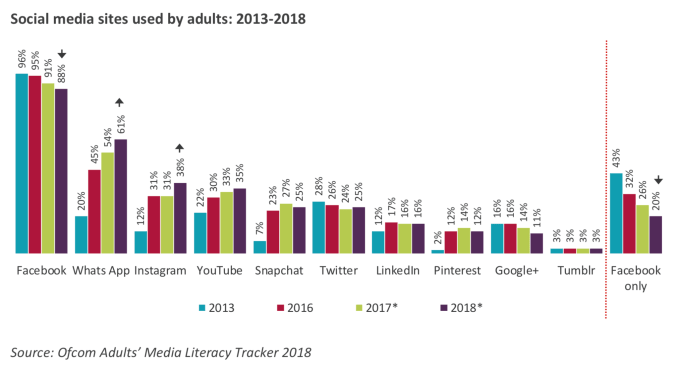
As in previous years of Ofcom ‘state of the Internet’ reports, the Online Nation study also found that Facebook use still dominates the social media landscape in the UK.
Though use of the eponymous service continues falling (from 95% of social media users in 2016 to 88% in 2018). Even as use of other Facebook-owned social properties — Instagram and WhatsApp — grew over the same period.
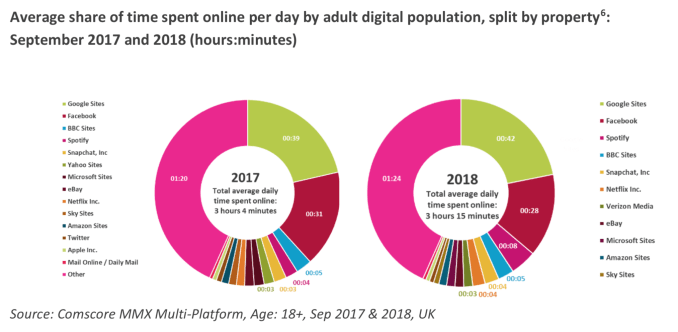
The report also recorded an increase in people using multiple social services — with just a fifth of social media users only using Facebook in 2018 (down from 32% in 2018). Though as noted above, Facebook still dominates time spent, clocking up way more time (~23 minutes) per user per day on average vs Snapchat (around nine minutes) and Instagram (five minutes).
A large majority (74%) of Facebook users also still check it at least once a day.
Overall, the report found that Brits have a varied online diet, though — on average spending a minute or more each day on 15 different internet sites and apps. Even as online ad revenues are not so equally distributed.
“Sites and apps that were not among the top 40 sites ranked by time spent accounted for 43% of average daily consumption,” the report notes. “Just over one in five internet users said that in the past month they had used ‘lots of websites or apps they’ve used before’ while a third (36%) said they ‘only use websites or apps they’ve used before’.”
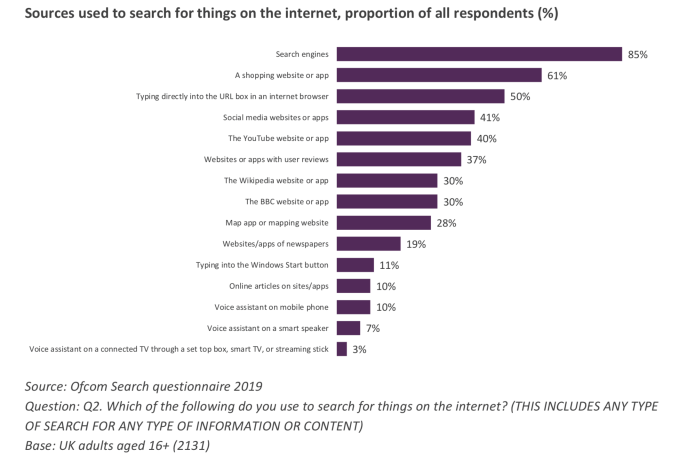
There is also variety when it comes to how Brits search for stuff online, and while 97% of adult internet users still use search engines the report found a variety of other services also in the mix.
It found that nearly two-thirds of people (65%) go more often to specific sites to find specific things, such as a news site for news stories or a video site for videos; while 30% of respondents said they used to have a search engine as their home page but no longer do.
The high proportion of searches being registered on shopping websites/apps (61%) also looks interesting in light of the 2017 EU antitrust ruling against Google Shopping — when the European Commission found Google had demoted rival shopping comparison services in search results, while promoting its own, thereby undermining rivals’ ability to gain traffic and brand recognition.
The report findings also indicate that use of voice-based search interfaces remains relatively low in the UK, with just 10% using voice assistants on a mobile phone — and even smaller percentages tapping into smart speakers (7%) or voice AIs on connected TVs (3%).
In another finding, the report suggests recommendation engines play a major part in content discovery.
“Recommendation engines are a key way for platforms to help people discover content and products — 70% of viewing to YouTube is reportedly driven by recommendations, while 35% of what consumers purchase on Amazon comes from recommendations,” it writes.
In overarching aggregate, the report says UK adults now spend the equivalent of almost 50 days online per year.
While, each week, 44 million Brits use the internet to send or receive email; 29 million send instant messages; 30 million bank or pay bills via the internet; 27 million shop online; and 21 million people download information for work, school or university.
The full report can be found here.

from Social – TechCrunch https://tcrn.ch/2W3Yz4y
Original Content From: https://techcrunch.com
Tech Solutions -Pakistan need quick fixes to break 10-match rut
At a ground where England made 481 not too long ago, their task will be cut out against West Indies
from Pakistan news from ESPN Cricinfo.com https://es.pn/2WbiXWt
Original Content From : https://es.pn/Ti8aBD
from Pakistan news from ESPN Cricinfo.com https://es.pn/2WbiXWt
Original Content From : https://es.pn/Ti8aBD
Technical Solutions - Xiaomi AirDots Pro Unboxing & First Look - Saste waale AirPods🔥🔥🔥
Xiaomi AirDots Pro Unboxing & First Look - Saste waale AirPods🔥🔥🔥
Namaskaar Dosto, is video mein maine aapse baat ki hai Xiaomi ke Mi AirDots Pro Wireless Earphones ke baare mein jo Xiaomi ne China mein launch kiye hue hai, price hai 399 Yuan aur yeh almost ek copy hai Apple Airpods ki jaha design bahut ajeeb hai lekin features ke maamle mein kaafi acche hai, in fact isme Active Noise Cancellation bhi hai. Mujhe umeed hai ki aapko Mi AirDots Pro ki yeh video pasand aayegi. Share, Support, Subscribe!!! Subscribe: http://bit.ly/1Wfsvt4 Android App: http://bit.ly/2mrm9Gy Youtube: http://www.youtube.com/c/TechnicalGuruji Twitter: http://www.twitter.com/technicalguruji Facebook: http://bit.ly/1Pi5LDP Facebook Myself: https://goo.gl/zUfbUU Instagram: http://bit.ly/1OW2vue Google Plus: http://bit.ly/1Pi5LDS Website: http://bit.ly/2mcM6KV Merchandise: http://bit.ly/2lN4Vbu About : Technical Guruji is a YouTube Channel, where you will find technological videos in Hindi, New Video is Posted Everyday :)
Namaskaar Dosto, is video mein maine aapse baat ki hai Xiaomi ke Mi AirDots Pro Wireless Earphones ke baare mein jo Xiaomi ne China mein launch kiye hue hai, price hai 399 Yuan aur yeh almost ek copy hai Apple Airpods ki jaha design bahut ajeeb hai lekin features ke maamle mein kaafi acche hai, in fact isme Active Noise Cancellation bhi hai. Mujhe umeed hai ki aapko Mi AirDots Pro ki yeh video pasand aayegi. Share, Support, Subscribe!!! Subscribe: http://bit.ly/1Wfsvt4 Android App: http://bit.ly/2mrm9Gy Youtube: http://www.youtube.com/c/TechnicalGuruji Twitter: http://www.twitter.com/technicalguruji Facebook: http://bit.ly/1Pi5LDP Facebook Myself: https://goo.gl/zUfbUU Instagram: http://bit.ly/1OW2vue Google Plus: http://bit.ly/1Pi5LDS Website: http://bit.ly/2mcM6KV Merchandise: http://bit.ly/2lN4Vbu About : Technical Guruji is a YouTube Channel, where you will find technological videos in Hindi, New Video is Posted Everyday :)
TECH Solutions - 5G: EE launches UK's next-generation mobile network
BT's EE switches on its next-generation 5G mobile network with a Stormzy gig.
from BBC News - Technology https://bbc.in/2EJrNjp
Original Content From: http://bbci.co.uk
from BBC News - Technology https://bbc.in/2EJrNjp
Original Content From: http://bbci.co.uk
TECH Solutions - Veterans mark code-breaking machine's 75th anniversary
Colossus, the world's first programmable computer, is credited with shortening World War Two.
from BBC News - Technology https://bbc.in/2Kd40Mv
Original Content From: http://bbci.co.uk
from BBC News - Technology https://bbc.in/2Kd40Mv
Original Content From: http://bbci.co.uk
Wednesday, May 29, 2019
TECH Solutions - Online usage grows, but so do social media concerns - Ofcom study
Most people say the internet improves their lives, but 70% would support tougher social media laws.
from BBC News - Technology https://bbc.in/2XdOR0V
Original Content From: http://bbci.co.uk
from BBC News - Technology https://bbc.in/2XdOR0V
Original Content From: http://bbci.co.uk
TECH Solutions - Tech gives drone the ability to avoid mid-air crashes
The system allows the drone to alter its flight path and move away from obstacles flying towards it.
from BBC News - Technology https://bbc.in/2VVduy4
Original Content From: http://bbci.co.uk
from BBC News - Technology https://bbc.in/2VVduy4
Original Content From: http://bbci.co.uk
TECH Solutions - 5G: Finally, it's here in the UK - but so what?
A brief guide to what 5G offers today and how it should improve over the years to come.
from BBC News - Technology https://bbc.in/2wsTfO4
Original Content From: http://bbci.co.uk
from BBC News - Technology https://bbc.in/2wsTfO4
Original Content From: http://bbci.co.uk
TECH Solutions - Facebook's Mark Zuckerberg to face leadership vote
Some shareholders want Facebook's chairman and chief executive to step down from one of his roles.
from BBC News - Technology https://bbc.in/2QzA6mt
Original Content From: http://bbci.co.uk
from BBC News - Technology https://bbc.in/2QzA6mt
Original Content From: http://bbci.co.uk
TECH Solutions - Roblox: 'I thought he was playing an innocent game'
Online multiplayer game Roblox is marketed at children - but there are fears it also being used for grooming.
from BBC News - Technology https://bbc.in/2wrqktt
Original Content From: http://bbci.co.uk
from BBC News - Technology https://bbc.in/2wrqktt
Original Content From: http://bbci.co.uk
TECH Solutions - UK parking space data offered up to app developers
New standards for data on parking spaces could revolutionise how drivers find and pay for parking.
from BBC News - Technology https://bbc.in/2Qu3x9y
Original Content From: http://bbci.co.uk
from BBC News - Technology https://bbc.in/2Qu3x9y
Original Content From: http://bbci.co.uk
Daily Crunch: Uber will deactivate low-rated riders
The Daily Crunch is TechCrunch’s roundup of our biggest and most important stories. If you’d like to get this delivered to your inbox every day at around 9am Pacific, you can subscribe here.
1. Uber will start deactivating riders with low ratings
Uber drivers have been able to rate their passengers before this, but those passengers were never really at risk of deactivation — until now. In a blog post, Uber’s Kate Parker said that while only “a small number of riders” should be affected, “it’s the right thing to do.”
The company isn’t announcing a specific rating cutoff. Instead, it says it will deactivate users who fall significantly below a city’s average, after “several notifications and opportunities to improve his or her rating.”
2. Huawei files motion to challenge sweeping US ban, calling it ‘not normal’
The Chinese hardware giant has filed a motion for summary judgement that questions the constitutionality of the section of the National Defense Authorization Act that the Trump administration used to halt imports.
3. Flipboard hacks prompt password resets for millions of users
Hackers stole usernames, email addresses, passwords and account tokens for third-party services. According to Flipboard, “not all” users’ account data were involved in the breaches, but the company declined to say how many users were affected.

4. Amazon just launched a $90, 5.5-inch Echo Show
The Echo Show 5 (that’s “five” for inches) doesn’t replace any existing Amazon smart screen, even though the price point will no doubt make many think twice about the $130 Spot.
5. Talkspace picks up $50 million Series D
Talkspace launched back in 2012 with a mission to make therapy accessible to as many people as possible. The platform allows users to pay a subscription fee for unlimited messaging with one of the company’s 5,000 healthcare professionals.
6. NYC subway riders will be able to swipe in with Apple Pay starting Friday
Apple Pay is hitting select subway stations this Friday, May 31. New Yorkers will then be able to swipe their iPhones or Apple Watches to catch a ride.
7. Q&A with J Crowley, Head of Product at Airbnb Lux, on what makes a great PM
Crowley has run product at three big-name companies: Foursquare/Swarm, Blue Apron and now Airbnb. (Extra Crunch membership required.)



from Mobile – TechCrunch https://tcrn.ch/2YVEqiV
ORIGINAL CONTENT FROM: https://techcrunch.com/
Tech Solutions -World Cup 2019 opening party - live
Get in the World Cup mood with updates from the tournament opening party on the Mall
from Pakistan news from ESPN Cricinfo.com https://es.pn/2YSkUE4
Original Content From : https://es.pn/Ti8aBD
from Pakistan news from ESPN Cricinfo.com https://es.pn/2YSkUE4
Original Content From : https://es.pn/Ti8aBD
Technical Solutions - Tech Talks #828 - Realme X India Launch, MediaTek 5G, Folding iPhones, YouTube Student Discount
Tech Talks #828 - Realme X India Launch, MediaTek 5G, Folding iPhones, YouTube Student Discount
TG Deals@ https://tg.deals/ New Channel: https://goo.gl/Jz6p5K Namaskaar Dosto, Tech Talks ke is Episode mein maine aapse kuch interesting Tech News Share ki hai jaise Realme X India Launch, MediaTek 5G Chipset, Folding iPhones Patent, YouTube Student Discount for YouTube Music and YouTube Premium, Galaxy M40 Details, Bamboo Drone aur bahut kuch. Mujhe umeed hai ki yeh video aapko pasand aayega. Share, Support, Subscribe!!! Subscribe: http://bit.ly/1Wfsvt4 Android App: http://bit.ly/2mrm9Gy Youtube: http://www.youtube.com/c/TechnicalGuruji Twitter: http://www.twitter.com/technicalguruji Facebook: http://bit.ly/1Pi5LDP Facebook Myself: https://goo.gl/zUfbUU Instagram: http://bit.ly/1OW2vue Google Plus: http://bit.ly/1Pi5LDS Website: http://bit.ly/2mcM6KV Merchandise: http://bit.ly/2lN4Vbu About : Technical Guruji is a YouTube Channel, where you will find technological videos in Hindi, New Video is Posted Everyday :)
TG Deals@ https://tg.deals/ New Channel: https://goo.gl/Jz6p5K Namaskaar Dosto, Tech Talks ke is Episode mein maine aapse kuch interesting Tech News Share ki hai jaise Realme X India Launch, MediaTek 5G Chipset, Folding iPhones Patent, YouTube Student Discount for YouTube Music and YouTube Premium, Galaxy M40 Details, Bamboo Drone aur bahut kuch. Mujhe umeed hai ki yeh video aapko pasand aayega. Share, Support, Subscribe!!! Subscribe: http://bit.ly/1Wfsvt4 Android App: http://bit.ly/2mrm9Gy Youtube: http://www.youtube.com/c/TechnicalGuruji Twitter: http://www.twitter.com/technicalguruji Facebook: http://bit.ly/1Pi5LDP Facebook Myself: https://goo.gl/zUfbUU Instagram: http://bit.ly/1OW2vue Google Plus: http://bit.ly/1Pi5LDS Website: http://bit.ly/2mcM6KV Merchandise: http://bit.ly/2lN4Vbu About : Technical Guruji is a YouTube Channel, where you will find technological videos in Hindi, New Video is Posted Everyday :)
UK’s first 5G network taster goes live in six cities tomorrow
The UK’s first 5G consumer mobile network is launching tomorrow in six cities.
Mobile network operator EE will switch on the next-gen cellular connectivity in select locations in London, Cardiff, Edinburgh, Belfast, Birmingham and Manchester — promising “increased speeds, reliability and connectivity”. Though of course consumers will also need to have a 5G handset and 5G price plan, as well as being in the right location, to see any of the touted benefits.
EE says it expects customers to experience an increase in speeds of around 100-150Mbps when using the 5G network — “even in the busiest areas” where network coverage extends.
“Some customers will break the one gigabit-per-second milestone on their 5G smartphones,” it adds.
Ten other UK cities are set to get a taste of EE’s 5G later by the end of this year, also in select, busier parts — namely Glasgow, Newcastle, Liverpool, Leeds, Hull, Sheffield, Nottingham, Leicester, Coventry and Bristol — with more cities planned to come on stream in 2020.
While rival mobile operator Vodafone has said it will began its own rollout of a 5G network in July.
Among the advantages for 5G that EE is pushing on its website to try to persuade users to upgrade are better connections in busy places (such as festivals or stadiums); faster download speeds to support movie downloads and higher quality video streaming; and a gamer-friendly lack of lag — which it bills as “almost instant Internet connection”.
Whether those additions will convince masses of mobile users to shell out for an EE 5G device plan — which start at £53 per month — remains to be seen.
Earlier this month the network operator, which is owned by BT, launched its first 5G Sim-only handset plans, and began ranging 5G handsets — from the likes of Samsung, LG, OnePlus and Oppo.
Though not from Huawei. Last week it told the BBC it would pause on offering any 5G smartphones made by Chinese device maker Huawei — saying it wanted to “make sure we can carry out the right level of testing and quality assurance” for its customers.
Huawei remains subject to a US executive order intended to dissuade US companies from doing business with it on national security grounds. And Google has been reported to have taken a decision to withdrawn some Android-related services from Huawei — raising question-marks about the future quality of its smartphones. (The Chinese company’s involvement in building out core UK 5G networks is also subject to restriction, with the government reportedly intending to impose limits.)
EE says the 5G network it’s launching tomorrow is an additional layer on top of its existing 4G network — dubbing it “phase 1”. So this switch on is really a toe in the water. Or, well, a marketing opportunity to claim a 5G first.
It describes it as a “non-standalone” deployment, saying it’s combining 4G and 5G to “give customers the fastest, most reliable mobile broadband experience they’ve ever had” — planning to upgrade more than 100 cell sites to 5G per month, as it builds out 5G coverage. It will also expand its 4G coverage into rural areas and add more capacity to 4G sites — as 4G will remain the fall-back option for years to come (if not indefinitely).
Phase 2 of EE’s 5G rollout, from 2022, will introduce the “full next generation 5G core network, enhanced device chipset capabilities, and increased availability of 5G-ready spectrum”.
“Higher bandwidth and lower latency, coupled with expansive and growing 5G coverage, will enable a more responsive network, enabling truly immersive mobile augmented reality, real-time health monitoring, and mobile cloud gaming,” EE adds.
A third phase of the 5G rollout, from 2023, is slated to bring Ultra-Reliable Low Latency Communications, Network Slicing and multi-gigabit-per-second speeds.
“This phase of 5G will enable critical applications like real-time traffic management of fleets of autonomous vehicles, massive sensor networks with millions of devices measuring air quality across the entire country, and the ‘tactile internet’, where a sense of touch can be added to remote real-time interactions,” EE suggests.
As we’ve said before, there’s little call for consumers to rush to upgrade to a 5G handset, with network coverage the exception not the rule, even as building out the touted benefits will be a work of years.


from Mobile – TechCrunch https://tcrn.ch/2Wx2Z8o
ORIGINAL CONTENT FROM: https://techcrunch.com/
TECH Solutions - 'Demo' found written on South Sudan in Google Maps
The word is inexplicably spelled out in territory in the south east of the central African nation.
from BBC News - Technology https://bbc.in/2JLnkky
Original Content From: http://bbci.co.uk
from BBC News - Technology https://bbc.in/2JLnkky
Original Content From: http://bbci.co.uk
Following FTC complaint, Google rolls out new policies around kids’ apps on Google Play
Google announced this morning a new set of developer policies aimed at providing additional protections for children and families seeking out kid-friendly apps on Google Play. The new policies require that developers ensure their apps are meeting all the necessary policy and regulatory requirements for apps that target children in terms of their content, ads, and how they handle personally identifiable information.
For starters, developers are being asked to consider whether children are a part of their target audience — and, if they’re not, developers must ensure their app doesn’t unintentionally appeal to them. Google says it will now also double-check an app’s marketing to confirm this is the case and ask for changes, as needed.
Apps that do target children have to meet the policy requirements concerning content and handling of personally identifiable information. This shouldn’t be new to developers playing by the rules, as Google has had policies around “kid-safe” apps for years as part of its “Designed for Families” program, and countries have their own regulations to follow when it comes to collecting children’s data.
In addition, developers whose apps are targeting children must only serve ads from an ads network that has certified compliance with Google’s families policies.
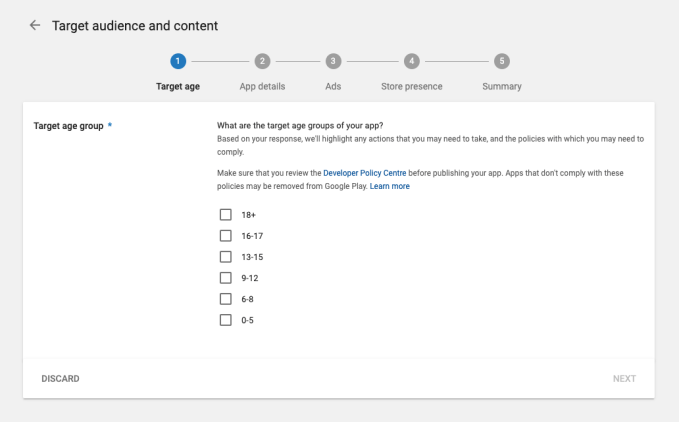
To enforce these policies at scale, Google is now requiring all developers to complete the new target audience and content section of the Google Play Console. Here, they will have to specify more details about their app. If they say that children are targeted, they’ll be directed to the appropriate policies.
Google will use this information, alongside its review of the app’s marketing materials, in order to categorize apps and apply policies across three target groups: children, children and older users, and older users. (And because the definition of “children” may vary by country, developers will need to determine what age-based restrictions apply in the countries where their app is listed.)
Developers have to comply with the process of filling out the information on Google Play and come into compliance with the updated policies by September 1, 2019.
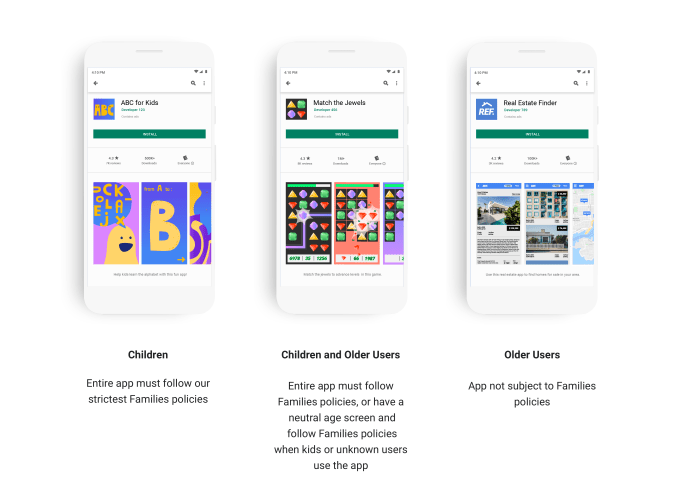
The company says it’s committed to providing “a safe, positive environment” for kids and families, which is why it’s announcing these changes.
However, the changes are more likely inspired by an FTC complaint filed in December, in which a coalition of 22 consumer and public health advocacy groups, led by Campaign for a Commercial-Free Childhood (CCFC) and Center for Digital Democracy (CDD), asked for an investigation of kids’ apps on Google Play.
The organizations claimed that Google was not verifying apps and games featured in the Family section of Google Play for compliance with U.S. children’s privacy law COPPA.
They also said many so-called “kids” apps exhibited bad behaviors — like showing ads that are difficult to exit or showing those that require viewing in order to continue the current game. Some apps pressured kids into making in-app purchases, and others were found serving ads for alcohol and gambling. And others, still, were found to model harmful behavior or contain graphic, sexualized images, the groups warned regulators.
The time when violations like these can slip through the cracks is long past, thanks to increased regulatory oversight across the online industry by way of laws like the EU’s GDPR, which focuses on data protection and privacy. The FTC is also more keen to act, as needed — it even recently doled out a record fine for TikTok for violating COPPA.
The target audience and content section are live today in the Google Play Console, along with documentation on the new policies, a developer guide, and online training. In addition, Google says it has also increased its staffing and improved its communications for the Google Play app review and appeals processes in order to help developers get timely decisions and understand any changes they’re directed to make.


from Mobile – TechCrunch https://tcrn.ch/2ERZWhh
ORIGINAL CONTENT FROM: https://techcrunch.com/
Under-the-radar payments app True Balance just clocked $100M in GMV in India
Away from the limelight of urban cities, where an increasingly growing number of firms are fighting for a piece of India’s digital payments market, a South Korean startup’s app is quietly helping millions of Indians pay digitally and enjoy many financial services for the first time.
The app, called True Balance, began its life as a tool to help users easily find their mobile balance, or topping up pre-pay mobile credit. But in its four years journey, its ambition has significantly grown beyond that. Today, it serves as a digital wallet app that helps users pay their mobile and electricity bills, and it also lets users pay later.
One thing that has not changed for the parent company of True Balance, BalanceHero, which employs under 200 people, is its consumer focus. It is strictly catering to people in tier two and tier three markets — often dubbed as India 2 and India 3 — who have relatively limited access to the internet, and lower financial power. And it remains operational just in India.
Even as India is already the second largest internet market with more than 500 million users, more than half of its popular remains offline. In recent years, the nation has become a battleground for Silicon Valley giants and Chinese firms that are increasingly trying to win existing users and bring the rest of the population online.
And like many other companies, BalanceHero’s bet on India is beginning to pay off. The startup told TechCrunch today that it has clocked $100 million in GMV sales and has amassed about 60 million registered users. Yongsung Yoo, a spokesperson for the startup, added that BalanceHero, which has raised $42 million to date, is also nearing profitability.
The South Korean firm’s playbook is different from many other players that are racing to claim a slice of India’s burgeoning digital payments market. True Balance competes with the likes of Paytm, MobiKwik, Google, Amazon, and Walmart-owned Flipkart, though its competitors are still largely catering to the urban parts of India.
In the last two years, many firms have begun to explore smaller cities and towns, but their services are still too out-of-the-world for local residents. Raising awareness about digital services is a big challenge in such markets, Yoo said, so the startup is relying on existing users to help others make their first transactions and in paying bills.
Yoo said the startup rewards these “digital agents” with cashback and other benefits. For these digital agents, many of whom do not have a day job, True Balance has emerged as a side project to make extra money.
Later this year, Yoo said the startup, which recently also added support for UPI in its service, will open an e-commerce store on its app and also offer insurance to users. To accelerate its growth and expansion, True Balance is in final stages of raising between $50 million to $70 million in a new round that it expects to close in July this year, Yoo said.


from Mobile – TechCrunch https://tcrn.ch/2Mfk9n0
ORIGINAL CONTENT FROM: https://techcrunch.com/
ASUS leans into dual-screen laptops with the ZenBook Pro Duo, featuring two 4K touchscreen displays
Last year during Computex, ASUS introduced the ZenBook Pro 14 and 15, with a touchscreen in place of a regular touchpad. This year in Taipei, it took the concept of a built-in second screen and went much further with it, unveiling new versions of the ZenBook with even larger second screens. Instead of just replacing the touchpad, the 14-inch second screen on the new ZenBook Pro Duo extend all the way across the device above the keyboard, acting as both an extension and companion to the main 4K OLED 15.6-inch display.
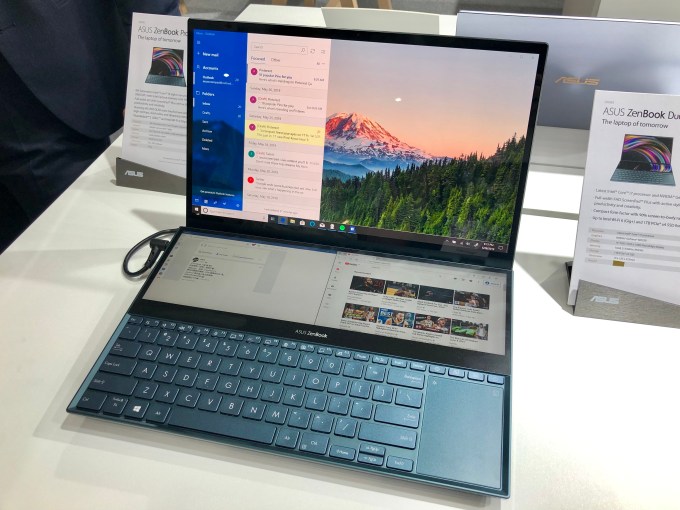
The touchpad-replacement on last year’s ZenBook Pros seemed like a novelty, with the bonus of giving you a small, extra screen for messaging apps, videos and simple utility apps like a calculator. The much larger size of the second screen on the ZenBook Pro Duo, however, enables many new possibilities. Both of its screens are touchscreens and moving apps between the windows with your finger takes a little bit of getting used to, but it is simple and intuitive (frequently-used apps can also be pinned).
During a demo, an ASUS employee showed me how it can support dual displays of maps: the larger screen giving you a bird’s eye view of the geography, while the second screen allows you to zone in on streets and locations. But the ZenBook Pro Duo’s main draw is multitasking, enabling you to monitor your email, send messages, watch videos, keep an eye on news headlines and other tasks while you use the main screen to for apps like Office 365 or video conferences.
Basically, the ASUS ZenBook Pro Duo 14 is designed to anyone who likes using a second monitor (or is tired of propping up their phone or tablet as an improvised second screen), but also wants a PC with more portability. At 2.5kg, the ZenBook Pro Duo is not the lightest laptop around, but still reasonably lightweight considering its specs and two screens.

Its Intel Core i9 HK processor and Nvidia RTX 20
60 ensures that both screens run smoothly, even with multiple tabs and apps open. ASUS also partnered with Harman/Kardon for its speakers, which means sound quality should be better than average. A smaller version, the ZenBook Duo, is also available, with Core i7 and a GeForce MX 250 and HD instead of 4K on both its displays.
ASUS hasn’t announced pricing and availability yet.


from Mobile – TechCrunch https://tcrn.ch/2wrMRGB
ORIGINAL CONTENT FROM: https://techcrunch.com/