Five UK broadband and landline providers will now compensate users when services do not work.
from BBC News - Technology https://ift.tt/2TOILl2
Original Content From: http://bbci.co.uk

This Blog is created to share Technical Solutions for public interest. The Content is related with IT solutions, SEO tips, Online Earning, online marketing, website developement, CSS, java, C++, python, C sharp Languages.
Sunday, March 31, 2019
Technical Solutions - #118 Sunday Tech Masala - Mumbai se Live.. #BoloGuruji
#118 Sunday Tech Masala - Mumbai se Live.. #BoloGuruji
Namaskaar Dosto, yeh ek live video hai Sunday Tech Masala ke ek naye episode ka jaha maine aapse live baatein ki hai aur aapke sawaalo ke jawab dene ki koshish ki hai. Mujhe umeed hai ki aapko yeh video pasand aayegi. Share, Support, Subscribe!!! Subscribe: http://bit.ly/1Wfsvt4 Android App: https://ift.tt/2mrm9Gy Youtube: http://www.youtube.com/c/TechnicalGuruji Twitter: http://www.twitter.com/technicalguruji Facebook: https://ift.tt/1Pi5LDP Facebook Myself: https://goo.gl/zUfbUU Instagram: https://ift.tt/1OW2vue Google Plus: https://ift.tt/1Pi5LDS Website: https://ift.tt/2mcM6KV Merchandise: https://ift.tt/2lN4Vbu About : Technical Guruji is a YouTube Channel, where you will find technological videos in Hindi, New Video is Posted Everyday :)
Namaskaar Dosto, yeh ek live video hai Sunday Tech Masala ke ek naye episode ka jaha maine aapse live baatein ki hai aur aapke sawaalo ke jawab dene ki koshish ki hai. Mujhe umeed hai ki aapko yeh video pasand aayegi. Share, Support, Subscribe!!! Subscribe: http://bit.ly/1Wfsvt4 Android App: https://ift.tt/2mrm9Gy Youtube: http://www.youtube.com/c/TechnicalGuruji Twitter: http://www.twitter.com/technicalguruji Facebook: https://ift.tt/1Pi5LDP Facebook Myself: https://goo.gl/zUfbUU Instagram: https://ift.tt/1OW2vue Google Plus: https://ift.tt/1Pi5LDS Website: https://ift.tt/2mcM6KV Merchandise: https://ift.tt/2lN4Vbu About : Technical Guruji is a YouTube Channel, where you will find technological videos in Hindi, New Video is Posted Everyday :)
TECH Solutions - Pakistan Army Launched Amazing New Game || The Glorious Resolve - Must Watch
Pakistan Army Launched Amazing New Game || The Glorious Resolve - Must Watch
Hi Friends: This is my Blog Technical Solutions created to share videos and content of technical solutions with the world. At this blog you can find videos about Free Search Engine Optimization Course, how to develope Android Applications and What is Computer hardware and software, you would be able to increse your channel views, or boost your website. so guys keep visiting my blog for learning technical things. Thank You!
Hi Friends: This is my Blog Technical Solutions created to share videos and content of technical solutions with the world. At this blog you can find videos about Free Search Engine Optimization Course, how to develope Android Applications and What is Computer hardware and software, you would be able to increse your channel views, or boost your website. so guys keep visiting my blog for learning technical things. Thank You!
Tech Solutions -Abbas returns in Pakistan's quest for consolation win
Australia also made one change with Jason Behrendorff replacing Nathan Coulter-Nile
from Pakistan news from ESPN Cricinfo.com https://ift.tt/2Vf5Qig
Original Content From : https://ift.tt/Ti8aBD
from Pakistan news from ESPN Cricinfo.com https://ift.tt/2Vf5Qig
Original Content From : https://ift.tt/Ti8aBD
TECH Solutions - Saudi Arabia 'hacked Amazon boss's phone', says investigator
An investigator working for Jeff Bezos says Saudi Arabia accessed data on the Amazon boss's phone.
from BBC News - Technology https://ift.tt/2JT8IAx
Original Content From: http://bbci.co.uk
from BBC News - Technology https://ift.tt/2JT8IAx
Original Content From: http://bbci.co.uk
Saturday, March 30, 2019
TECH Solutions - Mark Zuckerberg asks governments to help control internet content
Mark Zuckerberg writes an open letter calling for new laws to monitor internet content.
from BBC News - Technology https://ift.tt/2WF2qGd
Original Content From: http://bbci.co.uk
from BBC News - Technology https://ift.tt/2WF2qGd
Original Content From: http://bbci.co.uk
TECH Solutions - Mark Zuckerberg actually calls for regulation of content, elections, privacy
It’s been a busy day for Facebook exec op-eds. Earlier this morning, Sheryl Sandberg broke the site’s silence around the Christchurch massacre, and now Mark Zuckerberg is calling on governments and other bodies to increase regulation around the sorts of data Facebook traffics in. He’s hoping to get out in front of heavy-handed regulation and get a seat at the table shaping it.
The founder published a letter simultaneously on his own page and The Washington Post, the latter of which is an ideal way to get your sentiments on every desk inside the beltway. In the wake a couple of years that have come with black eyes and growing pains, Zuckerberg notes that if he had it to do over again, he’d ask for increased external scrutiny in four key areas:
- Harmful content – He wants overarching rules and benchmarks social apps can be measured by
- Election integrity – He wants clear government definitions of what constitutes a political or issue ad
- Privacy – He wants GDPR-style regulations globally that can impose sanctions on violators
- Data portability – He wants users to be able to bring their info from one app to another
The story of why the letter breaks down each doubles as kind of recent history of the social network. Struggles and missteps have defined much of Facebook’s last few years, with several controversies often swirling around the social network at once. Not every CEO gets asked to testify in front of Congress. Facebook houses and controls an incredible collection of data, playing a key role in everything from ad targeting and interpersonal relationships to news cycles and elections.
“Lawmakers often tell me we have too much power over speech, and frankly I agree,” Zuckerberg writes, three days after issuing a blanket ban on “white nationalism” and “white separatism.” He goes on to describe the company’s work with various governments, along with its development of independent oversight committee, before anyone can accuse the company of completely passing the buck.
“One idea is for third-party bodies to set standards governing the distribution of harmful content and to measure companies against those standards,” Zuckerberg writes, “Regulation could set baselines for what’s prohibited and require companies to build systems for keeping harmful content to a bare minimum.”
Zuckerberg goes on to encourage increased legislation around election tampering and political advertisements. Notably, the U.S. Department of Housing and Urban Development hit Facebook earlier this week with charges that its targeted ads violate the Fair Housing Act.
The op-ed rings somewhat hollow, though, because there’s plenty that Facebook could do to improve in these four areas without help from the government.
Facebook’s harmful content policies have long been confusing, inconsistent, and isolated. For example, Infowars conspiracy theorist Alex Jones was removed from Facebook but not from Instagram. Meanwhile, bad actors can just hop between social networks to spread problematic posts. Facebook should apply enforcement of its policies across its whole family of apps, publicly work through its logic for why it does or doesn’t remove things instead of having those discussions leak, and cooperate better with fellow social networks to coordinate blanket takedowns of the worst offenders.
As for election integrity, Facebook made a big advance this week by placing all active and old inactive political ad campaigns into keyword-searchable Ad Library. But after pressure from news publishers who didn’t want their ads promoting politicized articles to be included beside traditional campaign ads, Facebook exempted them. Those ads can still influence the electorate, and while they should be classified separately, they should still be archived for research.
On privacy, well, there’s a ton to be done. One major area where it could improve is allowing people to more completely opt out of search, including by their phone number, to avoid stalkers. And better controls should be available for how Facebook uses your contact info when uploaded in the address books of other users.
Finally, with data portability, Facebook has been dragging its feet. A year ago, we published a deep dive into how Facebook only lets you export your social graph as a list of friends’ names which can’t be easily used to find them on other social networks. Facebook must make its social graph truely interoperable so users don’t lose their community if they switch apps. That would coerce Facebook to treat users better since leaving would actually be a viable option.
Taking these steps would show regulators that Zuckerberg isn’t just paying lip service in hopes of getting a more lenient sentence. It would demonstrate he’s ready to make change that serves society.

from Social – TechCrunch https://ift.tt/2I0IsBy
Original Content From: https://techcrunch.com
Technical Solutions - Tech Talks #777 - #YTFF, OnePlus Car, Earn 13Lakh in 60 Days, Oppo Reno, MIUI 11, PUBG 0.12.0
Tech Talks #777 - #YTFF, OnePlus Car, Earn 13Lakh in 60 Days, Oppo Reno, MIUI 11, PUBG 0.12.0
TG Deals@ https://tg.deals/ New Channel: https://goo.gl/Jz6p5K Namaskaar Dosto, Tech Talks ke is Episode mein maine aapse kuch interesting Tech News Share ki hai jaise #YTFF, OnePlus Car, Earn 13Lakh in 60 Days, Oppo Reno, MIUI 11, PUBG 0. 12.0, NASA Mars Helicopter, Instagram Update aur bahut kuch. Mujhe umeed hai ki yeh video aapko pasand aayega. Share, Support, Subscribe!!! Subscribe: http://bit.ly/1Wfsvt4 Android App: https://ift.tt/2mrm9Gy Youtube: http://www.youtube.com/c/TechnicalGuruji Twitter: http://www.twitter.com/technicalguruji Facebook: https://ift.tt/1Pi5LDP Facebook Myself: https://goo.gl/zUfbUU Instagram: https://ift.tt/1OW2vue Google Plus: https://ift.tt/1Pi5LDS Website: https://ift.tt/2mcM6KV Merchandise: https://ift.tt/2lN4Vbu About : Technical Guruji is a YouTube Channel, where you will find technological videos in Hindi, New Video is Posted Everyday :)
TG Deals@ https://tg.deals/ New Channel: https://goo.gl/Jz6p5K Namaskaar Dosto, Tech Talks ke is Episode mein maine aapse kuch interesting Tech News Share ki hai jaise #YTFF, OnePlus Car, Earn 13Lakh in 60 Days, Oppo Reno, MIUI 11, PUBG 0. 12.0, NASA Mars Helicopter, Instagram Update aur bahut kuch. Mujhe umeed hai ki yeh video aapko pasand aayega. Share, Support, Subscribe!!! Subscribe: http://bit.ly/1Wfsvt4 Android App: https://ift.tt/2mrm9Gy Youtube: http://www.youtube.com/c/TechnicalGuruji Twitter: http://www.twitter.com/technicalguruji Facebook: https://ift.tt/1Pi5LDP Facebook Myself: https://goo.gl/zUfbUU Instagram: https://ift.tt/1OW2vue Google Plus: https://ift.tt/1Pi5LDS Website: https://ift.tt/2mcM6KV Merchandise: https://ift.tt/2lN4Vbu About : Technical Guruji is a YouTube Channel, where you will find technological videos in Hindi, New Video is Posted Everyday :)
Tech Solutions -Can Australia sign off Asian leg with whitewash?
Can an improved Pakistan showing in the fourth game galvanise them sufficiently to stave off another whitewash?
from Pakistan news from ESPN Cricinfo.com https://ift.tt/2uyneD7
Original Content From : https://ift.tt/Ti8aBD
from Pakistan news from ESPN Cricinfo.com https://ift.tt/2uyneD7
Original Content From : https://ift.tt/Ti8aBD
Technical Solutions - Apple AirPower Is No More? How and Why?
Apple AirPower Is No More? How and Why?
Namaskaar Dosto, is video mein maine aapse baat ki hai Apple AirPower ke baare mein, uske announcement ke baare mein aur market mein aane se pehle hi cancel hone ke baare mein. Mujhe umeed hai ki aapko AirPower ke baare mein yeh video pasand aayegi. Share, Support, Subscribe!!! Subscribe: http://bit.ly/1Wfsvt4 Android App: https://ift.tt/2mrm9Gy Youtube: http://www.youtube.com/c/TechnicalGuruji Twitter: http://www.twitter.com/technicalguruji Facebook: https://ift.tt/1Pi5LDP Facebook Myself: https://goo.gl/zUfbUU Instagram: https://ift.tt/1OW2vue Google Plus: https://ift.tt/1Pi5LDS Website: https://ift.tt/2mcM6KV Merchandise: https://ift.tt/2lN4Vbu About : Technical Guruji is a YouTube Channel, where you will find technological videos in Hindi, New Video is Posted Everyday :)
Namaskaar Dosto, is video mein maine aapse baat ki hai Apple AirPower ke baare mein, uske announcement ke baare mein aur market mein aane se pehle hi cancel hone ke baare mein. Mujhe umeed hai ki aapko AirPower ke baare mein yeh video pasand aayegi. Share, Support, Subscribe!!! Subscribe: http://bit.ly/1Wfsvt4 Android App: https://ift.tt/2mrm9Gy Youtube: http://www.youtube.com/c/TechnicalGuruji Twitter: http://www.twitter.com/technicalguruji Facebook: https://ift.tt/1Pi5LDP Facebook Myself: https://goo.gl/zUfbUU Instagram: https://ift.tt/1OW2vue Google Plus: https://ift.tt/1Pi5LDS Website: https://ift.tt/2mcM6KV Merchandise: https://ift.tt/2lN4Vbu About : Technical Guruji is a YouTube Channel, where you will find technological videos in Hindi, New Video is Posted Everyday :)
Friday, March 29, 2019
TECH Solutions - Tech Tent: Apple, Lyft and feel-good tech
Lyft shares, Apple TV+, and those times when tech gets it right.
from BBC News - Technology https://ift.tt/2TIeXXh
Original Content From: http://bbci.co.uk
from BBC News - Technology https://ift.tt/2TIeXXh
Original Content From: http://bbci.co.uk
TECH Solutions - How YouTube Copyright claims and Takedowns System Works
How YouTube Copyright claims and Takedowns System Works
Hi Friends: This is my Blog Technical Solutions created to share videos and content of technical solutions with the world. At this blog you can find videos about Free Search Engine Optimization Course, how to develope Android Applications and What is Computer hardware and software, you would be able to increse your channel views, or boost your website. so guys keep visiting my blog for learning technical things. Thank You!
Hi Friends: This is my Blog Technical Solutions created to share videos and content of technical solutions with the world. At this blog you can find videos about Free Search Engine Optimization Course, how to develope Android Applications and What is Computer hardware and software, you would be able to increse your channel views, or boost your website. so guys keep visiting my blog for learning technical things. Thank You!
TECH Solutions - Russia police probe 'dark net' murder case
Investigators are looking into claims that a killing was arranged and paid for via covert net forums.
from BBC News - Technology https://ift.tt/2CI4aH6
Original Content From: http://bbci.co.uk
from BBC News - Technology https://ift.tt/2CI4aH6
Original Content From: http://bbci.co.uk
Tech Solutions - #816 25W Charging S10+, Oppo Reno, Vivo S1, Zenfone6, iPhone XI, Whatsapp Dark,
#816 25W Charging S10+, Oppo Reno, Vivo S1, Zenfone6, iPhone XI, Whatsapp Dark,
Hi Friends: This is my Blog Technical Solutions created to share videos and content of technical solutions with the world. At this blog you can find videos about Free Search Engine Optimization Course, how to develope Android Applications and What is Computer hardware and software, you would be able to increse your channel views, or boost your website. so guys keep visiting my blog for learning technical things. Thank You!
Hi Friends: This is my Blog Technical Solutions created to share videos and content of technical solutions with the world. At this blog you can find videos about Free Search Engine Optimization Course, how to develope Android Applications and What is Computer hardware and software, you would be able to increse your channel views, or boost your website. so guys keep visiting my blog for learning technical things. Thank You!
Technical Solutions - Tech Talks #776 Realme 3 Pro Leaks, Oppo New Patent, S10 25W Charging, Android Q, Jio Chatbot
Tech Talks #776 Realme 3 Pro Leaks, Oppo New Patent, S10 25W Charging, Android Q, Jio Chatbot
Namaskaar Dosto, Share, Support, Subscribe!!! Subscribe: http://bit.ly/1Wfsvt4 Android App: https://ift.tt/2mrm9Gy Youtube: http://www.youtube.com/c/TechnicalGuruji Twitter: http://www.twitter.com/technicalguruji Facebook: https://ift.tt/1Pi5LDP Facebook Myself: https://goo.gl/zUfbUU Instagram: https://ift.tt/1OW2vue Google Plus: https://ift.tt/1Pi5LDS Website: https://ift.tt/2mcM6KV Merchandise: https://ift.tt/2lN4Vbu About : Technical Guruji is a YouTube Channel, where you will find technological videos in Hindi, New Video is Posted Everyday :)
Namaskaar Dosto, Share, Support, Subscribe!!! Subscribe: http://bit.ly/1Wfsvt4 Android App: https://ift.tt/2mrm9Gy Youtube: http://www.youtube.com/c/TechnicalGuruji Twitter: http://www.twitter.com/technicalguruji Facebook: https://ift.tt/1Pi5LDP Facebook Myself: https://goo.gl/zUfbUU Instagram: https://ift.tt/1OW2vue Google Plus: https://ift.tt/1Pi5LDS Website: https://ift.tt/2mcM6KV Merchandise: https://ift.tt/2lN4Vbu About : Technical Guruji is a YouTube Channel, where you will find technological videos in Hindi, New Video is Posted Everyday :)
TECH Solutions - Snap CEO’s sister Caroline Spiegel starts a no-visuals porn site
If you took the photos and videos out of pornography, could it appeal to a new audience? Caroline Spiegel’s first startup Quinn aims to bring some imagination to adult entertainment. Her older brother, Snapchat CEO Evan Spiegel, spent years trying to convince people his app wasn’t just for sexy texting. Now Caroline is building a website dedicated to sexy text and audio. The 22-year-old college senior tells TechCrunch that on April 13th she’ll launch Quinn, which she describes as “a much less gross, more fun Pornhub for women”.
TechCrunch checked out Quinn’s private beta site, which is pretty bare bones right now. Caroline tells us she’s already raised under a million dollars for the project. But given her brother’s success spotting the next generation’s behavior patterns and turning them into beloved products, Caroline might find investors are eager to throw cash at Quinn. That’s especially true given she’s taking a contrarian approach. There will be no imagery on Quinn.

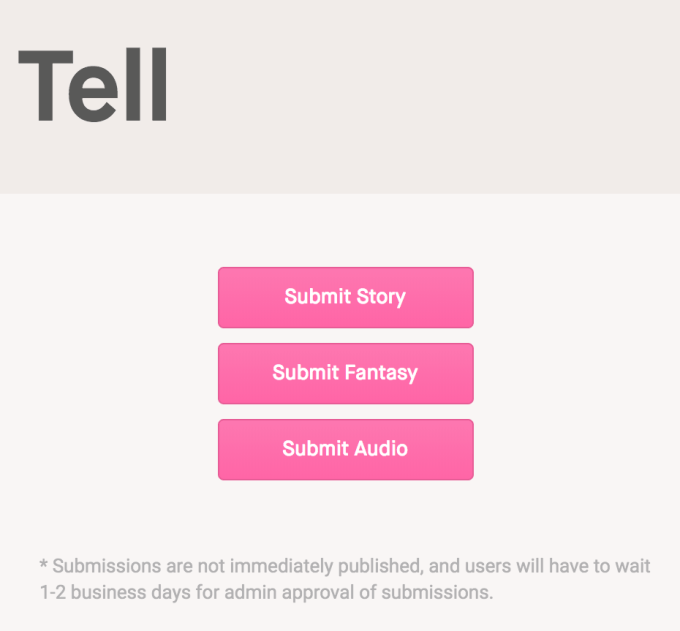
Caroline explains that “There’s no visual content on the site– just audio and written stories. And the whole thing is open source, so people can submit content and fantasies, etc. Everything is vetted by us before it goes on the site.” Caroline is building Quinn with a three-woman team of her best friends she met while at college at Stanford including Greta Meyer, though they plan to relocate to LA after graduation.
“His dream girl was named ‘Quinn'”
The idea for Quinn sprung from a deeply personal need. “I came up with it because I had to leave Stanford my junior year because i was struggling with anorexia and sexual dysfunction that came along with that” Caroline tells me. “I started to do a lot of research into sexual dysfunction cures. There are about 30 FDA-approved drugs for sexual dysfunction for men but zero for women and that’s a big bummer.”
She believes there’s still a stigma around women pleasuring themselves, leading to a lack of products offering assistance. Sure, there are plenty of porn sites but few are explicitly designed for women, and fewer stray outside of visual content. Caroline says photos and videos can create body image pressure, but with text and audio, anyone can imagine themselves in a scene. “Most visual media perpetuates the male gaze . . . all mainstream porn tells one story . . . You don’t have to fit one idea of what a woman should look like.”
That concept fits with the startup’s name “Quinn”, which Caroline says one of her best guy friends thought up. “He said this girl he met — his dream girl — was named ‘Quinn.'”
Caroline took to Reddit and Tumblr to find Quinn’s first creators. Reddit stuck to text and links for much of its history, fostering the kinky literature and audio communities. And when Tumblr banned porn in December, it left a legion of adult content makers looking for a new home. “Our audio ranges from guided masturbation to overheard sex, and there’s also married stories. It’s literally everything. Different strokes for different for folks, know what I mean?” Caroline says with a cheeky laugh.
To establish its brand, Quinn is running social media influencer campaigns where “The basic idea is to make people feel like it’s okay to experience pleasure. It’s hard to make something like masturbation cool, so that’s a little bit of a lofty goal. We’re just trying to make it feel okay, and even more okay than it is for men.”
As for the business model, Caroline’s research found younger women were embarrassed to pay for porn. Instead Quinn plans to run ads, though there could be commerce opportunities too. And since the site doesn’t bombard users with nude photos or hardcore videos, it might be able to attract sponsors that most porn sites can’t.
Evan is “very supportive”
Until monetization spins up, Quinn has the sub-$1 million in funding that Caroline won’t reveal the source of, though she confirms it’s not from her brother. “I wouldn’t say that he’s particularly involved other than he’s one of the most important people in my life and I talk to him all the time. He gives me the best advice I can imagine” the younger sibling says. “He doesn’t have any qualms, He’s very supportive.”
Quinn will need all the morale it can get, as Caroline bluntly admits “we have a lot of competitors”. There’s the traditional stuff like Pornhub, user generated content sites like Make Love Not Porn, and spontaneous communities like on Reddit. She calls $5 million-funded audio porn startup Dipsea “an exciting competitor” though she notes that “we sway a little more erotic than they do, but we’re so supportive of their mission.” How friendly.
Quinn’s biggest rival will likely be outdated but institutionalized site Literotica, which SimilarWeb ranks as the 60th most popular adult website, 631st most visited site overall, showing it gets 53 million hits per month. But the fact that Literotica looks like a web 1.0 forum yet has so much traffic signals a massive opportunity for Quinn. With rules prohibiting Quinn from launching native mobile apps, it will have to put all its effort into making its website stand out if it’s going to survive.
But more than competition, Caroline fears that Quinn will have to convince women to give its style of porn a try. “Basically, there’s this idea that for men, masturbation is an innate drive and for women it’s a ‘could do without it, could do with it’. Quinn is going to have to make a market alongside a product and that terrifies me” Caroline says, her voice building with enthusiasm. “But that’s what excites me the most about it, because what I’m banking on is if you’ve never had chocolate before, you don’t know. But once you have it, you start craving it. A lot of women haven’t experienced raw, visceral pleasure before, [but once we help them find it] we’ll have momentum.”
Most importantly, Quinn wants all women to feel they have rightful access to whatever they fancy. “It’s not about deserving to feel great, You don’t have to do Pilates to use this. You don’t have to always eat right. There’s no deserving with our product. Our mission is for women to be more in touch with themselves and feel fucking great. It’s all about pleasure and good vibes.”

from Social – TechCrunch https://ift.tt/2CJ7i5z
Original Content From: https://techcrunch.com
Snap CEO’s sister Caroline Spiegel starts a no-visuals porn site
If you took the photos and videos out of pornography, could it appeal to a new audience? Caroline Spiegel’s first startup Quinn aims to bring some imagination to adult entertainment. Her older brother, Snapchat CEO Evan Spiegel, spent years trying to convince people his app wasn’t just for sexy texting. Now Caroline is building a website dedicated to sexy text and audio. The 22-year-old college senior tells TechCrunch that on April 13th she’ll launch Quinn, which she describes as “a much less gross, more fun Pornhub for women”.
TechCrunch checked out Quinn’s private beta site, which is pretty bare bones right now. Caroline tells us she’s already raised under a million dollars for the project. But given her brother’s success spotting the next generation’s behavior patterns and turning them into beloved products, Caroline might find investors are eager to throw cash at Quinn. That’s especially true given she’s taking a contrarian approach. There will be no imagery on Quinn.
Caroline explains that “There’s no visual content on the site– just audio and written stories. And the whole thing is open source, so people can submit content and fantasies, etc. Everything is vetted by us before it goes on the site.” Caroline is building Quinn with a three-woman team of her best friends she met while at college at Stanford including Greta Meyer, though they plan to relocate to LA after graduation.
“His dream girl was named ‘Quinn'”
The idea for Quinn sprung from a deeply personal need. “I came up with it because I had to leave Stanford my junior year because i was struggling with anorexia and sexual dysfunction that came along with that” Caroline tells me. “I started to do a lot of research into sexual dysfunction cures. There are about 30 FDA-approved drugs for sexual dysfunction for men but zero for women and that’s a big bummer.”
She believes there’s still a stigma around women pleasuring themselves, leading to a lack of products offering assistance. Sure, there are plenty of porn sites but few are explicitly designed for women, and fewer stray outside of visual content. Caroline says photos and videos can create body image pressure, but with text and audio, anyone can imagine themselves in a scene. “Most visual media perpetuates the male gaze . . . all mainstream porn tells one story . . . You don’t have to fit one idea of what a woman should look like.”
That concept fits with the startup’s name “Quinn”, which Caroline says one of her best guy friends thought up. “He said this girl he met — his dream girl — was named ‘Quinn.'”
Caroline took to Reddit and Tumblr to find Quinn’s first creators. Reddit stuck to text and links for much of its history, fostering the kinky literature and audio communities. And when Tumblr banned porn in December, it left a legion of adult content makers looking for a new home. “Our audio ranges from guided masturbation to overheard sex, and there’s also married stories. It’s literally everything. Different strokes for different for folks, know what I mean?” Caroline says with a cheeky laugh.
To establish its brand, Quinn is running social media influencer campaigns where “The basic idea is to make people feel like it’s okay to experience pleasure. It’s hard to make something like masturbation cool, so that’s a little bit of a lofty goal. We’re just trying to make it feel okay, and even more okay than it is for men.”
As for the business model, Caroline’s research found younger women were embarrassed to pay for porn. Instead Quinn plans to run ads, though there could be commerce opportunities too. And since the site doesn’t bombard users with nude photos or hardcore videos, it might be able to attract sponsors that most porn sites can’t.
Evan is “very supportive”
Until monetization spins up, Quinn has the sub-$1 million in funding that Caroline won’t reveal the source of, though she confirms it’s not from her brother. “I wouldn’t say that he’s particularly involved other than he’s one of the most important people in my life and I talk to him all the time. He gives me the best advice I can imagine” the younger sibling says. “He doesn’t have any qualms, He’s very supportive.”
Quinn will need all the morale it can get, as Caroline bluntly admits “we have a lot of competitors”. There’s the traditional stuff like Pornhub, user generated content sites like Make Love Not Porn, and spontaneous communities like on Reddit. She calls $5 million-funded audio porn startup Dipsea “an exciting competitor” though she notes that “we sway a little more erotic than they do, but we’re so supportive of their mission.” How friendly.
Quinn’s biggest rival will likely be outdated but institutionalized site Literotica, which SimilarWeb ranks as the 60th most popular adult website, 631st most visited site overall, showing it gets 53 million hits per month. But the fact that Literotica looks like a web 1.0 forum yet has so much traffic signals a massive opportunity for Quinn. With rules prohibiting Quinn from launching native mobile apps, it will have to put all its effort into making its website stand out if it’s going to survive.
But more than competition, Caroline fears that Quinn will have to convince women to give its style of porn a try. “Basically, there’s this idea that for men, masturbation is an innate drive and for women it’s a ‘could do without it, could do with it’. Quinn is going to have to make a market alongside a product and that terrifies me” Caroline says, her voice building with enthusiasm. “But that’s what excites me the most about it, because what I’m banking on is if you’ve never had chocolate before, you don’t know. But once you have it, you start craving it. A lot of women haven’t experienced raw, visceral pleasure before, [but once we help them find it] we’ll have momentum.”
Most importantly, Quinn wants all women to feel they have rightful access to whatever they fancy. “It’s not about deserving to feel great, You don’t have to do Pilates to use this. You don’t have to always eat right. There’s no deserving with our product. Our mission is for women to be more in touch with themselves and feel fucking great. It’s all about pleasure and good vibes.”


from Mobile – TechCrunch https://ift.tt/2CJ7i5z
ORIGINAL CONTENT FROM: https://techcrunch.com/
TECH Solutions - Facebook begins new EU political ads rules
The new rules, are part of attempts by the social network to clamp down on election abuse.
from BBC News - Technology https://ift.tt/2uzwJ4V
Original Content From: http://bbci.co.uk
from BBC News - Technology https://ift.tt/2uzwJ4V
Original Content From: http://bbci.co.uk
TECH Solutions - NSA contractor pleads guilty to data theft
The former programmer could get a jail sentence of nine years for stealing terabytes of sensitive data.
from BBC News - Technology https://ift.tt/2V5UVHY
Original Content From: http://bbci.co.uk
from BBC News - Technology https://ift.tt/2V5UVHY
Original Content From: http://bbci.co.uk
TECH Solutions - Facebook challenges Belgian tracking ban
The company faces a fine of 250,000 euros per day for not complying with a request to delete personal data.
from BBC News - Technology https://ift.tt/2UjrIfk
Original Content From: http://bbci.co.uk
from BBC News - Technology https://ift.tt/2UjrIfk
Original Content From: http://bbci.co.uk
Tech Solutions -Pakistan bowl and name two debutants
Meanwhile, Australia make two changes in their fast bowling department
from Pakistan news from ESPN Cricinfo.com https://ift.tt/2Uc6z6Q
Original Content From : https://ift.tt/Ti8aBD
from Pakistan news from ESPN Cricinfo.com https://ift.tt/2Uc6z6Q
Original Content From : https://ift.tt/Ti8aBD
Thursday, March 28, 2019
Technical Solutions - Internet Not Working??? Problem with WiFi? Common Reasons Explained!!!
Internet Not Working??? Problem with WiFi? Common Reasons Explained!!!
Namaskaar Dosto, is video mein maine discuss kiya hai ki kyu kabhi kabhi aapko randomly WiFi mein problems dekhne ko milti hai. Mujhe umeed hai ki aapko yeh video pasand aayegi. Share, Support, Subscribe!!! Subscribe: http://bit.ly/1Wfsvt4 Android App: https://ift.tt/2mrm9Gy Youtube: http://www.youtube.com/c/TechnicalGuruji Twitter: http://www.twitter.com/technicalguruji Facebook: https://ift.tt/1Pi5LDP Facebook Myself: https://goo.gl/zUfbUU Instagram: https://ift.tt/1OW2vue Google Plus: https://ift.tt/1Pi5LDS Website: https://ift.tt/2mcM6KV Merchandise: https://ift.tt/2lN4Vbu About : Technical Guruji is a YouTube Channel, where you will find technological videos in Hindi, New Video is Posted Everyday :)
Namaskaar Dosto, is video mein maine discuss kiya hai ki kyu kabhi kabhi aapko randomly WiFi mein problems dekhne ko milti hai. Mujhe umeed hai ki aapko yeh video pasand aayegi. Share, Support, Subscribe!!! Subscribe: http://bit.ly/1Wfsvt4 Android App: https://ift.tt/2mrm9Gy Youtube: http://www.youtube.com/c/TechnicalGuruji Twitter: http://www.twitter.com/technicalguruji Facebook: https://ift.tt/1Pi5LDP Facebook Myself: https://goo.gl/zUfbUU Instagram: https://ift.tt/1OW2vue Google Plus: https://ift.tt/1Pi5LDS Website: https://ift.tt/2mcM6KV Merchandise: https://ift.tt/2lN4Vbu About : Technical Guruji is a YouTube Channel, where you will find technological videos in Hindi, New Video is Posted Everyday :)
TECH Solutions - Facebook’s handling of Alex Jones is a microcosm of its content policy problem
A revealing cluster of emails leaked to Business Insider offers a glimpse at how Facebook decides what content is objectionable in high profile cases. In this instance, a group of executives at Facebook went hands on in determining if an Alex Jones Instagram post violated the platform’s terms of service or not.
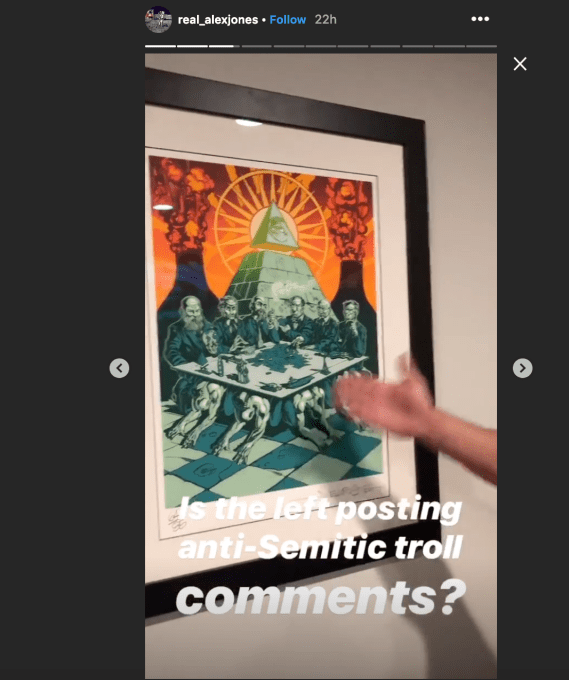
As Business Insider reports, 20 Facebook and Instagram executives hashed it out over the Jones post, which depicted a mural known as “False Profits” by the artist Mear One. Facebook began debating the post after it was flagged by Business Insider for kicking up anti semitic comments on Wednesday.
The company removed 23 of 500 comments on the post that it interpreted to be in clear violation of Facebook policy. Later in the conversation, some of the UK-based Instagram and Facebook executives on the email provided more context for their US-based peers.
Last year, a controversy over the same painting erupted when British politician Jeremy Corbyn argued in support of the mural’s creator after the art was removed from a wall in East London due what many believed to be antisemitic overtones. Because of that, the image and its context are likely better known in the UK, a fact that came up in Facebook’s discussion over how to handle the Jones post.
“This image is widely acknowledged to be anti-Semitic and is a famous image in the UK due to public controversy around it,” one executive said. “If we go back and say it does not violate we will be in for a lot criticism.”
Ultimately, after some back and forth, the post was removed.
According to the emails, Alex Jones’ Instagram account “does not currently violate [the rules]” as “an IG account has to have at least 30% of content violating at any given time as per our regular guidelines.” That fact might prove puzzling once you know that Alex Jones got his main account booted off Facebook itself in 2018 — and the company did another sweep for Jones-linked pages last month.
Whether you agree with Facebook’s content moderation decisions or not, it’s impossible to argue that they are consistently enforced. In the latest example, the company argued over a single depiction of a controversial image even as the same image is literally for sale by the artist elsewhere on both on Instagram and Facebook. (As any Facebook reporter can attest, these inconsistencies will probably be resolved shortly after this story goes live.)

The artist himself sells its likeness on a t-shirt on both Instagram and Facebook and numerous depictions of the same image appear on various hashtags. And even after the post was taken down, Jones displayed it prominently in his Instagram story, declaring that the image “is just about monopoly men and the class struggle” and decrying Facebook’s “crazy-level censorship.”
It’s clear that even as Facebook attempts to make strides, its approach to content moderation remains reactive, haphazard and probably too deeply preoccupied with public perception. Some cases of controversial content are escalated all the way to the top while others languish, undetected. Where the line is drawn isn’t particularly clear. And even when high profile violations are determined, it’s not apparent that those case studies meaningfully trickle down clarify smaller, everyday decisions by content moderators on Facebook’s lower rungs.
As always, the squeaky wheel gets the grease — but two billion users and reactive rather than proactive policy enforcement means that there’s an endless sea of ungreased wheels drifting around. This problem isn’t unique to Facebook, but given its scope, it does make the biggest case study in what can go wrong when a platform scales wildly with little regard for the consequences.
Unfortunately for Facebook, it’s yet another lose-lose situation of its own making. During its intense, extended growth spurt, Facebook allowed all kinds of potentially controversial and dangerous content to flourish for years. Now, when the company abruptly cracks down on accounts that violate its longstanding policies forbidding hate speech, divisive figures like Alex Jones can cry censorship, roiling hundreds of thousands of followers in the process.
Like other tech companies, Facebook is now paying mightily for the worry-free years it enjoyed before coming under intense scrutiny for the toxic side effects of all that growth. And until Facebook develops a more uniform interpretation of its own community standards — one the company enforces from the bottom up rather than the top down — it’s going to keep taking heat on all sides.

from Social – TechCrunch https://ift.tt/2V3TKZg
Original Content From: https://techcrunch.com
TECH Solutions - Facebook launches searchable transparency library of all active ads
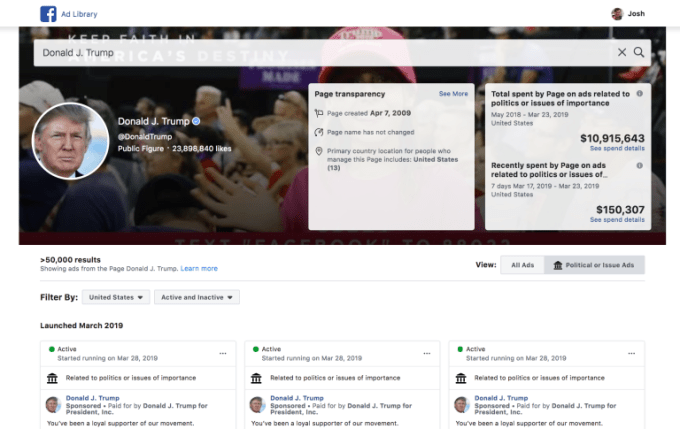
Now you can search Facebook for how much Trump has spent on ads in the past year, which Pages’ ads reference immigration, or what a Page’s previous names were. It’s all part of Facebook’s new Ad Library launching today that makes good on its promise to increase transparency after the social network’s ads were used to try to influence the 2016 US presidential elections.

Facebook’s Ads Archive that launched in May 2018 previously only included ads related to politics or policy issues, but now shows all active ads about anything as well as inactive political and issue ads. It displays Page creation dates, mergers with other Pages, Page name changes, and where a Page is managed from, and the option to report an ad for policy violations — all of which will be visible on a new Page Transparency tab on all Pages. Users can search political and issue ads by keyword or other ads by Page name, and Facebook will lend a hand with auto-fill suggestions and previous searches. The Library also displays Pages’ total political ad in the past week or since May 2018. And in mid-May Facebook will move to offering daily downloadable Ad Library reports as well as monthly and quarterly ones instead of just weekly ones as it currently does.
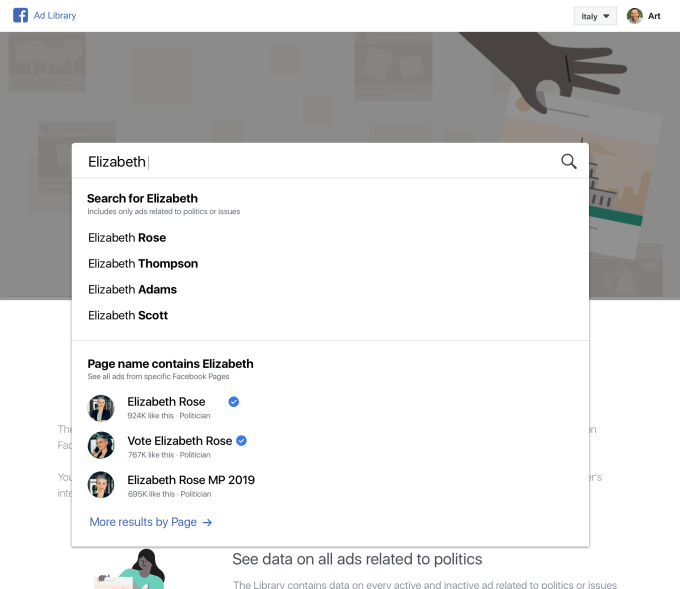
The improved transparency could allow researchers, government investigators, journalists, or anyone play watchdog to ensure ads aren’t being misused to spread misinformation, suppress voting, exacerbate polarization, or otherwise be sketchy.
Facebook stopped short of putting all expired and inactive non-political ads in the archive. It wouldn’t say why, but some advertisers have expressed concern that it could let competitors copy their messaging and targeting strategies. Another exemption will be news publishers, who teamed up to complain that sticking Paid For By labels on their ads promoting their political coverage made them look like they were campaigning for a certain side. Facebook exempted UK publishers in November, and now Facebook will use third-party lists of legitimate US publishers to exempt their ads from the labels and Politics tab of the Ad Library as well.
Facebook is also bringing its political ad labeling to the whole European Union after launching in the UK in October. Political and issue ad buyers will have to submit documents and pass technical checks to verify their location and identity that will be reviewed by automated systems and audited by users who can report ads without proper labels. The goal is to prevent people from outside of a country from using ads to meddle in different nations’ elections. Facebook will also add a “Paid for by” label to all political and issue ads on Facebook and Instagram and place active and inactive ones in the Ad Library. The labels will review who bought the ad, their contact details, the budget for that ad, how many people saw it and the age, location, and gender demographic details.
Facebook notes that it now has transparency tools revving up in Brazil, India, Ukraine, and Israel as those nations prepare for elections. Facebook plans to have political and issue ad transparency tools available globally by the end of June.
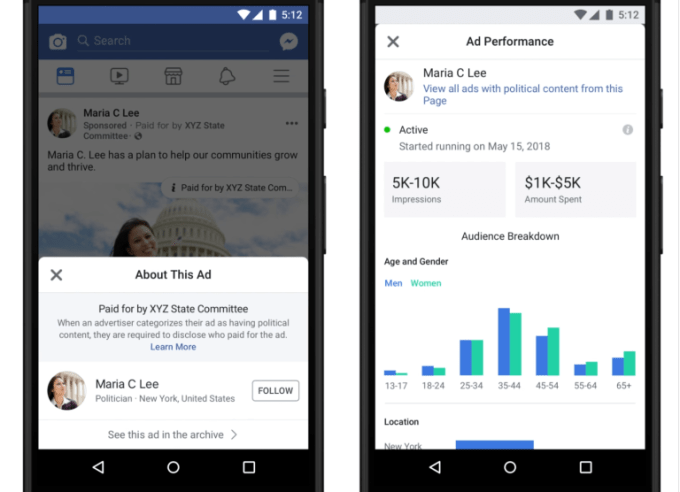
Meanwhile, Facebook is expanding researchers’ and developers’ programmatic access to Ad Library API which was previously in closed beta. Now anyone with a Facebook developer account who goes through the Identity Confirmation process and agrees to the platform terms of service can use software to sift through and spot trends in the data. To prevent another Cambridge Analytica situation, Facebook tells TechCrunch it will impost rate limits on the API, but won’t disclose them to ensure bad actors can’t toe the line. When asked how else Facebook would safeguard the API given people don’t necessarily abide by the TOS, __ told me “this is why we have the Identity Verification process in place. we want to know the identity of someone accessign the data so if they do abuse our platform terms of service . . . we have the ability to revoke access.”

One fascinating move here is that the Ad Library and reports can be accessed even if you don’t have a Facebook account. That could ward off some critics and congress members who’ve ragged on Facebook for requiring users sign up access transparency information or stop it from collecting data on them.
Between the depth and convenience of access to Facebook ad data, watchdogs could spot problematic campaigns before influence too much of the electorate. If someone spots a campaign trying to convince people they can vote by text message, that the Pope endorsed Trump, or that are puporsefully stoking anger to boost engagement, they could flag the ads to Facebook for removal.
As Facebook being charged with housing discrimination by the US Department Of Housing And Urban Development today proves, Facebook has repeatedly failed to stop problematic ads on its own. By opening itself up to assistance, it might not alleviate scrutiny, but at least all the eyes on it can help battle election interference and other abuse.

from Social – TechCrunch https://ift.tt/2TGmE0f
Original Content From: https://techcrunch.com
TECH Solutions - Twitter introduces a battery-saving ‘Lights Out’ dark mode option
As promised back in January by Twitter CEO Jack Dorsey, the company today is rolling out an even darker version of the app’s existing dark mode. Before, Twitter’s dark theme was more of a blue-ish shade instead of a true black, which not everyone seemed to like. Now, there’s an optional setting that makes the current dark mode more of a pitch black.
To use the new feature, you’ll first visit the Twitter app’s “Settings and Privacy” section, then click on “Display and Sound.” From there, you can toggle on the “Dark mode” which enables the current blue-black theme.
A second option, “Lights out” is offered below. If checked, dark mode ditches the blue tones and becomes black instead.
It’s an interesting choice to not just darken the existing theme, but rather introduce a third option. Most apps offering a dark mode don’t do this – they just offer a bright, white theme and another darker one. Twitter – which doesn’t always do things by the book to say the least – has gone a different route.
A tweak to the dark mode may seem like a minor adjustment to be concerned with, but dark modes today have grown in popularity as larger phone screens became the norm – particularly because they can help to conserve battery life on high-end OLED devices. (And especially on apps used as regularly as Twitter!)
Some people also feel a dark mode is just easier on the eyes when apps are used for long stretches of time.
The topic of dark modes even made its way to The Wall Street Journal which made a case for darker themes becoming standard not only for the battery benefits, but also because they may help lessen device addiction and improve sleep.
Today, a number of apps support dark themes including YouTube, Google, Medium, Reddit, Instapaper, Pocket, iBooks, Kindle, Google Maps and Waze, and others. WhatsApp is also reportedly working on a dark mode, according to recent reports.
Dorsey first announced Twitter’s plans for a new dark mode a few months ago, in response to a customer complaint which called Twitter’s dark mode a “weird blue.”
Twitter says the new Lights Out mode is rolling out today.

from Social – TechCrunch https://ift.tt/2CFyVwo
Original Content From: https://techcrunch.com
TECH Solutions - What to Do Before Google+ Shuts Down Urdu Hindi Tutorial
What to Do Before Google+ Shuts Down Urdu Hindi Tutorial
Hi Friends: This is my Blog Technical Solutions created to share videos and content of technical solutions with the world. At this blog you can find videos about Free Search Engine Optimization Course, how to develope Android Applications and What is Computer hardware and software, you would be able to increse your channel views, or boost your website. so guys keep visiting my blog for learning technical things. Thank You!
Hi Friends: This is my Blog Technical Solutions created to share videos and content of technical solutions with the world. At this blog you can find videos about Free Search Engine Optimization Course, how to develope Android Applications and What is Computer hardware and software, you would be able to increse your channel views, or boost your website. so guys keep visiting my blog for learning technical things. Thank You!
TECH Solutions - Chad - where social media has been cut for a year
Activists in Chad are demanding that the government restore access to social media after it was cut a year ago.
from BBC News - Technology https://ift.tt/2CIXMzj
Original Content From: http://bbci.co.uk
from BBC News - Technology https://ift.tt/2CIXMzj
Original Content From: http://bbci.co.uk
Moolah Mobile partners with Surge to offer free mobile service with ads
Moolah Mobile is teaming up with SurgePhone Wireless to offer people a new way to pay their cell phone bills — by putting ads on their homescreens.
Moolah CEO Vernell Woods (pictured above) said the startup has already been offering gift cards and other rewards to users who view its homescreen ads. So this is a similar model, except instead of leading to gift cards, the ads are subsidizing cell phone service from Surge.
The ads show up on users’ homescreen during all those interstitial moments between using apps, so the goal is to offer free service without consumers having to change their behavior. Woods said all that ad time adds up, with “the average person who’s using their phone on a consistent basis” viewing “easily between two to three hours” of home screen ads each day. And that’s enough to pay for the “equivalent” of Surge’s $10 monthly plan.
On the other hand, if for some reason a subscriber isn’t hitting the necessary total, Woods said they can also earn more points by accepting offers or taking surveys.
Moolah isn’t the only company using advertising to make previously paid products free. Just last week, I wrote about PreShow, a startup promising a free movie ticket for watching 15 to 20 minutes of ads. (Not everyone was crazy about the idea.)

Moolah Mobile screenshot
But Woods said he’s doing this because he wants to make wireless service more affordable to people in low-income communities. In the announcement, Moolah investor Tip “T.I.” Harris said it’s “one of the few tech companies I’ve seen who truly want to help everyday people have access to technology.”
But could this also be seen as a way to harvest personal data from a vulnerable population? Woods said he wants to protect against that with a blockchain initiative set to launch this fall, allowing users to see exactly what data is being shared with advertisers.
“No personal information should be going to advertisers without users knowing about it,” he said, adding that companies “definitely should not be making money off” personal data without giving users a cut of the profits.
The subsidized wireless service should be available on Surge Volt Android devices with Moolah install kits, as well as on SIM Starter Kits distributed by Surge. Moolah and Surge said they will roll this out Florida, Virginia, Georgia and Texas initially, with an aim of reaching 40,000 locations by the end of the year.


from Mobile – TechCrunch https://ift.tt/2uy750D
ORIGINAL CONTENT FROM: https://techcrunch.com/
Tech Solutions - #815 Do the Math, Poco F1 Tops, Note10 No Button, Oppo Reno Tilt Camera, Instagram Seek
#815 Do the Math, Poco F1 Tops, Note10 No Button, Oppo Reno Tilt Camera, Instagram Seek
Hi Friends: This is my Blog Technical Solutions created to share videos and content of technical solutions with the world. At this blog you can find videos about Free Search Engine Optimization Course, how to develope Android Applications and What is Computer hardware and software, you would be able to increse your channel views, or boost your website. so guys keep visiting my blog for learning technical things. Thank You!
Hi Friends: This is my Blog Technical Solutions created to share videos and content of technical solutions with the world. At this blog you can find videos about Free Search Engine Optimization Course, how to develope Android Applications and What is Computer hardware and software, you would be able to increse your channel views, or boost your website. so guys keep visiting my blog for learning technical things. Thank You!
Tech Solutions - Future of Smartphones 😲😲😲
Future of Smartphones 😲😲😲
Hi Friends: This is my Blog Technical Solutions created to share videos and content of technical solutions with the world. At this blog you can find videos about Free Search Engine Optimization Course, how to develope Android Applications and What is Computer hardware and software, you would be able to increse your channel views, or boost your website. so guys keep visiting my blog for learning technical things. Thank You!
Hi Friends: This is my Blog Technical Solutions created to share videos and content of technical solutions with the world. At this blog you can find videos about Free Search Engine Optimization Course, how to develope Android Applications and What is Computer hardware and software, you would be able to increse your channel views, or boost your website. so guys keep visiting my blog for learning technical things. Thank You!
Technical Solutions - Tech Talks #775 - Galaxy Note 10, Oppo Reno Tilt Camera, Xiaomi Folding Phone, Cargo Drone, Jio 4G
Tech Talks #775 - Galaxy Note 10, Oppo Reno Tilt Camera, Xiaomi Folding Phone, Cargo Drone, Jio 4G
TG Deals@ https://tg.deals/ New Channel: https://goo.gl/Jz6p5K Namaskaar Dosto, Tech Talks ke is Episode mein maine aapse kuch interesting Tech News Share ki hai jaise Galaxy Note 10, Oppo Reno Tilt Camera, Xiaomi Folding Phone video, Cargo Drone, Jio 4G usage in India, Apple AppStore Ads, Galaxy Fold Fold Test, Vivo S1 Launch, Microsoft April Fool Prank aur bahut kuch. Mujhe umeed hai ki yeh video aapko pasand aayega. Share, Support, Subscribe!!! Subscribe: http://bit.ly/1Wfsvt4 Android App: https://ift.tt/2mrm9Gy Youtube: http://www.youtube.com/c/TechnicalGuruji Twitter: http://www.twitter.com/technicalguruji Facebook: https://ift.tt/1Pi5LDP Facebook Myself: https://goo.gl/zUfbUU Instagram: https://ift.tt/1OW2vue Google Plus: https://ift.tt/1Pi5LDS Website: https://ift.tt/2mcM6KV Merchandise: https://ift.tt/2lN4Vbu About : Technical Guruji is a YouTube Channel, where you will find technological videos in Hindi, New Video is Posted Everyday :)
TG Deals@ https://tg.deals/ New Channel: https://goo.gl/Jz6p5K Namaskaar Dosto, Tech Talks ke is Episode mein maine aapse kuch interesting Tech News Share ki hai jaise Galaxy Note 10, Oppo Reno Tilt Camera, Xiaomi Folding Phone video, Cargo Drone, Jio 4G usage in India, Apple AppStore Ads, Galaxy Fold Fold Test, Vivo S1 Launch, Microsoft April Fool Prank aur bahut kuch. Mujhe umeed hai ki yeh video aapko pasand aayega. Share, Support, Subscribe!!! Subscribe: http://bit.ly/1Wfsvt4 Android App: https://ift.tt/2mrm9Gy Youtube: http://www.youtube.com/c/TechnicalGuruji Twitter: http://www.twitter.com/technicalguruji Facebook: https://ift.tt/1Pi5LDP Facebook Myself: https://goo.gl/zUfbUU Instagram: https://ift.tt/1OW2vue Google Plus: https://ift.tt/1Pi5LDS Website: https://ift.tt/2mcM6KV Merchandise: https://ift.tt/2lN4Vbu About : Technical Guruji is a YouTube Channel, where you will find technological videos in Hindi, New Video is Posted Everyday :)
TECH Solutions - HUD hits Facebook with housing discrimination charges over ad targeting
The U.S. Department of Housing and Urban Development this morning hit Facebook with charges of housing discrimination. The filing states that the the online giant has violated the Fair Housing Act through its ad targeting tools, which allow sellers to limit listings based on categories like race, sex and nation of origin.
The charges are the result of an investigation initiated in August of last year, investigating a formal complaint that homesellers and landlords can target ads across a broad range of different categories.
“Facebook is discriminating against people based upon who they are and where they live,” HUD Secretary Ben Carson said in a statement tied to the news. “Using a computer to limit a person’s housing choices can be just as discriminatory as slamming a door in someone’s face.”
Facebook said it was “surprised” by the decision, in a statement offered to TechCrunch. A spokesperson for the company went on to discuss “significant steps” taken to above the discrimination detailed in HUD’s filing.
“Last year we eliminated thousands of targeting options that could potentially be misused, and just last week we reached historic agreements with the National Fair Housing Alliance, ACLU, and others that change the way housing, credit, and employment ads can be run on Facebook,” the company says. “While we were eager to find a solution, HUD insisted on access to sensitive information – like user data – without adequate safeguards. We’re disappointed by today’s developments, but we’ll continue working with civil rights experts on these issues.”
Last week, the social network avoided legal woes by reaching an agreement with The ACLU, Outten & Golden LLC and the Communications Workers of America. The deal is designed to help adhere to section VII of the Civil Rights Act of 1964, with Facebook removing gender, age and race-based targeting from housing and employment ads and creating a new one-stop portal for listings.

from Social – TechCrunch https://ift.tt/2TIaeoC
Original Content From: https://techcrunch.com
UK report blasts Huawei for network security incompetence
The latest report by a UK oversight body set up to evaluation Chinese networking giant Huawei’s approach to security has dialled up pressure on the company, giving a damning assessment of what it describes as “serious and systematic defects” in its software engineering and “cyber security competence”.
Although it falls short of calling for an outright ban on Huawei equipment in domestic networks — an option U.S. president Trump continues dangling across the pond.
The report, prepared for the National Security Advisor of the UK by the Huawei Cyber Security Evaluation Centre (HCSEC) Oversight Board, also identifies new “significant technical issues” which it says lead to new risks for UK telecommunications networks using Huawei kit.
The HCSEC was set up by Huawei in 2010, under what the oversight board couches as “a set of arrangements with the UK government”, to provide information to state agencies on its products and strategies in order that security risks could be evaluated.
And last year, under pressure from UK security agencies concerned about technical deficiencies in its products, Huawei pledged to spend $2BN to try to address long-running concerns.
But the report throws doubt on its ability to do so — with the board writing that it has “not yet seen anything to give it confidence in Huawei’s capacity to successfully complete the elements of its transformation programme that it has proposed as a means of addressing these underlying defects”.
So it sounds like $2BN isn’t going to be nearly enough to fix Huawei’s security problem in the UK.
The board also writes that it will require “sustained evidence” of better software engineering and cyber security “quality”, verified by HCSEC and the UK’s National Cyber Security Centre (NCSC), if there’s to be any possibility of it reaching a different assessment of the company’s ability to reboot its security credentials.
In another damning segment it says there has been “no material progress” on issues raised by last year’s report.
All the issues identified by the security evaluation process relate to “basic engineering competence and cyber security hygiene” which the board noting that gives rise to vulnerabilities capable of being exploited by “a range of actors”. It adds that the NCSC does not believe the defects found are a result of Chinese state interference.
This year’s report is the fifth the oversight board has produced since it was established in 2014, and it comes at a time of acute scrutiny for Huawei, as 5G network rollouts are ramping up globally — pushing governments to address head on any suspicions attached to the Chinese giant and consider whether to trust it with critical next-gen infrastructure.
“The Oversight Board advises that it will be difficult to appropriately risk-manage future products in the context of UK deployments, until the underlying defects in Huawei’s software engineering and cyber security processes are remediated,” the report warns in one of several key conclusions that make very uncomfortable reading for Huawei.
“Overall, the Oversight Board can only provide limited assurance that all risks to UK national security from Huawei’s involvement in the UK’s critical networks can be sufficiently mitigated long-term,” it adds in summary.
Reached for its response to the report, a Huawei UK spokesperson sent us a statement in which it describes the $2BN earmarked for security improvements related to UK products as an “initial budget”.
It writes:
The 2019 OB [oversight board] report details some concerns about Huawei’s software engineering capabilities. We understand these concerns and take them very seriously. The issues identified in the OB report provide vital input for the ongoing transformation of our software engineering capabilities. In November last year Huawei’s Board of Directors issued a resolution to carry out a companywide transformation programme aimed at enhancing our software engineering capabilities, with an initial budget of US$2BN.
A high-level plan for the programme has been developed and we will continue to work with UK operators and the NCSC during its implementation to meet the requirements created as cloud, digitization, and software-defined everything become more prevalent. To ensure the ongoing security of global telecom networks, the industry, regulators, and governments need to work together on higher common standards for cyber security assurance and evaluation.
Seeking to find something positive to salvage from the report’s savaging, Huawei suggests it demonstrates the continued effectiveness of the HCSEC as a structure to evaluate and mitigate security risk — flagging a description where the board writes that it’s “arguably the toughest and most rigorous in the world”, and which Huawei claims shows at least there hasn’t been any increase in vulnerability of UK networks since the last report.
Though the report does identify new issues that open up fresh problems — albeit the underlying issues were presumably there last year too, just undiscovered.
The board’s withering assessment certainly amps up the pressure on Huawei which has been aggressively battling U.S.-led suspicion of its kit — claiming in a telecoms conference speech last month that “the U.S. security accusation of our 5G has no evidence”, for instance. And appealing for the industry to work together to come up with collective processes for evaluating the security and trustworthiness of network kit.
Earlier this month it opened another cyber security transparency center — this time in Brussels, where the company has been lobbying European policymakers to establish security standards to foster collective trust. Though there’s little doubt that’s a long game.
Meanwhile, critics of Huawei can now point to impatience rising in the U.K., despite comments by the head of the NCSC, Ciaran Martin, last month — who said then that security agencies believe the risk of using Huawei kit can be managed, suggesting the government won’t push for an outright ban.
The report does not literally overturn that view but it does blast out a very loud and alarming warning about the difficulty for UK operators to “appropriately” risk-manage defective and vulnerable Huawei kit.
Including flagging the risk of future products which the board suggests will be increasingly complex to manage — all of which could well just push operators to seek out alternatives.
On the mitigation front, the board writes that — “in extremis” — the NCSC could order Huawei to carry out specific fixes for equipment currently installed in the UK. Though it also warns that such a step would be difficult, and could for example require hardware replacement which may not mesh with operators “natural” asset management and upgrades cycles, emphasizing that it does not offer a sustainable solution to the underlying technical issues.
“Given both the shortfalls in good software engineering and cyber security practice and the currently unknown trajectory of Huawei’s R&D processes through their announced transformation plan, it is highly likely that security risk management of products that are new to the UK or new major releases of software for products currently in the UK will be more difficult,” the board writes in a concluding section discussing the UK national security risk.
“On the basis of the work already carried out by HCSEC, the NCSC considers it highly likely that there would be new software engineering and cyber security issues in products HCSEC has not yet examined.”
It also describes the number and severity of vulnerabilities discovered, as well as architectural and build issues, by what the relatively small team in the HCSEC as “a particular concern”.
“If an attacker has knowledge of these vulnerabilities and sufficient access to exploit them, they may be able to affect the operation of the network, in some cases causing it to cease operating correctly,” it adds. “Other impacts could include being able to access user traffic or reconfiguration of the network elements.”
In another section on mitigating the risks of using Huawei kit, the report notes that architectural controls in place in most UK operators can limit the ability of attackers to exploit any vulnerable network elements not explicitly exposed to the public Internet — adding that such controls, combined with good opsec generally, will “remain critically important in the coming years to manage the residual risks caused by the engineering defects identified”.
In other highlights from the report the board does have some positive things to say, writing that an NCSC technical review of its capabilities showed improvements in 2018, while another independent audit of HCSEC’s ability to operate independently of Huawei HQ once again found “no high or medium priority findings”.
“The audit report identified one low-rated finding, relating to delivery of information and equipment within agreed Service Level Agreements. Ernst & Young concluded that there were no major concerns and the Oversight Board is satisfied that HCSEC is operating in line with the 2010 arrangements between HMG and the company,” it further notes.
Last month the European Commissioner said it was preparing to step in to ensure a “common approach” across the European Union where 5G network security is concerned.
And earlier this week it issued a set of recommendations for Member States that combine legislative and policy measures to assess 5G network security risks and help strengthen preventive measures.
Among the suggested operational measures it advises Member States to take is to complete a national risk assessment of 5G network infrastructures by the end of June 2019, and follow that by updating existing security requirements for network providers — including conditions for ensuring the security of public networks.
“These measures should include reinforced obligations on suppliers and operators to ensure the security of the networks,” it recommended. “The national risk assessments and measures should consider various risk factors, such as technical risks and risks linked to the behaviour of suppliers or operators, including those from third countries. National risk assessments will be a central element towards building a coordinated EU risk assessment.”
At an EU level the Commission said Member States should share information on network security, saying this “coordinated work should support Member States’ actions at national level and provide guidance to the Commission for possible further steps at EU level” — leaving the door open for further action.
While the EU’s executive body has not pushed for a pan-EU ban on any 5G vendors it did restate Member States’ right to exclude companies from their markets for national security reasons if they fail to comply with their own standards and legal framework.


from Mobile – TechCrunch https://ift.tt/2FHwY4n
ORIGINAL CONTENT FROM: https://techcrunch.com/
Xiaomi teases another look at its foldable phone
Xiaomi is back with another teaser of the foldable concept device it first showed off in January.
This time around, in a video posted to its Weibo account, the Chinese company showed off the device working in tablet mode and, after folding, regular phone mode to illustrate how seamlessly it can be tucked up and put away… in this case atop of a cup of noodles.
Video: hat tip The Verge
Xiaomi has said it is developing a device — the previous video included a call-out for ideas and feedback — so the project isn’t likely as advanced as soon-to-launch products from Samsung, Huawei or lesser known Chinese brand Royole.
Unlike those three, Xiaomi’s offers two foldable edges instead of just one. That would appear to present a much tougher challenge in terms of design and logistics, but this new teaser (and there’s no doubt Xiaomi chose it carefully) seems to show impressive results. The phone folds nicely in terms of hardware and software, but you’d imagine those edges will make it thicker than others.
It’s all ifs and buts for now, though, since Xiaomi isn’t giving up details of what this product might become… or even whether it will become one at all. But Xiaomi being Xiaomi, you’d imagine that when it does drop, it won’t just be the two folds that set it apart from the rest. The Chinese firm is massively price-sensitive, so you can expect that it’ll price any foldable phone it releases much lower than the $2,000 or so that Samsung and Huawei are asking for their gen-one efforts.


from Mobile – TechCrunch https://ift.tt/2FGOXYx
ORIGINAL CONTENT FROM: https://techcrunch.com/
TECH Solutions - Grindr 'up for sale on security grounds'
The app's Chinese owner, Kunlun Group, is reportedly seen as a security risk by US authorities.
from BBC News - Technology https://ift.tt/2WzqGJP
Original Content From: http://bbci.co.uk
from BBC News - Technology https://ift.tt/2WzqGJP
Original Content From: http://bbci.co.uk
Tech Solutions -Chance for fringe players to impress in Dubai dead rubbers
With the series already wrapped up, both Australia and Pakistan will view the remaining two games at the Dubai International Stadium as World Cup primers.
from Pakistan news from ESPN Cricinfo.com https://ift.tt/2JJ32sF
Original Content From : https://ift.tt/Ti8aBD
from Pakistan news from ESPN Cricinfo.com https://ift.tt/2JJ32sF
Original Content From : https://ift.tt/Ti8aBD
TECH Solutions - Salesforce.com sued over links to trafficking site
The software firm is accused of helping a site known to be involved in the trafficking of women.
from BBC News - Technology https://ift.tt/2FGcYiH
Original Content From: http://bbci.co.uk
from BBC News - Technology https://ift.tt/2FGcYiH
Original Content From: http://bbci.co.uk
TECH Solutions - Facebook to ban white nationalism and separatism
The social media firm is under pressure after the New Zealand mosque attack was live-streamed.
from BBC News - Technology https://ift.tt/2WuCrkx
Original Content From: http://bbci.co.uk
from BBC News - Technology https://ift.tt/2WuCrkx
Original Content From: http://bbci.co.uk
Wednesday, March 27, 2019
Technical Solutions - Vivo Apex 2019 Hands On & First Look - Future is here 🔥🔥🔥
Vivo Apex 2019 Hands On & First Look - Future is here 🔥🔥🔥
Namaskaar Dosto, is video mein maine aapse Vivo Apex 2019 ke baare mein baat ki hai jaha pe yeh ek concept phone hai Vivo ki taraf se jaha pe koi ports ya koi buttons nahi hai, yaha pe Full Screen In display fingerprint scanner hai aur snapdragon 855 processor hai 12GB RAM ke saath mein, 512GB ki Storage hai, jaha pe aapko touch buttons milte hai aur ek unibody glass design hai, magnetic charge port ke saath, yaha pe koi selfie camera nahi hai, but yeh phone kaafi kamaal hai aur kaafi interesting hai kuch unique technologies ke saath, Mujhe umeed hai ki aapko Vivo Apex 2019 concept phone ki yeh video pasand aayegi. Share, Support, Subscribe!!! Subscribe: http://bit.ly/1Wfsvt4 Android App: https://ift.tt/2mrm9Gy Youtube: http://www.youtube.com/c/TechnicalGuruji Twitter: http://www.twitter.com/technicalguruji Facebook: https://ift.tt/1Pi5LDP Facebook Myself: https://goo.gl/zUfbUU Instagram: https://ift.tt/1OW2vue Google Plus: https://ift.tt/1Pi5LDS Website: https://ift.tt/2mcM6KV Merchandise: https://ift.tt/2lN4Vbu About : Technical Guruji is a YouTube Channel, where you will find technological videos in Hindi, New Video is Posted Everyday :)
Namaskaar Dosto, is video mein maine aapse Vivo Apex 2019 ke baare mein baat ki hai jaha pe yeh ek concept phone hai Vivo ki taraf se jaha pe koi ports ya koi buttons nahi hai, yaha pe Full Screen In display fingerprint scanner hai aur snapdragon 855 processor hai 12GB RAM ke saath mein, 512GB ki Storage hai, jaha pe aapko touch buttons milte hai aur ek unibody glass design hai, magnetic charge port ke saath, yaha pe koi selfie camera nahi hai, but yeh phone kaafi kamaal hai aur kaafi interesting hai kuch unique technologies ke saath, Mujhe umeed hai ki aapko Vivo Apex 2019 concept phone ki yeh video pasand aayegi. Share, Support, Subscribe!!! Subscribe: http://bit.ly/1Wfsvt4 Android App: https://ift.tt/2mrm9Gy Youtube: http://www.youtube.com/c/TechnicalGuruji Twitter: http://www.twitter.com/technicalguruji Facebook: https://ift.tt/1Pi5LDP Facebook Myself: https://goo.gl/zUfbUU Instagram: https://ift.tt/1OW2vue Google Plus: https://ift.tt/1Pi5LDS Website: https://ift.tt/2mcM6KV Merchandise: https://ift.tt/2lN4Vbu About : Technical Guruji is a YouTube Channel, where you will find technological videos in Hindi, New Video is Posted Everyday :)
FTC smacks down robocallers, but the penalties don’t match their heinous crimes
The fight against robocallers is just getting started, and the wheel of justice turns slowly, but the FTC just took down a handful of major operations responsible for billions of unwanted calls, some of them adding additional fraud to the mix. The money coming out of the cases is surprisingly small, however — but there’s a reason for that.
In an announcement yesterday, the FTC said it had taken down four operations: NetDotSolutions, which did all kinds of marketing with a custom mass dialing platform; Higher Goals Marketing, which promised fake debt relief; Pointbreak Media, which threatened to delist companies from Google unless they paid; Veterans of America, AKA Saving Our Soldiers, AKA Act of Valor, whose creator Travis Deloy Peterson deserves a special place in hell for scamming people trying to donate vehicles to vets.
Together they accounted for some two billion calls, which in the context of the five billion made every month may seem to be a drop in the bucket, but at this point even a slight reduction is welcome.
What is less heartening is the scale of the penalties. Although the cases resulted in judgments totaling some 24 million dollars, the actual amount the scammers will end up paying will end up closer to $3-4 million. One scammer whose judgments totaled more than $5 million will be suspended when he pays just $18,332 — and whatever comes from the sale of his shiny new Mercedes.
I talked with an FTC spokesperson about why this is the case. They explained that the judgment amount is essentially a ceiling defined by how much consumer harm was done, but most times the defendants have nowhere near that much available as money or assets. You can only get as much as they have, and sometimes that’s not a lot.
Especially in Florida, they went on, where the Homestead rule means that houses can’t be seized in these proceedings — meaning a robocall scammer based in the state could make 10 million bucks, drop it all on a house, and then declare they have no assets when the FTC or whoever comes knocking. This seems likely to be the case with Mr “I only have 18 grand and a 2017 Mercedes CLS” above, who is indeed a Floridian.
The FTC goes to great lengths to investigate and enumerate a defendant’s assets, but they can’t seize what isn’t there. In the case of a large company like Dish, a massive judgment like last year’s $180 million one may end up being paid in full — but individuals and small, fly-by-night businesses are considerably harder to pin down.
Even so, the agency collects quite a bit of cash to return to affected consumers, which should happen with the money here as well. You won’t see a dime just for getting annoyed by calls, though — you’d need to show that it was one of these companies and that they defrauded you, or attempted to.
More importantly, the people and companies in question are immediately shut down and the people involved forbidden from doing anything like this again. Consumer relief is the FTC’s goal, and if they chose to litigate, the case could be drawn out for years, all while the company and call network continues to operate or develops layers of insulation against the law.
You can read the full release and order documents at the FTC’s site — but be warned it may make you angry to hear about these slimeballs living the high life.


from Mobile – TechCrunch https://ift.tt/2Ue1yKP
ORIGINAL CONTENT FROM: https://techcrunch.com/
TECH Solutions - Facebook is finally banning white supremacy that goes by other names
Facebook is abandoning a longstanding policy of allowing white supremacy to flourish on its platform under the guise of terms like white nationalism and white separatism.
Motherboard first reported that the decision came out of a conversation on platform moderation out of Facebook’s Content Standards Forum yesterday and will go into effect next week. Under the new rules, detailed in a Facebook Newsroom post, the company will direct users who search for content related to white supremacy to Life After Hate, an organization that helps individuals leave violent far-right groups.
As Facebook explains in its Newsroom post:
“… Over the past three months our conversations with members of civil society and academics who are experts in race relations around the world have confirmed that white nationalism and separatism cannot be meaningfully separated from white supremacy and organized hate groups. Our own review of hate figures and organizations – as defined by our Dangerous Individuals & Organizations policy – further revealed the overlap between white nationalism and separatism and white supremacy. Going forward, while people will still be able to demonstrate pride in their ethnic heritage, we will not tolerate praise or support for white nationalism and separatism.
As we wrote last year, Facebook foolishly took the distinction between white nationalism and white supremacy seriously even while most white supremacists don’t. For hate groups, hiding behind the guise of a slightly more benign term like white nationalism is a very useful way to obscure the fact that many of these superficially disparate ideologies have nearly total ideological overlap.
Last year, leaked internal documents revealed that Facebook policy formally distinguished between white supremacy and white nationalism. That misguided policy failed to see that white nationalism, white pride, and white separatism are guises for and generally synonymous with the ideals set forth by white supremacy, a dangerous form of race-motivated radicalism that inspires hate-based violence.
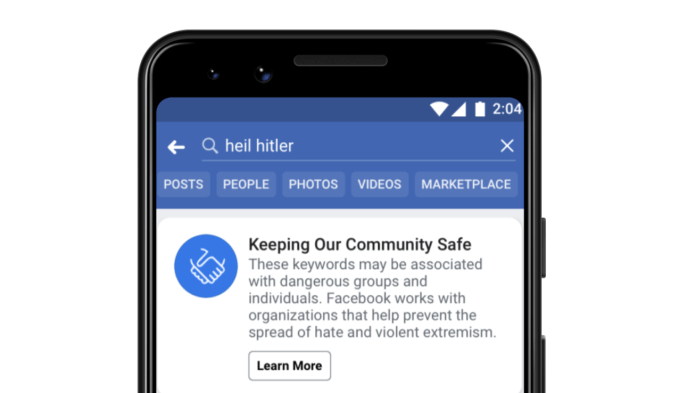
Image via Facebook
Six months ago, Facebook indicated that it would review its policy on white nationalism and white separatism after speaking with civil rights groups that decried the company’s stance toward forms of white supremacy on its platform.
“Color Of Change alerted Facebook years ago to the growing dangers of white nationalists on its platform, and today, we are glad to see the company’s leadership take this critical step forward in updating its policy on white nationalism,” Color Of Change President Rashad Robinson said of the upcoming policy shift.
“… Facebook’s update should move Twitter, YouTube, and Amazon to act urgently to stem the growth of white nationalist ideologies, which find space on platforms to spread the violent ideas and rhetoric that inspired the tragic attacks witnessed in Charlottesville, Pittsburgh, and now Christchurch.”
TechCrunch has reached out to Facebook for more details about the new policy on white nationalism and white separatism and will be following the story as it develops.
Facebook’s shift toward taking white supremacism in its many forms more seriously is a big deal. Online platforms, particularly those driven by algorithms, play a big role in funneling users toward suggested content. As long as white supremacy, under the guise of white nationalism or white separatism, has a place on major tech platforms, users expressing even passing interest in white supremacist themes and language will be funneled deeper down the radicalization rabbit hole.
Facebook has taken major strides in the last year, taking action against white supremacy-adjacent groups like the Proud Boys, which relied the platform for international recruitment. Still, it wasn’t very long ago that a simple search of a ubiquitous white supremacist term like “1488” would steer Facebook users toward a wealth of memes, posts and groups promoting violence against jews and the black community, normalizing race-based hate in the process.

from Social – TechCrunch https://ift.tt/2uwkhCZ
Original Content From: https://techcrunch.com