Thursday, January 31, 2019

TECH Solutions - We dismantle Facebook’s memo defending its “Research”

Facebook published an internal memo today trying to minimize the morale damage of TechCrunch’s investigation that revealed it’d been paying people to suck in all their phone data. Attained by Business Insider’s Rob Price, the memo from Facebook’s VP of production engineering and security Pedro Canahuati gives us more detail about exactly what data Facebook was trying to collect from teens and adults in the US and India. But it also tries to claim the program wasn’t secret, wasn’t spying, and that Facebook doesn’t see it as a violation of Apple’s policy against using its Enterprise Certificate system to distribute apps to non-employees — despite Apple punishing it for the violation.

For reference, Facebook was recruiting users age 13-35 to install a Research app, VPN, and give it root network access so it could analyze all their traffic. It’s pretty sketchy to be buying people’s privacy, and despite being shut down on iOS, it’s still running on Android.

Here we lay out the memo with section by section responses to Facebook’s claims challenging TechCrunch’s reporting. Our responses are in bold and we’ve added images.

Memo from Facebook VP Pedro Canahuati

APPLE ENTERPRISE CERTS REINSTATED

Early this morning, we received agreement from Apple to issue a new enterprise certificate; this has allowed us to produce new builds of our public and enterprise apps for use by employees and contractors. Because we have a few dozen apps to rebuild, we’re initially focusing on the most critical ones, prioritized by usage and importance: Facebook, Messenger, Workplace, Work Chat, Instagram, and Mobile Home.

New builds of these apps will soon be available and we’ll email all iOS users for detailed instructions on how to reinstall. We’ll also post to iOS FYI with full details.

Meanwhile, we’re expecting a follow-up article from the New York Times later today, so I wanted to share a bit more information and background on the situation.
What happened?

On Tuesday TechCrunch reported on our Facebook Research program. This is a market research program that helps us understand consumer behavior and trends to build better mobile products.

TechCrunch implied we hid the fact that this is by Facebook – we don’t. Participants have to download an app called Facebook Research App to be involved in the stud. They also characterized this as “spying,” which we don’t agree with. People participated in this program with full knowledge that Facebook was sponsoring this research, and were paid for it. They could opt-out at any time. As we built this program, we specifically wanted to make sure we were as transparent as possible about what we were doing, what information we were gathering, and what it was for — see the screenshots below.

We used an app that we built ourselves, which wasn’t distributed via the App Store, to do this work. Instead it was side-loaded via our enterprise certificate. Apple has indicated that this broke their Terms of Service so disabled our enterprise certificates which allow us to install our own apps on devices outside of the official app store for internal dogfooding.

Author’s response: To start, “build better products” is a vague way of saying determining what’s popular and buying or building it. Facebook has used competitive analysis gathered by its similar Onavo Protect app and Facebook Research app for years to figure out what apps were gaining momentum and either bring them in or box them out. Onavo’s data is how Facebook knew WhatsApp was sending twice as many messages as Messenger, and it should invest $19 billion to acquire it.

Facebook claims it didn’t hide the program, but it was never formally announced like every other Facebook product. There were no Facebook Help pages, blog posts, or support info from the company. It used intermediaries Applause (which owns uTest) and CentreCode (which owns Betabound) to run the program under names like Project Atlas and Project Kodiak. Users only found out Facebook was involved once they started the sign-up process and signed a non-disclosure agreement prohibiting them from discussing it publicly.

TechCrunch has reviewed communications indicating Facebook would threaten legal action if a user spoke publicly about being part of the Research program. While the program had run since 2016, it had never been reported on. We believe that these facts combined justify characterizing the program as “secret”
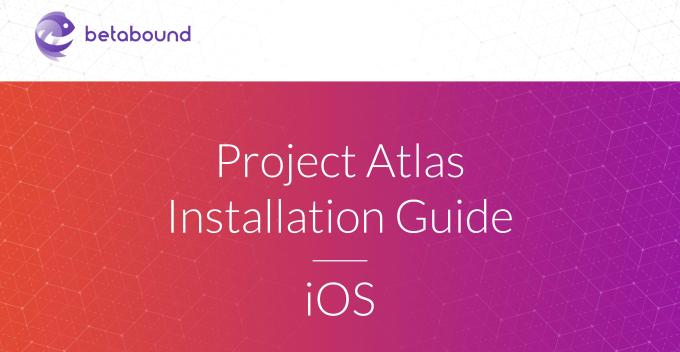
The Facebook Research program was called Project Atlas until you signed up

How does this program work?

We partner with a couple of market research companies (Applause and CentreCode) to source and onboard candidates based in India and USA for this research project. Once people are onboarded through a generic registration page, they are informed that this research will be for Facebook and can decline to participate or opt out at any point. We rely on a 3rd party vendor for a number of reasons, including their ability to target a Diverse and representative pool of participants. They use a generic initial Registration Page to avoid bias in the people who choose to participate.

After generic onboarding people are asked to download an app called the ‘Facebook Research App,’ which takes them through a consent flow that requires people to check boxes to confirm they understand what information will be collected. As mentioned above, we worked hard to make this as explicit and clear as possible.

This is part of a broader set of research programs we conduct. Asking users to allow us to collect data on their device usage is a highly efficient way of getting industry data from closed ecosystems, such as iOS and Android. We believe this is a valid method of market research.

Author’s response: Facebook claims it wasn’t “spying”, yet it never fully laid out the specific kinds of information it would collect. In some cases, descriptions of the app’s data collection power were included in merely a footnote. The program did not specify specific data types gathered, only saying it would scoop up “which apps are on your phone, how and when you use them” and “information about your internet browsing activity”

The parental consent form from Facebook and Applause lists none of the specific types of data collected or the extent of Facebook’s access. Under “Risks/Benefits”, the form states “There are no known risks associated with this project however you acknowledge that the inherent nature of the project involves the tracking of personal information via your child’s use of Apps. You will be compensated by Applause for your child’s participation.” It gives parents no information about what data their kids are giving up.

Facebook claims it uses third-parties to target a diverse pool of participants. Yet Facebook conducts other user feedback and research programs on its own without the need for intermediaries that obscure its identity, and only ran the program in two countries. It claims to use a generic signup page to avoid biasing who will choose to participate, yet the cash incentive and technical process of installing the root certificate also bias who will participate, and the intermediaries conveniently prevent Facebook from being publicly associated with the program at first glance. Meanwhile, other clients of the Betabound testing platform like Amazon, Norton, and SanDisk reveal their names immediately before users sign up.
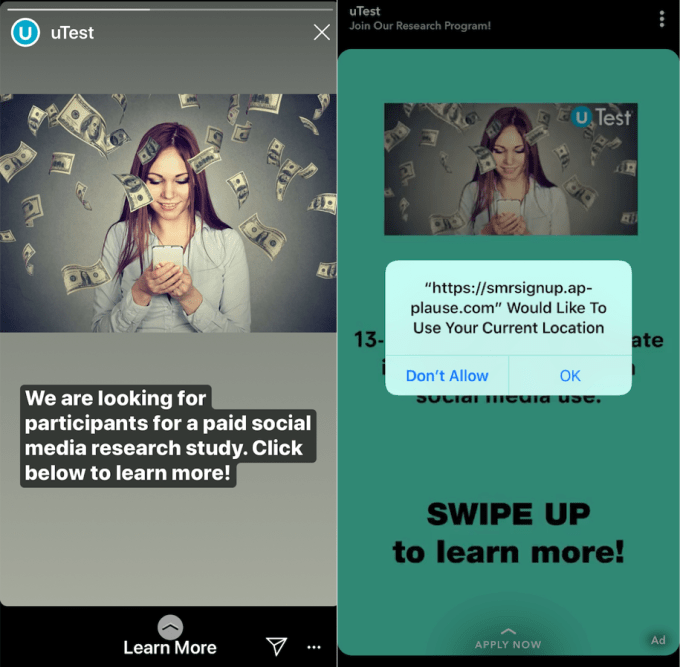
Facebook’s ads recruiting teens for the program didn’t disclose its involvement

Did we intentionally hide our identity as Facebook?

No — The Facebook brand is very prominent throughout the download and installation process, before any data is collected. Also, the app name of the device appears as “Facebook Research” — see attached screenshots. We use third parties to source participants in the research study, to avoid bias in the people who choose to participate. But as soon as they register, they become aware this is research for Facebook

Author’s response: Facebook here admits that users did not know Facebook was involved before they registered.

What data do we collect? Do we read people’s private messages?

No, we don’t read private messages. We collect data to understand how people use apps, but this market research was not designed to look at what they share or see. We’re interested in information such as watch time, video duration, and message length, not that actual content of videos, messages, stories or photos. The app specifically ignores information shared via financial or health apps.

Author’s response: We never reported that Facebook was reading people’s private messages, but that it had the ability to collect them. Facebook here admits that the program was “not designed to look at what they share or see”, but stops far short of saying that data wasn’t collected. Fascinatingly, Facebook reveals it was that it was closely monitoring how much time people spent on different media types.
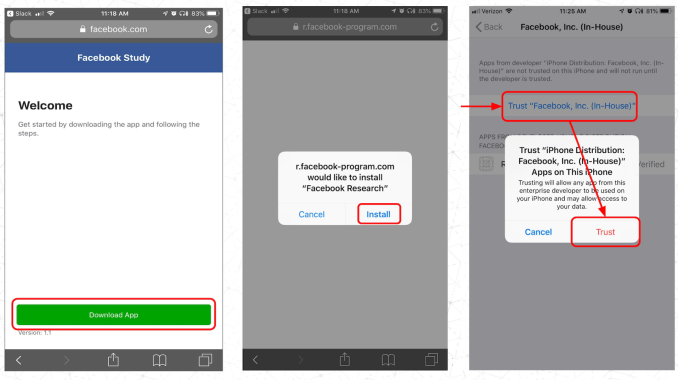
Facebook Research abused the Enterprise Certificate system meant for employee-only apps

Did we break Apple’s terms of service?

Apple’s view is that we violated their terms by sideloading this app, and they decide the rules for their platform, We’ve worked with Apple to address any issues; as a result, our internal apps are back up and running. Our relationship with Apple is really important — many of us use Apple products at work every day, and we rely on iOS for many of our employee apps, so we wouldn’t put that relationship at any risk intentionally. Mark and others will be available to talk about this further at Q&A later today.

Author’s response: TechCrunch reported that Apple’s policy plainly states that the Enterprise Certificate program requires companies to “Distribute Provisioning Profiles only to Your Employees and only in conjunction with Your Internal Use Applications for the purpose of developing and testing” and that “You may not use, distribute or otherwise make Your Internal Use Applications available to Your Customers”. Apple took a firm stance in its statement that Facebook did violate the program’s policies, stating “Facebook has been using their membership to distribute a data-collecting app to consumers, which is a clear breach of their agreement with Apple.”

Given Facebook distributed the Research apps to teenagers that never signed tax forms or formal employment agreements, they were obviously not employees or contractors, and most likely use some Facebook-owned service that qualifies them as customers. Also, I’m pretty sure you can’t pay employees in gift cards.


from Social – TechCrunch https://tcrn.ch/2S2wIEU
Original Content From: https://techcrunch.com

Tech Solutions -'Bureaucracy over common sense' - Mani lashes out at Sarfaraz's ban

The PCB chairman held that, "because ICC couldn't get the two players in a room together, they said let's charge him. And that to my mind is utter nonsense."

from Pakistan news from ESPN Cricinfo.com https://es.pn/2Uuyf3h
Original Content From : https://es.pn/Ti8aBD

TECH Solutions - Apple reactivates Facebook’s employee apps after punishment for Research spying

After TechCrunch caught Facebook violating Apple’s employee-only app distribution policy to pay people for all their phone data, Apple invalidated the social network’s Enterprise Certificate as punishment. That deactivated not only this Facebook Research app VPN, but also all of Facebook’s internal iOS apps for workplace collaboration, beta testing and even getting the company lunch or bus schedule. That threw Facebook’s offices into chaos yesterday morning. Now after nearly two work days, Apple has ended Facebook’s time-out and restored its Enterprise Certification. That means employees can once again access all their office tools, pre-launch test versions of Facebook and Instagram… and the lunch menu.

A Facebook spokesperson issued this statement to TechCrunch: “We have had our Enterprise Certification, which enables our internal employee applications, restored. We are in the process of getting our internal apps up and running. To be clear, this didn’t have an impact on our consumer-facing services.”

Meanwhile, TechCrunch’s follow-up report found that Google was also violating the Enterprise Certificate program with its own “market research” VPN app called Screenwise Meter that paid people to snoop on their phone activity. After we informed Google and Apple yesterday, Google quickly apologized and took down the app. But apparently in service of consistency, this morning Apple invalidated Google’s Enterprise Certificate too, breaking its employee-only iOS apps.

Google’s internal apps are still broken. Unlike Facebook that has tons of employees on iOS, Google at least employs plenty of users of its own Android platform, so the disruption may have caused fewer problems in Mountain View than Menlo park. “We’re working with Apple to fix a temporary disruption to some of our corporate iOS apps, which we expect will be resolved soon,” said a Google spokesperson. A spokesperson for Apple said: “We are working together with Google to help them reinstate their enterprise certificates very quickly.”

TechCrunch’s investigation found that the Facebook Research app not only installed an Enterprise Certificate on users phones and a VPN that could collect their data, but also demanded root network access that allows Facebook to man-in-the-middle their traffic and even deencrypt secure transmissions. It paid users age 13 to 35 $10 to $20 per month to run the app so it could collect competitive intelligence on who to buy or copy. The Facebook Research app contained numerous code references to Onavo Protect, the app Apple banned and pushed Facebook to remove last August, yet Facebook kept on operating the Research data collection program.

When we first contacted Facebook, it claimed the Research app and its Enterprise Certificate distribution that sidestepped Apple’s oversight was in line with Apple’s policy. Seven hours later, Facebook announced it would shut down the Research app on iOS (though it’s still running on Android which has fewer rules). Facebook also claimed that “there was nothing ‘secret’ about this”, challenging the characterization of our reporting. However, TechCrunch has since reviewed communications proving that the Facebook Research program threatened legal action if its users spoke publicly about the app. That sounds pretty “secret” to us.

Then we learned yesterday morning that Facebook hadn’t voluntarily pulled the app as Apple had actually already invalidated Facebook’s Enterprise Certificate, thereby breaking the Research app and the social network’s employee tools. Apple provided this brutal statement, which it in turn applied to Google today:

We designed our Enterprise Developer Program solely for the internal distribution of apps within an organization. Facebook has been using their membership to distribute a data-collecting app to consumers, which is a clear breach of their agreement with Apple. Any developer using their enterprise certificates to distribute apps to consumers will have their certificates revoked, which is what we did in this case to protect our users and their data.”

Apple is being likened to a vigilante privacy regulator overseeing Facebook and Google by The Verge’s Casey Newton and The New York Times’ Kevin Roose, perhaps with too much power given they’re all competitors. But in this case, both Facebook and Google blatantly violated Apple’s policies to collect the maximum amount of data about iOS users, including teenagers. That means Apple was fully within its right to shut down their market research apps. Breaking their employee apps too could be seen as just collateral damage since they all use the same Enterprise Certification, or as additional punishment for violating the rules. This only becomes a real problem if Apple steps beyond the boundaries of its policies. But now, all eyes are on how it enforces its rules, whether to benefit its users or beat up on its rivals.


from Social – TechCrunch https://tcrn.ch/2DMjaoh
Original Content From: https://techcrunch.com
TECH Solutions - Twitter cuts off API access to follow/unfollow spam dealers

Notification spam ruins social networks, diluting the real human interaction. Desperate to gain an audience, users pay services to rapidly follow and unfollow tons of people in hopes that some will follow them back. The services can either automate this process or provide tools for users to generate this spam themselves, Earlier this month, a TechCrunch investigation found over two dozen follow-spam companies were paying Instagram to run ads for them. Instagram banned all the services in response an vowed to hunt down similar ones more aggressively.

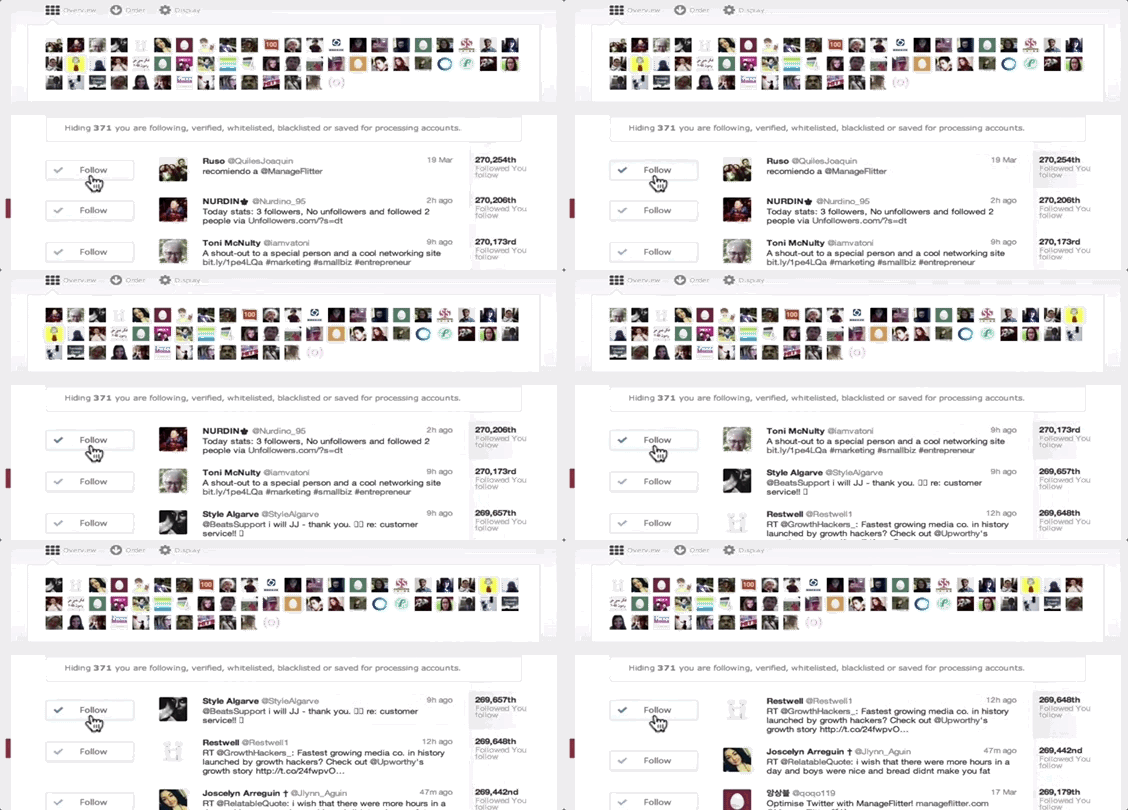
ManageFlitter’s spammy follow/unfollow tools

Today, Twitter is stepping up its fight against notification spammers. Earlier today, the functionality of three of these services — ManageFlitter, Statusbrew, Crowdfire — ceased to function, as spotted by social media consultant Matt Navarra.

TechCrunch inquired with Twitter about whether it had enforced its policy against those companies. A spokesperson provided this comment: “We have suspended these three apps for having repeatedly violated our API rules related to aggressive following & follow churn. As a part of our commitment to building a healthy service, we remain focused on rapidly curbing spam and abuse originating from use of Twitter’s APIs.” These apps will cease to function since they’ll no longer be able to programatically interact with Twitter to follow or unfollow people or take other actions.

Twitter’s policies specify that “Aggressive following (Accounts who follow or unfollow Twitter accounts in a bulk, aggressive, or indiscriminate manner) is a violation of the Twitter Rules.” This is to prevent a ‘tragedy of the commons’ situation. These services and their customers exploit Twitter’s platform, worsening the experience of everyone else to grow these customers’ follower counts. We dug into these three apps and found they each promoted features designed to help their customers spam Twitter users.

ManageFlitter‘s site promotes how “Following relevant people on Twitter is a great way to gain new followers. Find people who are interested in similar topics, follow them and often they will follow you back.” For $12 to $49 per month, customers can use this feature shown in the GIF above to rapidly follow others, while another feature lets them check back a few days later and rapidly unfollow everyone who didn’t follow them back. 

Crowdfire had already gotten in trouble with Twitter for offering a prohibited auto-DM feature and tools specifically for generating follow notifications. Yep it only changed its functionality to dip just beneath the rate limits Twitter imposes. It seems it preferred charging users up to $75 per month to abuse the Twitter ecosystem than accept that what it was doing was wrong.

StatusBrew details how “Many a time when you follow users, they do not follow back . . . thereby, you might want to disconnect with such users after let’s say 7 days. Under ‘Cleanup Suggestion’ we give you a reverse sorted list of the people who’re Not Following Back”. It charges $25 to $416 month for these spam tools. After losing its API access today, StatusBrew posted a confusing half-mea culpa, half-“it was our customers’ fault” blog post announcing it will shut down its follow/unfollow features.

Twitter tells TechCrunch it will allow these companies “apply for a new developer account and register a new, compliant app” but the existing apps will remain suspended. I think they deserve an additional time-out period. But still, this is a good step towards Twitter protecting the health of conversation on its platform from greedy spam services. I’d urge the company to also work to prevent companies and sketchy individuals from selling fake followers or follow/unfollow spam via Twitter ads or tweets.

When you can’t trust that someone who follows you is real, the notifications become meaningless distractions, faith in finding real connection sinks, and we become skeptical of the whole app. It’s the users that lose, so it’s the platforms’ responsibility to play referee.


from Social – TechCrunch https://tcrn.ch/2TrepG0
Original Content From: https://techcrunch.com
TECH Solutions - Facebook just removed a new wave of suspicious activity linked to Iran

Facebook just announced its latest round of “coordinated inauthentic behavior,” this time out of Iran. The company took down 262 Pages, 356 accounts, three Facebook groups and 162 Instagram accounts that exhibited “malicious-looking indicators” and patterns that identify it as potentially state-sponsored or otherwise deceptive and coordinated activity.

As Facebook Head of Cybersecurity Policy Nathaniel Gleicher noted in a press call, Facebook coordinated closely with Twitter to discover these accounts, and by collaborating early and often the company “[was] able to use that to build up our own investigation.” Today, Twitter published a postmortem on its efforts to combat misinformation during the US midterm election last year.

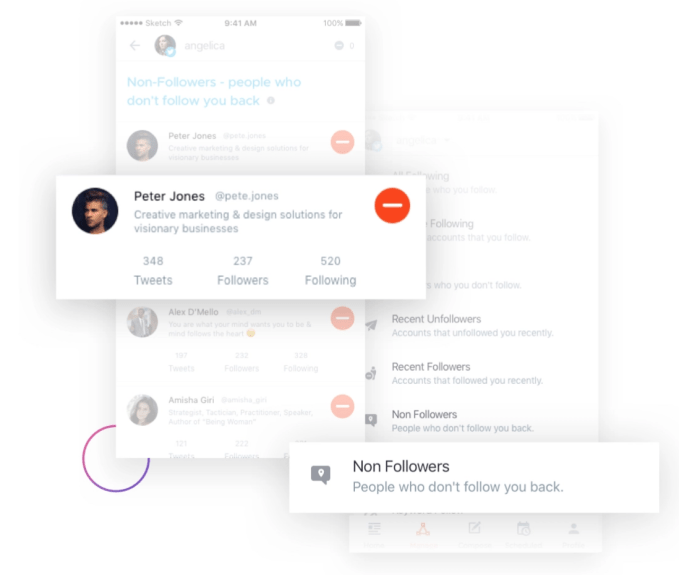
Example of the content removed

As the Newsroom post details, the activity affected a broad swath of areas around the globe:

“There were multiple sets of activity, each localized for a specific country or region, including Afghanistan, Albania, Algeria, Bahrain, Egypt, France, Germany, India, Indonesia, Iran, Iraq, Israel, Libya, Mexico, Morocco, Pakistan, Qatar, Saudi Arabia, Serbia, South Africa, Spain, Sudan, Syria, Tunisia, US, and Yemen. The Page administrators and account owners typically represented themselves as locals, often using fake accounts, and posted news stories on current events… on topics like Israel-Palestine relations and the conflicts in Syria and Yemen, including the role of the US, Saudi Arabia, and Russia.

Today’s takedown is the result of an internal investigation linking the newly discovered activity to other content out of Iran late last year. Remarkably, the activity Facebook flagged today dates back to 2010.

The Iranian activity was not focused on creating real world events, as we’ve seen in other cases. In many cases, the content “repurposed” reporting from Iranian state media and spread ideas that could benefit Iran’s positions on various geopolitical issues. Still, Facebook declined to link the newly identified activity to Iran’s government directly.

“Whenever we make an announcement like this we’re really careful,” Gleicher said. “We’re not in a position to directly assert who the actor is in this case, we’re asserting what we can prove.”


from Social – TechCrunch https://tcrn.ch/2WAkFgP
Original Content From: https://techcrunch.com

TECH Solutions - Instagram: Girl tells how she was 'hooked' on self-harm images

Libby's father says he reported disturbing content to Instagram, but the company did nothing.

from BBC News - Technology https://bbc.in/2t2rtpz
Original Content From: http://bbci.co.uk

TECH Solutions - Facebook users who quit the social network for a month feel happier

New research out of Stanford and New York University took a look at what happens when people step back from Facebook for a month.

Through Facebook, the research team recruited 2,488 people who averaged an hour of Facebook use each day. After assessing their “willingness to accept” the idea of deactivating their account for a month, the study assigned eligible participants to an experimental category that would deactivate their accounts or a control group that would not.

Over the course of the month-long experiment, researchers monitored compliance by checking participants’ profiles. The participants self-reported a rotating set of well being measures in real time, including happiness, what emotion a participant felt over the last 10 minutes and a measure of loneliness.

As the researchers report, leaving Facebook correlated with improvements on well being measures. They found that the group tasked with quitting Facebook ended up spending less time on other social networks too, instead spending more time to offline activities like spending time with friends and family (good) and watching television (maybe not so good). Overall the group reported that it spent less time consuming news in general.

The group that Facebook also reported less time spent on the social network after the study-imposed hiatus was up, suggesting that the break might have given them new insight into their own habits.

“Reduced post-experiment use aligns with our finding that deactivation improved subjective well-being, and it is also consistent with the hypotheses that Facebook is habit forming… or that people learned that they enjoy life without Facebook more than they had anticipated,” the paper’s authors wrote.

There are a few things to be aware of with the research. The paper notes that subjects were told they would “keep [their] access to Facebook Messenger.” Though the potential impact of letting participants remain on Messenger isn’t mentioned again, it sounds like they were still freely using one of the platform’s main functions though perhaps one with fewer potential negative effects on mood and behavior.

Unlike some recent research, this study was conducted by economics researchers. That’s not unusual for social psych-esque stuff like this but does inform aspects of the method, measured used and perspective.

Most important for a bit more context, the research was conducted in the run-up to the 2016 U.S. presidential election. That fact that is likely to have informed participants’ attitudes around social media, both before and after the election.

While the participants reported that they were less informed about current events, they also showed evidence of being less politically polarized, “consistent with the concern that social media have played some role in the recent rise of polarization in the US.”

In an era of ubiquitous threats to quit the world’s biggest social network, the fact remains that we mostly have no idea what our online habits are doing to our brains and behavior. Given that, we also don’t know what happens when we step back from social media environments like Facebook and give our brains a reprieve. With its robust sample size and fairly thorough methodology, this study provides us a useful glimpse into those effects. For more insight into the research, you can read the full paper here.


from Social – TechCrunch https://tcrn.ch/2RuvoW6
Original Content From: https://techcrunch.com

TECH Solutions - Digital influencers and the dollars that follow them

Animated characters are as old as human storytelling itself, dating back thousands of years to cave drawings that depict animals in motion. It was really in the last century, however — a period bookended by the first animated short film in 1908 and Pixar’s success with computer animation with Toy Story from 1995 onward — that animation leapt forward. Fundamentally, this period of great innovation sought to make it easier to create an animated story for an audience to passively consume in a curated medium, such as a feature-length film.

Our current century could be set for even greater advances in the art and science of bringing characters to life. Digital influencers — virtual or animated humans that live natively on social media — will be central to that undertaking. Digital influencers don’t merely represent the penetration of cartoon characters into yet another medium, much as they sprang from newspaper strips to TV and the multiplex. Rather, digital humans on social media represent the first instance in which fictional entities act in the same plane of communication as you and I — regular people — do. Imagine if stories about Mickey Mouse were told over a telephone or in personalized letters to fans. That’s the kind of jump we’re talking about.

Social media is a new storytelling medium, much as film was a century ago. As with film then, we have yet to transmit virtual characters to this new medium in a sticky way.

Which isn’t to say that there aren’t digital characters living their lives on social channels right now. The pioneers have arrived: Lil’ Miquela, Astro, Bermuda and Shudu are prominent examples. But they are still only notable for their novelty, not yet their ubiquity. They represent the output of old animation techniques applied to a new medium. This TechCrunch article did a great job describing the current digital influencer landscape.

So why haven’t animated characters taken off on social media platforms? It’s largely an issue of scale — it’s expensive and time-consuming to create animated characters and to depict their adventures. One 2017 estimate stated that a 60 to 90-second animation took about 6 weeks to create. An episode of animated TV takes between 13 months to produce, typically with large teams in South Korea doing much of the animation legwork. That pace simply doesn’t work in a medium that calls for new original content multiple times a day.

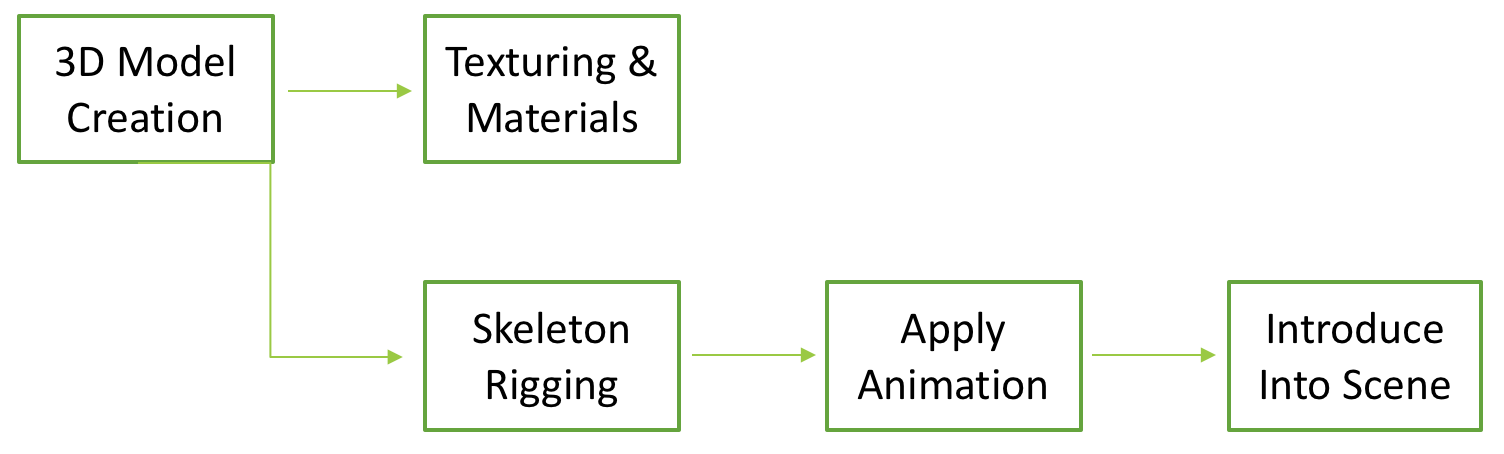
Yet the technical piece of the puzzle is falling into place, which is primarily what I want to talk about today. Traditionally, virtual characters were created by a team of experts — not scalable — in the following way:

  • Create a 3D model
  • Texture the model and add additional materials
  • Rig the 3D model skeleton
  • Animate the 3D model
  • Introduce character into desired scene

Today, there are generally three types of virtual avatar: realistic high-resolution CGI avatars, stylized CGI avatars and manipulated video avatars. Each has its strengths and pitfalls, and the fast-approaching world of scaled digital influencers will likely incorporate aspects of all three.

The digital influencers mentioned above are all high-resolution CGI avatars. It’s unsurprising that this tech has breathed life into the most prominent digital influencers so far — this type of avatar offers the most creative latitude and photorealism. You can create an original character and have her carry out varied activities.

The process for their creation borrows most from the old-school CGI pipeline described above, though accelerated through the use of tools like Daz3D for animation, Moka Studio for rigging, and Rokoko for motion capture. It’s old wine in new bottles. Naturally, it shares the same bottlenecks as the old-school CGI pipeline: creating characters in this way consumes a lot of time and expertise.

Though researchers, like Ari Shapiro at the University of Southern California Institute for Creative Technologies, are currently working on ways to automate the creation of high-resolution CGI avatars, that bottleneck remains the obstacle for digital influencers entering the mainstream.

Stylized CGI avatars, on the other hand, have entered the mainstream. If you have an iPhone or use Snapchat, chances are you have one. Apple, Samsung, Pinscreen, Loom.ai, Embody Digital, Genies and Expressive.ai are just some of the companies playing in this space. These avatars, while likely to spread ubiquitously à la Bitmoji before them, are limited in scope.

While they extend the ability to create an animated character to anyone who uses an associated app, that creation and personalization is circumscribed: the avatar’s range is limited for the purposes of what we’re discussing in this article. It’s not so much a technology for creating new digital humans as it is a tool for injecting a visual shorthand for someone into the digital world. You’ll use it to embellish your Snapchat game, but storytellers will be unlikely to use these avatars to create a spiritual successor to Mickey Mouse and Buzz Lightyear (though they will be a big advertising / brand partnership opportunity nonetheless).

Video manipulation — you probably know it as deepfakes — is another piece of tech that is speeding virtual or fictional characters into the mainstream. As the name implies, however, it’s more about warping reality to create something new. Anyone who has seen Nicolas Cage’s striking features dropped onto Amy Adams’ body in a Superman film will understand what I’m talking about.

Open-source packages like this one allow almost anyone to create a deepfake (with some technical knowhow — your grandma probably hasn’t replaced her time-honored Bingo sessions with some casual deepfaking). It’s principally used by hobbyists, though recently we’ve seen startups like Synthesia crop up with business use cases. You can use deepfake tech for mimicry, but we haven’t yet seen it used for creating original characters. It shares some of the democratizing aspects of stylized CGI avatars, and there are likely many creative applications for the tech that simply haven’t been realized yet.

While none of these technology stacks on their own currently enable digital humans at scale, when combined they may make up the wardrobe that takes us into Narnia. Video manipulation, for example, could be used to scale realistic high-res characters like Lil’ Miquela through accelerating the creation of new stories and tableaux for her to inhabit. Nearly all of the most famous animated characters have been stylized, and I wouldn’t bet against social media’s Snow White being stylized too. What is clear is that the technology to create digital influencers at scale is nearing a tipping point. When we hit that tipping point, these creations will transform entertainment and storytelling.


from Social – TechCrunch https://tcrn.ch/2HKGyq7
Original Content From: https://techcrunch.com

Pandora-powered channels will come to SiriusXM’s app this year

SiriusXM this week offered a few more details on how it plans to leverage its newest asset, Pandora, following its $3.5 billion acquisition of the streaming music service last year, which officially closes on Friday. At the time of the deal, the company spoke about the potential for cross-promotion opportunities between the services and new subscription packages. Now, those efforts are getting off the ground — starting with a promotion within the Pandora app for SiriusXM subscriptions, followed by the launch of Pandora channels within the SiriusXM app.

Currently, SiriusXM offers a variety of programming packages, ranging from a cheaper ($11/mo) “Mostly Music” sampling of channels all the way up to a premium “All Access” ($21/mo) subscription. It also runs various time-limited promotions that offer its service for as little as $5 per month for a set period, like six months.

According to Sirius XM CEO James Meyer — speaking to investors on the Q4 earnings call on Wednesday — the company will now start promoting special SiriusXM packages to Pandora listeners.

The company, he said, intends “to capitalize on cross-promotion opportunities between SiriusXM’s more than 36 million subscribers across North America and Pandora’s approximately 70 million monthly active users. In early February, we will begin a targeted promotion to SiriusXM subscribers and Pandora listeners,” he noted. “Select Pandora listeners will receive an offer to obtain a unique $5 a month ‘Mostly News,’ ‘Mostly Music’ or ‘News Talk’ [SiriusXM subscription] package in their satellite-equipped vehicle.”

In other words, SiriusXM will be pushing low-cost $5 per month streaming plans within the Pandora app itself.

The company believes the cross-promotions will be successful because of the overlap in the two services’ customer bases. It found that approximately half of the owners of the SiriusXM-enabled vehicle fleet of 100 million cars have used Pandora in the past two years, for example. SiriusXM aims to leverage those Pandora listeners’ data in order to convert, retain or bring them back to SiriusXM.

In addition, the exec said that existing SiriusXM subscribers would receive extended 14-day trials to Pandora’s Premium service.

By mid-2019, the company plans to launch a new Pandora-powered channel within its own SiriusXM app, based on their favorite artist. It will also add a new radio channel to the SiriusXM app that’s driven by the latest trends from Pandora’s “billions of thumbs” — meaning the “thumbs up” (likes), songs receive within the streaming app.

Meyer spoke briefly about the challenges facing Pandora — specifically a decline in listening hours, which SiriusXM believes can be fixed by improving Pandora’s in-car listening statistics, making the Pandora app more compelling, and adding more content.

“This is just the beginning. We expect, over time, to create new, unique audio packages that will bring together the best of both services, creating a powerful platform for artists to reach their fans and to create new audiences,” said Meyer.

The merger of the two companies has not been without upheaval, though.

This week, the company announced that Pandora CEO Roger Lynch and other executives would be stepping down, including general counsel Steve Bene, CFO Naveen Chopra and chief human resources officer Kristen Robinson. Meyer will instead lead the combined company, he said, in order to streamline decision-making and increase the speed of the integrations.

SiriusXM reported record revenues for the fourth quarter and year, at $1.5 billion and $5.8 billion, respectively. Net income was $251 million for the quarter, up from a loss of $37 million in the year-ago period. Full-year 2018 net income grew 81 percent to a record $1.2 billion.

The newly combined company will have more than 100 million listeners in North America, with nearly 40 million self-paying subscribers and more than 75 million on trials or using ad-based products.


from Mobile – TechCrunch https://tcrn.ch/2S1Mvna
ORIGINAL CONTENT FROM: https://techcrunch.com/

TECH Solutions - Obscene porn rules relaxed in England and Wales

Guidelines about what constitutes "obscene" pornography have been relaxed in England and Wales.

from BBC News - Technology https://bbc.in/2GbfmOU
Original Content From: http://bbci.co.uk

TECH Solutions - Mario Kart mobile delayed until summer 2019

Nintendo announces the Mario Kart Tour app will be delayed until summer 2019.

from BBC News - Technology https://bbc.in/2G1broD
Original Content From: http://bbci.co.uk

Nintendo’s Mario Kart mobile game won’t launch until the summer

It’s been a long year for Nintendo fans waiting on Mario Kart Tour to come to mobile and, unfortunately, more patience is required after the game’s launch was moved back to this summer.

Nintendo announced plans to bring the much-loved franchise to smartphones one year ago. It was originally slated to launch by the end of March 2019, but the Japanese games giant said today it is pushing that date back to summer 2019.

The key passage sits within Nintendo’s latest earnings report, released today, which explains that additional time is needed “to improve [the] quality of the application and expand the content offerings after launch.”

It’s frustrating but, as The Verge points out, you can refer to a famous Nintendo phrase if you are seeking comfort.

Shigeru Miyamoto, who created the Mario and Zelda franchises, once remarked that “a delayed game is eventually good, but a rushed game is forever bad.”

There’s plenty riding on the title — excuse the pun. Super Mario Run, the company’s first major game for the iPhone, showed its most popular IP has the potential to be a success on mobile, even though Mario required a $9.99 payment to go beyond the limited demo version. Mario Kart is the most successful Switch title to date, so it figures that it can be a huge smash on mobile if delivered in the right way.


from Mobile – TechCrunch https://tcrn.ch/2DKPmZ3
ORIGINAL CONTENT FROM: https://techcrunch.com/

Tech Solutions -Sussex sign Mir Hamza for Championship spell

Left-arm seamer will be available for eight Specsavers Championship matches between May and July

from Pakistan news from ESPN Cricinfo.com https://es.pn/2DLQJqA
Original Content From : https://es.pn/Ti8aBD

Step targets teens and parents with a no-fees mobile bank account and Visa card

A new mobile banking startup called Step wants to help bring teenagers and other young adults into the cashless era. Today, cash is used less often, as more consumers shop online and send money to one another through payment apps like Venmo. But teenagers in particular are still heavily burdened with cash — even though they, too, want to spend their money on things that require a payment card, like Amazon.com purchases or mobile gaming, for example.

That’s where Step comes in.

The company aims to address the needs of what it believes is an underserved market in mobile banking — the 75 million children and young adults under the age of 21 in the U.S., who are still being forced to use cash.

This market isn’t the “unbanked,” it’s the “pre-banked,” explains Step CEO CJ MacDonald, whose previous startup, mobile gift card platform Gyft, sold to First Data several years ago.

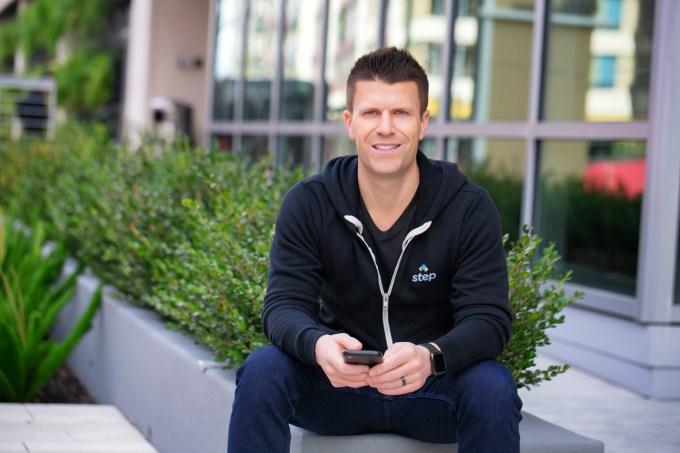
Above: Step CEO, CJ MacDonald

“We’re building an all-in-one banking solution that primarily focuses on teens and parents,” he says. “We want it to be a teen’s first bank account. We want to be a teen’s first spending card. And we want to teach financial literacy and responsibility firsthand.”

MacDonald, along with CTO Alexey Kalinichenko, previously of Square and financial services startup Token, founded Step in May 2018. The 10-person team also includes several prior Gyft employees.

Last summer, Step closed on $3.8 million in seed funding from Sesame Ventures, Crosslink Capital and Collaborative Fund. Crosslink general partner Eric Chin sits on the board.

While there are a number of mobile banking apps out there today — like Chime, Monzo, Simple, Revolut and others — Step will specifically target teens, 13 and up, and other young adults with its marketing. Teens under 18 still need parents’ approval to sign up, of course. But the goal is to encourage the teens to bring the idea to their parents — not the other way around.

Step’s focus on this younger demographic puts it in a different space, where there are fewer competitors. Its more direct rivals are not the bigger mobile banks, but rather startups like teen debit card and bank app Current, or the parent-managed debit card for kids from Greenlight.

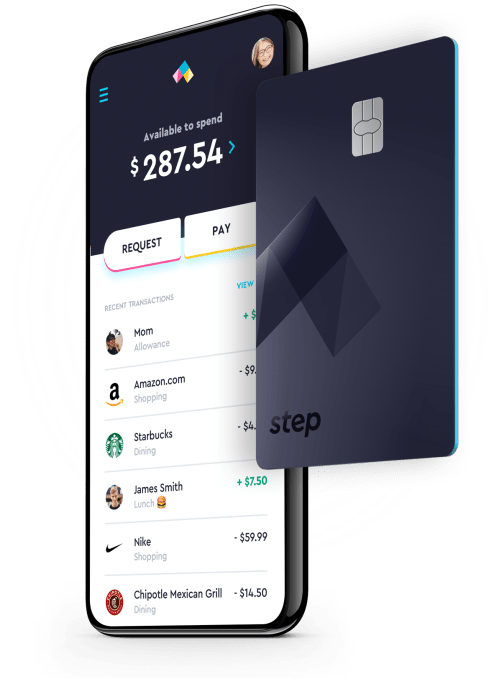
The mobile banking service Step provides will also aim to be more comprehensive than just a debit card. It will offer a combination of checking, savings and a Visa card that works as both credit and debit.

The card includes Visa’s Zero Liability Protection on all purchases from unauthorized use, and allows parents to set spending limits.

Parents will also be able to connect their own bank accounts to Step to instantly transfer in funds, which can then be distributed to kids’ accounts for things like allowances and chores, or other everyday spending needs. Step’s bank account itself is backed by Evolve Bank, so it’s FDIC-insured up to $250,000.

Unlike Current, which charges a subscription to use its service, Step aims to be a fee-free bank for consumers. Users don’t have to pay for their account, and there are no fees for things like overdrafts. Instead, Step’s plan is to generate revenue through traditional means — like interchange fees and by way of lending practices, once it has established a deposit base.

The company pays a 2.5 percent interest rate on deposits, offers a round-up savings feature and a range of budgeting tools and supports free instant transfers between Step accounts. It also provides access to a network of 35,000 ATMs with no fees.

Beyond simply facilitating mobile banking, Step’s bigger goal is to teach teens to become financially responsible.

“Schools do not teach kids about money. A lot of families don’t talk about money. And it’s a crucial life skill that’s not really addressed properly when people are growing up,” says MacDonald, who says he was lacking in life skills in this area, even as a young college grad.

“There were ‘Money 101’ skills that I had not learned — that no one had talked to me about. Things like building credit, how many credit cards you should have, debt to income ratio,” he continues. “A lot of people get released into the real world without experience [in those areas],” he says.

Long-term, after solving the needs associated with everyday banking transactions, Step wants to layer on other products and services — like tools that allow a family to save together for college, for example.

The company is launching the banking service under an invite-only system to scale up.

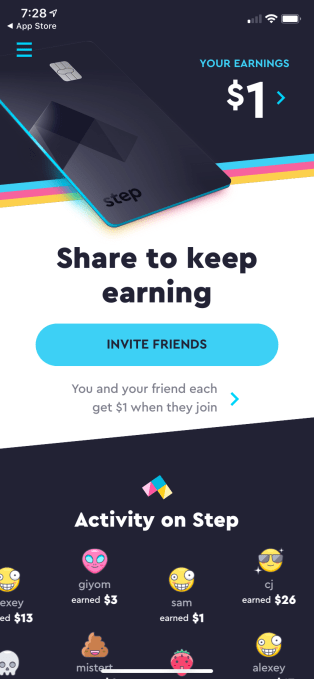
Today, it’s opening a waitlist and referral program. When you invite a friend, you each receive one dollar. Access will then be rolled out on a first-come, first-serve basis this spring. Users can join Step through the website, iOS or Android application.


from Mobile – TechCrunch https://tcrn.ch/2GcVMSr
ORIGINAL CONTENT FROM: https://techcrunch.com/

Technical Solutions - Tech Talks #727 - PUBG BAN in INDIA?, Oppo R17/F11 Leaks, Google Pay, Whatsapp Payments, Sony 52MP

Tech Talks #727 - PUBG BAN in INDIA?, Oppo R17/F11 Leaks, Google Pay, Whatsapp Payments, Sony 52MP
TG Deals@ https://tg.deals/ New Channel: https://goo.gl/Jz6p5K Namaskaar Dosto, Tech Talks ke is Episode mein maine aapse kuch interesting Tech News Share ki hai jaise Oppo R17/F11 Leaks with Pop Up Camera, Whatsapp Payments, Google Pay India, PUBG Ban in India, Meizu Zero on Indiegogo, Sony XZ4 52MP Camera, Gaming Profession in China, aur bahut kuch. Mujhe umeed hai ki yeh video aapko pasand aayega. Share, Support, Subscribe!!! Subscribe: http://bit.ly/1Wfsvt4 Android App: http://bit.ly/2mrm9Gy Youtube: http://www.youtube.com/c/TechnicalGuruji Twitter: http://www.twitter.com/technicalguruji Facebook: http://bit.ly/1Pi5LDP Facebook Myself: https://goo.gl/zUfbUU Instagram: http://bit.ly/1OW2vue Google Plus: http://bit.ly/1Pi5LDS Website: http://bit.ly/2mcM6KV Merchandise: http://bit.ly/2lN4Vbu About : Technical Guruji is a YouTube Channel, where you will find technological videos in Hindi, New Video is Posted Everyday :)


TECH Solutions - Leaked TikTok ad deck suggests it has 17M+ MAUs in Europe

An advertising pitch deck used by fast-growing short form video sharing app TikTok has leaked, providing a snapshot of usage in its biggest markets in Europe.

The pitch deck was obtained by Digiday which says it was sent to a large (unnamed) European ad agency.

Metrics and gender breakdowns for the UK, France, Germany, Spain and Italy are included in the deck. The slides are dated November 2018.

Germany and France come out as the top European markets for the video sharing app, according to the deck, with 4.1M+ and 4M+ monthly active users respectively, and an average of 6.5BN and 5BN video views.

Next is the UK, with 3.7M+ users (and 5BN video views); followed by Spain with 2.7M+ users (and 3BN video views); and Italy with 2.4M+ users (and 3BN views).

Last summer Beijing’s ByteDance, the company behind TikTok, said the app had passed 500 million monthly active users worldwide.

Analyst estimates suggest it’s had around 800M total downloads in total since launch in fall 2016.

Although usage stepped up in 2017, after Bytedance shelled out to acquire rival lip-sync video app, Musical.ly — paying between $800M and $1BN to bag and merge its 60M (mostly US) users.

In the UK, France and Germany TikTok users open the app an average of 8 times per day, according to the leaked deck, vs 6 times in Italy and Spain.

While UK users clock up the most time spent in the app, with an average of 41 minutes per day; followed by France (40 minutes); Germany (39 minutes); Italy (34 minutes); and Spain (31 minutes).

Users of the app skew female across all five markets but the skew is greatest in Italy and Spain, which both have a 65:35 female to male ratio.

The smallest skew is in Germany where the female to male ratio of users is 54:46.

The pitch deck also details ad formats TikTok is selling in the region, covering four ad products and how they are measured.

The listed ad products are: Brand takeover; in-feed native video; hashtag challenge; and Snapchat-style 2D lens filters for photos — with 3D and AR lenses listed as “coming soon” (2019, per another slide).

The slides do not include prices for the ad formats but Digiday cites one media buyer who told it the company is charging $10 CPMs for fixed buys. Though it says another media exec told it agencies are being given different rates, noting the person had heard higher prices for the brand takeover ad unit for example.

We’ve reached out to TikTok for comment.


from Social – TechCrunch https://tcrn.ch/2CXX3cU
Original Content From: https://techcrunch.com

Tech Solutions - #777 Whatsapp 1.8 Cr, Galaxy M20 OTA, Galaxy A50, Jio PrimeFriday, Realme 2 Pro Pie, Titan SF Rush

#777 Whatsapp 1.8 Cr, Galaxy M20 OTA, Galaxy A50, Jio PrimeFriday, Realme 2 Pro Pie, Titan SF Rush
Hi Friends: This is my Blog Technical Solutions created to share videos and content of technical solutions with the world. At this blog you can find videos about Free Search Engine Optimization Course, how to develope Android Applications and What is Computer hardware and software, you would be able to increse your channel views, or boost your website. so guys keep visiting my blog for learning technical things. Thank You!


TECH Solutions - Russian hackers 'stole Mueller inquiry evidence'

Hackers are trying to discredit the inquiry into alleged Russian interference in US politics, prosecutors say.

from BBC News - Technology https://bbc.in/2Rujpbd
Original Content From: http://bbci.co.uk

Tech Solutions -Odds tilted Pakistan's way as Newlands prepares for T20I series

Pakistan have won 11 T20I series in a row coming into this fixture against a home side that has several new faces to try out

from Pakistan news from ESPN Cricinfo.com https://es.pn/2Utze3F
Original Content From : https://es.pn/Ti8aBD

TECH Solutions - Drones help Galapagos tackle rat infestation

Tonnes of poison was laid down by drones in a project to get rid of the invasive species.

from BBC News - Technology https://bbc.in/2CXz8KE
Original Content From: http://bbci.co.uk

TECH Solutions - Facebook adviser attacks 'lax' child checks

Facebook's approach to parental consent was "most concerning", says a member of its Safety Advisory Board.

from BBC News - Technology https://bbc.in/2MGEtug
Original Content From: http://bbci.co.uk

TECH Solutions - Social media should have “duty of care” towards kids, UK MPs urge

Social media platforms are being urged to be far more transparent about how their services operate and to make “anonymised high-level data” available to researchers so the technology’s effects on users — and especially on children and teens — can be better understood.

The calls have been made in a report by the UK parliament’s Science and Technology Committee which has been looking into the impacts of social media and screen use among children — to consider whether such tech is “healthy or harmful”.

“Social media companies must also be far more open and transparent regarding how they operate and particularly how they moderate, review and prioritise content,” it writes.

Concerns have been growing about children’s use of social media and mobile technology for some years now, with plenty of anecdotal evidence and also some studies linking tech use to developmental problems, as well as distressing stories connecting depression and even suicide to social media use.

Although the committee writes that its dive into the topic was hindered by “the limited quantity and quality of academic evidence available”. But it also asserts: “The absence of good academic evidence is not, in itself, evidence that social media and screens have no effect on young people.”

“We found that the majority of published research did not provide a clear indication of causation, but instead indicated a possible correlation between social media/screens and a particular health effect,” it continues. “There was even less focus in published research on exactly who was at risk and if some groups were potentially more vulnerable than others when using screens and social media.”

The UK government expressed its intention to legislate in this area, announcing a plan last May to “make social media safer” — promising new online safety laws to tackle concerns.

The committee writes that it’s therefore surprised the government has not commissioned “any new, substantive research to help inform its proposals”, and suggests it get on and do so “as a matter of urgency” — with a focus on identifying people at risk of experiencing harm online and on social media; the reasons for the risk factors; and the longer-term consequences of the tech’s exposure on children.

It further suggests the government should consider what legislation is required to improve researchers’ access to this type of data, given platforms have failed to provide enough access for researchers of their own accord.

The committee says it heard evidence of a variety of instances where social media could be “a force for good” but also received testimonies about some of the potential negative impacts of social media on the health and emotional wellbeing of children.

“These ranged from detrimental effects on sleep patterns and body image through to cyberbullying, grooming and ‘sexting’,” it notes. “Generally, social media was not the root cause of the risk but helped to facilitate it, while also providing the opportunity for a large degree of amplification. This was particularly apparent in the case of the abuse of children online, via social media.

“It is imperative that the government leads the way in ensuring that an effective partnership is in place, across civil society, technology companies, law enforcement agencies, the government and non-governmental organisations, aimed at ending child sexual exploitation (CSE) and abuse online.”

The committee suggests the government commission specific research to establish the scale and prevalence of online CSE — pushing it to set an “ambitious target” to halve reported online CSE in two years and “all but eliminate it in four”.

A duty of care

A further recommendation will likely send a shiver down tech giants’ spines, with the committee urging a duty of care principle be enshrined in law for social media users under 18 years of age to protect them from harm when on social media sites.

Such a duty would up the legal risk stakes considerably for user generated content platforms which don’t bar children from accessing their services.

The committee suggests the government could achieve that by introducing a statutory code of practice for social media firms, via new primary legislation, to provide “consistency on content reporting practices and moderation mechanisms”.

It also recommends a requirement in law for social media companies to publish detailed Transparency Reports every six months.

It is also for a 24 hour takedown law for illegal content, saying that platforms should have to review reports of potentially illegal content and take a decision on whether to remove, block or flag it — and reply the decision to the individual/organisation who reported it — within 24 hours.

Germany already legislated for such a law, back in 2017 — though in that case the focus is on speeding up hate speech takedowns.

In Germany social media platforms can be fined up to €50 million if they fail to comply with the NetzDG law, as its truncated German name is known. (The EU executive has also been pushing platforms to remove terrorist related material within an hour of a report, suggesting it too could legislate on this front if they fail to moderate content fast enough.)

The committee suggests the UK’s media and telecoms regulator, Ofcom would be well-placed to oversee how illegal content is handled under any new law.

It also recommends that social media companies use AI to identify and flag to users (or remove as appropriate) content that “may be fake” — pointing to the risk posed by new technologies such as “deep fake videos”.

More robust systems for age verification are also needed, in the committee’s view. It writes that these must go beyond “a simple ‘tick box’ or entering a date of birth”.

Looking beyond platforms, the committee presses the government to take steps to improve children’s digital literacy and resilience, suggesting PSHE (personal, social and health) education should be made mandatory for primary and secondary school pupils — delivering “an age-appropriate understanding of, and resilience towards, the harms and benefits of the digital world”.

Teachers and parents should also not be overlooked, with the committee suggesting training and resources for teachers and awareness and engagement campaigns for parents.


from Social – TechCrunch https://tcrn.ch/2RXw2AC
Original Content From: https://techcrunch.com
Poor smartphones sales drag LG to first quarterly loss in 2 years

We’ve written extensively about LG’s struggling mobile business, which has suffered at the hands of aggressive Chinese Android makers, and now that unit has dragged its parent company into posting its first quarterly loss for two years.

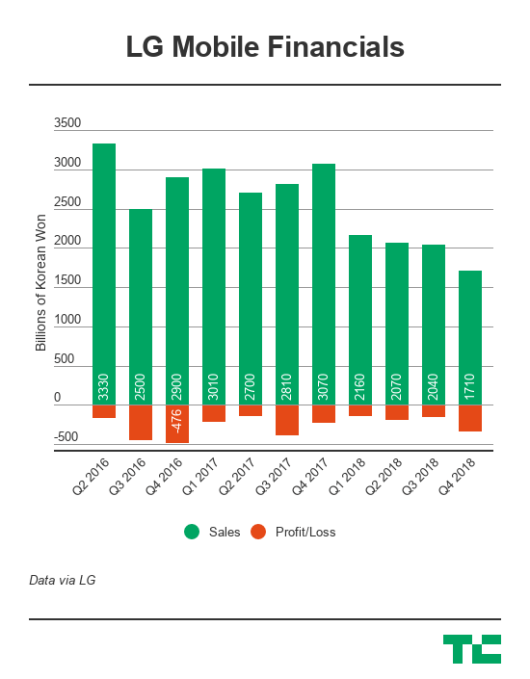
The Korean electronics giant is generally in good health — it posted a $2.4 billion profit for 2018 — but its smartphone business’s failings saw it post a loss in Q4 2018, its first quarterly negative since Q4 2016.

Overall, the company posted a KRW 75.7 billion ($67.1 million) operating loss as revenue slid seven percent year-on-year to KRW 15.77 trillion ($13.99 billion). LG said the change was “primarily due to lower sales of mobile products.”

We’ve known for some time that LG’s mobile business is strugglingthe division got another new head last November — but things went from bad to worse in Q4. LG Mobile saw revenue fall by 42 percent to reach KRW 1.71 trillion, $1.51 billion. The operating loss for the period grew to KRW 322.3 billion, or $289.8 million, from KRW 216.3 billion, $194 million, one year previous.

Over the full year, LG Mobile posted a $700 million loss (KRW 790.1 billion) but the company claimed things are improving thanks to “better material cost controls and overhead efficiencies based on the company’s platform modularization strategy.”

LG used CES to showcase a range of home entertainment products — that division is doing far better than mobile, with a record annual profit of $1.35 billion in 2018 — so we’ll have to wait until Mobile World Congress in February to see exactly what LG has in mind. Already, though, we have a suggestion and it isn’t exactly set-the-world-on-fire stuff.

“LG’s mobile division will push 5G products and smartphones featuring different form factors while focusing on key markets where the LG brand remains strong,” the company said in a statement.

It will certainly take something very special to turn things around. It seems more likely that LG Mobile head Brian Kwon — who also heads up that hugely-profitable home entertainment business — will focus on cutting costs and squeezing out the few sweet spots left. Continued losses, particularly against success from other units, might eventually see LG shutter its mobile business.

Still, things could be worse for LG, it could be HTC.


from Mobile – TechCrunch https://tcrn.ch/2SknHWY
ORIGINAL CONTENT FROM: https://techcrunch.com/

Tech Solutions -Dottin blitz helps West Indies brush past Pakistan in series opener

She struck an unbeaten 90 off 60 balls and followed it with a wicket to consign the hosts to a 71-run loss in Karachi

from Pakistan news from ESPN Cricinfo.com https://es.pn/2RXkZr8
Original Content From : https://es.pn/Ti8aBD

TECH Solutions - Knife crime: Suspects could be banned from social media

Those breaching sanctions aimed at cutting rising violence could face up to two years in prison.

from BBC News - Technology https://bbc.in/2S9v6bN
Original Content From: http://bbci.co.uk

Technical Solutions - Stock Android Vs Android One Vs Android Go - The Basic Differences Explained 🔥

Stock Android Vs Android One Vs Android Go - The Basic Differences Explained 🔥
Namaskaar Dosto, yeh video ek important video hai jaha maine aapse baat ki hai Android ke baare mein jaha pe, maine share ki hai information Android ke alag alag flavours ke baare mein jaha pe Android One hai, Android Go hai, Stock Android hai aur alag alag smartphone brands ki Custom Skins hai, jaha humne android updates ko bhi discuss kiya hai aur jaana hai inke beech ke main differences ko. Mujhe umeed hai ki aapko Android Versions ke baare mein yeh video pasand aayegi. Share, Support, Subscribe!!! Subscribe: http://bit.ly/1Wfsvt4 Android App: http://bit.ly/2mrm9Gy Youtube: http://www.youtube.com/c/TechnicalGuruji Twitter: http://www.twitter.com/technicalguruji Facebook: http://bit.ly/1Pi5LDP Facebook Myself: https://goo.gl/zUfbUU Instagram: http://bit.ly/1OW2vue Google Plus: http://bit.ly/1Pi5LDS Website: http://bit.ly/2mcM6KV Merchandise: http://bit.ly/2lN4Vbu About : Technical Guruji is a YouTube Channel, where you will find technological videos in Hindi, New Video is Posted Everyday :)


Samsung posts fourth-quarter profit drop, warns of weak demand until the second half of 2019

Samsung Electronics reported its largest quarterly profit decline in two years during its earnings report today. As the Galaxy maker warned in its earnings guidance earlier this month, its results were hurt by slower-than-expected demand for semiconductors, which had bolstered its earnings in previous quarters even when smartphone sales were slow.

Samsung’s forecast was also dour, at least for the first half of the year. It said annual earnings will decline thanks to continuing weak demand for chips, but expects demand for memory products and OLED panels to improve during the second half.

The company’s fourth-quarter operating profit was 10.8 trillion won (about $9.7 billion), a 28.7 percent decrease from the 15.15 trillion won it recorded in the same period one year ago. Revenue was 59.27 trillion won, a 10.2 percent drop year over year.

Broken out by business, Samsung’s semiconductor unit recorded quarterly operating profit of 7.8 trillion won, down from 10.8 trillion won a year ago. Its mobile unit’s operating profit was 1.5 trillion won, compared to 2.4 trillion won a year ago.

Smartphone makers, including Samsung rival Apple, have been hit hard by slowing smartphone sales around the world, especially in China. Upgrade cycles are also becoming longer as customers wait to buy newer models.

This hurt both Samsung’s smartphone and chip sales, as “overall market demand for NAND and DRAM drop[ped] due to macroeconomic uncertainties and adjustments in inventory levels by customers including datacenter companies and smartphone makers,” said the company’s earnings report.

Samsung expects chip sales to be sluggish during the first quarter because of weak seasonality and inventory adjustments by its biggest customers. The company was optimistic about the last two quarters of 2019, when it expects demand for chips and OLED panels to pick up thanks seasonal demand and customers finishing their inventory adjustments.


from Mobile – TechCrunch https://tcrn.ch/2Ts5sMQ
ORIGINAL CONTENT FROM: https://techcrunch.com/