Saturday, March 31, 2018

Facebook plans crackdown on ad targeting by email without consent

Facebook is scrambling to add safeguards against abuse of user data as it reels from backlash over the Cambridge Analytica scandal. Now TechCrunch has learned Facebook will launch a certification tool that demands that marketers guarantee email addresses used for ad targeting were rightfully attained. This new Custom Audiences certification tool was described by Facebook representatives to their marketing clients, according to two sources. Facebook will also prevent the sharing of Custom Audience data across Business accounts.
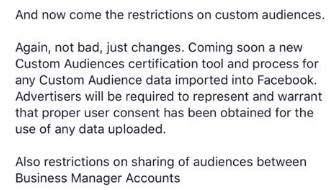
This snippet of a message sent by a Facebook rep to a client notes that “for any Custom Audiences data imported into Facebook, Advertisers will be required to represent and warrant that proper user content has been obtained.”

Once shown the message, Facebook spokesperson Elisabeth Diana told TechCrunch “I can confirm there is a permissions tool that we’re building.” It will require that advertisers and the agencies representing them pledge that “I certify that I have permission to use this data”, she said.

Diana noted that “We’ve always had terms in place to ensure that advertisers have consent for data they use but we’re going to make that much more prominent and educate advertisers on the way they can use the data.” The change isn’t in response to a specific incident, but Facebook does plan to re-review the way it works with third-party data measurement firms to ensure everything is responsibly used. This is a way to safeguard data” Diana concluded.The company declined to specify whether it’s ever blocked usage of a Custom Audience because it suspected the owner didn’t have user consent. ”

The social network is hoping to prevent further misuse of ill-gotten data after Dr. Aleksandr Kogan’s app that pulled data on 50 million Facebook users was passed to Cambridge Analytica in violation of Facebook policy. That sordid data is suspected to have been used by Cambridge Analytica to support the Trump and Brexit campaigns, which employed Custom Audiences to reach voters.
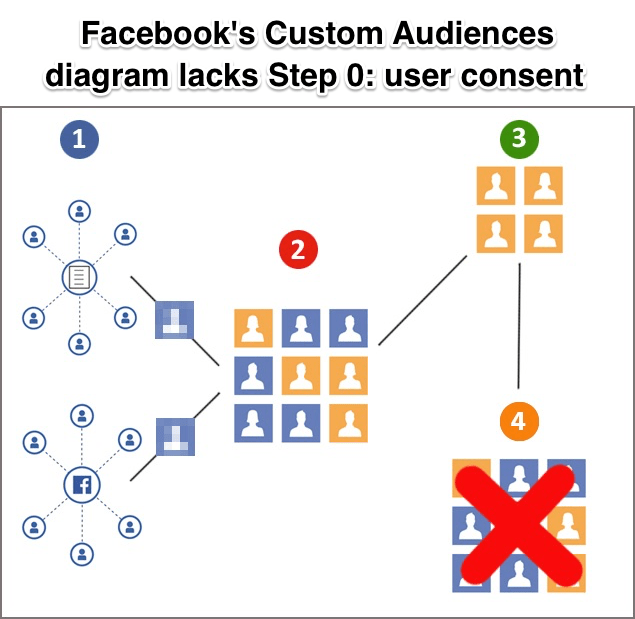
Facebook launched Custom Audiences back in 2012 to let businesses upload hashed lists of their customers email addresses or phone numbers, allowing advertisers to target specific people instead of broad demographics. Custom Audiences quickly became one of Facebook’s most powerful advertising options because businesses could easily reach existing customers to drive repeat sales. The Custom Audiences terms of service require that businesses have “provided appropriate notice to and secured any necessary consent from the data subjects” to attain and use these people’s contact info.

But just like Facebook’s policy told app developers like Kogan not to sell, share, or misuse data they collected from Facebook users, the company didn’t go further to enforce this rule. It essentially trusted that the fear of legal repercussions or suspension on Facebook would deter violations of both its app data privacy and Custom Audiences consent policies. With clear financial incentives to bend or break those rules and limited effort spent investigating to ensure compliance, Facebook left itself and its users open to exploitation.

Last week Facebook banned the use of third-party data brokers like Experian and Acxiom for ad targeting, closing a marketing featured called Partner Categories. Facebook is believed to have been trying to prevent any ill-gotten data from being laundered through these data brokers and then directly imported to Facebook to target users. But that left open the option for businesses to compile illicit data sets or pull them from data brokers, then upload them to Facebook as Custom Audiences by themselves.

The Custom Audiences certification tool could close that loophole. It’s still being built, so Facebook wouldn’t say exactly how it will work. I asked if Facebook would scan uploaded user lists and try to match them against a database of suspicious data, but for now it sounds more like Facebook will merely require a written promise.

Meanwhile, barring the sharing of Custom Audiences between Business Accounts might prevent those with access to email lists from using them to promote companies unrelated to the one to which users gave their email address. Facebook declined to comment on how the new ban on Custom Audience sharing would work.

Now Facebook must find ways to thwart misuse of its targeting tools and audit anyone it suspects may have already violated its policies. Otherwise it may receive the ire of privacy-conscious users and critics, and strengthen the case for substantial regulation of its ads (though regulation could end up protecting Facebook from competitors who can’t afford compliance). Still the question remains why it took such a massive data privacy scandal for Facebook to take a tougher stance on requiring user consent for ad targeting. And given that written promises didn’t stop Kogan or Cambridge Analytica from misusing data, why would they stop advertisers bent on boosting profits?

For more on Facebook’s recent scandals, check out TechCrunch’s coverage:


from Mobile – TechCrunch https://ift.tt/2GsTiwJ
ORIGINAL CONTENT FROM: https://techcrunch.com/

TECH Solutions - Facebook plans crackdown on ad targeting by email without consent

Facebook is scrambling to add safeguards against abuse of user data as it reels from backlash over the Cambridge Analytica scandal. Now TechCrunch has learned Facebook will launch a certification tool that demands that marketers guarantee email addresses used for ad targeting were rightfully attained. This new Custom Audiences certification tool was described by Facebook representatives to their marketing clients, according to two sources. Facebook will also prevent the sharing of Custom Audience data across Business accounts.

This snippet of a message sent by a Facebook rep to a client notes that “for any Custom Audiences data imported into Facebook, Advertisers will be required to represent and warrant that proper user content has been obtained.”

Once shown the message, Facebook spokesperson Elisabeth Diana told TechCrunch “I can confirm there is a permissions tool that we’re building.” It will require that advertisers and the agencies representing them pledge that “I certify that I have permission to use this data”, she said.

Diana noted that “We’ve always had terms in place to ensure that advertisers have consent for data they use but we’re going to make that much more prominent and educate advertisers on the way they can use the data.” The change isn’t in response to a specific incident, but Facebook does plan to re-review the way it works with third-party data measurement firms to ensure everything is responsibly used. This is a way to safeguard data” Diana concluded.The company declined to specify whether it’s ever blocked usage of a Custom Audience because it suspected the owner didn’t have user consent. ”

The social network is hoping to prevent further misuse of ill-gotten data after Dr. Aleksandr Kogan’s app that pulled data on 50 million Facebook users was passed to Cambridge Analytica in violation of Facebook policy. That sordid data is suspected to have been used by Cambridge Analytica to support the Trump and Brexit campaigns, which employed Custom Audiences to reach voters.

Facebook launched Custom Audiences back in 2012 to let businesses upload hashed lists of their customers email addresses or phone numbers, allowing advertisers to target specific people instead of broad demographics. Custom Audiences quickly became one of Facebook’s most powerful advertising options because businesses could easily reach existing customers to drive repeat sales. The Custom Audiences terms of service require that businesses have “provided appropriate notice to and secured any necessary consent from the data subjects” to attain and use these people’s contact info.

But just like Facebook’s policy told app developers like Kogan not to sell, share, or misuse data they collected from Facebook users, the company didn’t go further to enforce this rule. It essentially trusted that the fear of legal repercussions or suspension on Facebook would deter violations of both its app data privacy and Custom Audiences consent policies. With clear financial incentives to bend or break those rules and limited effort spent investigating to ensure compliance, Facebook left itself and its users open to exploitation.

Last week Facebook banned the use of third-party data brokers like Experian and Acxiom for ad targeting, closing a marketing featured called Partner Categories. Facebook is believed to have been trying to prevent any ill-gotten data from being laundered through these data brokers and then directly imported to Facebook to target users. But that left open the option for businesses to compile illicit data sets or pull them from data brokers, then upload them to Facebook as Custom Audiences by themselves.

The Custom Audiences certification tool could close that loophole. It’s still being built, so Facebook wouldn’t say exactly how it will work. I asked if Facebook would scan uploaded user lists and try to match them against a database of suspicious data, but for now it sounds more like Facebook will merely require a written promise.

Meanwhile, barring the sharing of Custom Audiences between Business Accounts might prevent those with access to email lists from using them to promote companies unrelated to the one to which users gave their email address. Facebook declined to comment on how the new ban on Custom Audience sharing would work.

Now Facebook must find ways to thwart misuse of its targeting tools and audit anyone it suspects may have already violated its policies. Otherwise it may receive the ire of privacy-conscious users and critics, and strengthen the case for substantial regulation of its ads (though regulation could end up protecting Facebook from competitors who can’t afford compliance). Still the question remains why it took such a massive data privacy scandal for Facebook to take a tougher stance on requiring user consent for ad targeting. And given that written promises didn’t stop Kogan or Cambridge Analytica from misusing data, why would they stop advertisers bent on boosting profits?

For more on Facebook’s recent scandals, check out TechCrunch’s coverage:


from Social – TechCrunch https://ift.tt/2GsTiwJ
Original Content From: https://techcrunch.com

TECH Solutions - Donald Trump steps up attacks on Amazon

The president accuses the online retail giant of scamming the US Postal Service.

from BBC News - Technology https://ift.tt/2GI341k
Original Content From: http://bbci.co.uk

TECH Solutions - Arbtr wants to create an anti-feed where users can only share one thing at a time

At a time when the models of traditional social networks are being questioned, it’s more important than ever to experiment with alternatives. Arbtr is a proposed social network that limits users to sharing a single thing at any given time, encouraging “ruthless self-editing” and avoiding “nasty things” like endless feeds filled with trivial garbage.

It’s seeking funds on Kickstarter and could use a buck or two. I plan to.

Now, I know what you’re thinking. “Why would I give money to maybe join a social network eventually that might not have any of my friends on it on it? That is, if it ever even exists?” Great question.

The answer is: how else do you think we’re going to replace Facebook? Someone with a smart, different idea has to come along and we have to support them. If we won’t spare the cost of a cup of coffee for a purpose like that, then we deserve the social networks we’ve got. (And if I’m honest, I’ve had very similar ideas over the last few years and I’m eager to see how they might play out in reality.)

The fundamental feature is, of course, the single-sharing thing. You can only show off one item at a time, and when you post a new one, the old one (and any discussion, likes, etc) will be deleted. There will be options to keep logs of these things, and maybe premium features to access them (or perhaps metrics), but the basic proposal is, I think, quite sound — at the very least, worth trying.

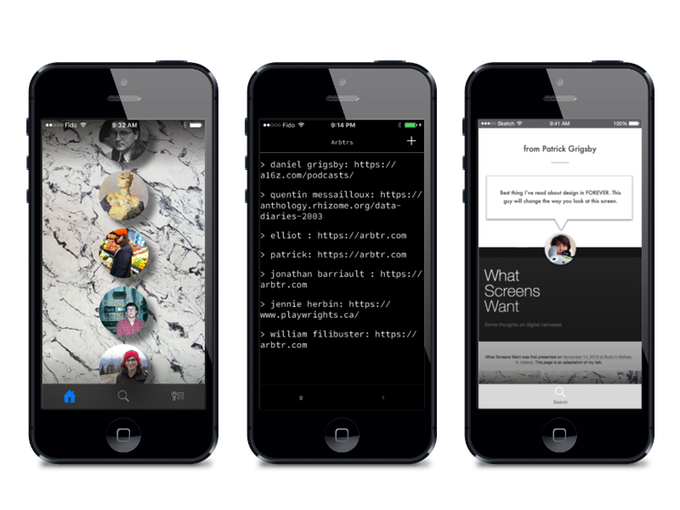
Some design ideas for the app. I like the text one but it does need thumbnails.

If you’re sharing less, as Arbtr insists you will, then presumably you’ll put more love behind those things you do share. Wouldn’t that be nice?

We’re in this mess because we bought wholesale the idea that the more you share, the more connected you are. Now that we’ve found that isn’t the case – and in fact we were in effect being fattened for a perpetual slaughter — I don’t see why we shouldn’t try something else.

Will it be Arbtr? I don’t know. Probably not, but we’ve got a lot to gain by giving ideas like this a shot.


from Social – TechCrunch https://ift.tt/2uyViC3
Original Content From: https://techcrunch.com

Arbtr wants to create an anti-feed where users can only share one thing at a time

At a time when the models of traditional social networks are being questioned, it’s more important than ever to experiment with alternatives. Arbtr is a proposed social network that limits users to sharing a single thing at any given time, encouraging “ruthless self-editing” and avoiding “nasty things” like endless feeds filled with trivial garbage.

It’s seeking funds on Kickstarter and could use a buck or two. I plan to.

Now, I know what you’re thinking. “Why would I give money to maybe join a social network eventually that might not have any of my friends on it on it? That is, if it ever even exists?” Great question.

The answer is: how else do you think we’re going to replace Facebook? Someone with a smart, different idea has to come along and we have to support them. If we won’t spare the cost of a cup of coffee for a purpose like that, then we deserve the social networks we’ve got. (And if I’m honest, I’ve had very similar ideas over the last few years and I’m eager to see how they might play out in reality.)

The fundamental feature is, of course, the single-sharing thing. You can only show off one item at a time, and when you post a new one, the old one (and any discussion, likes, etc) will be deleted. There will be options to keep logs of these things, and maybe premium features to access them (or perhaps metrics), but the basic proposal is, I think, quite sound — at the very least, worth trying.

Some design ideas for the app. I like the text one but it does need thumbnails.

If you’re sharing less, as Arbtr insists you will, then presumably you’ll put more love behind those things you do share. Wouldn’t that be nice?

We’re in this mess because we bought wholesale the idea that the more you share, the more connected you are. Now that we’ve found that isn’t the case – and in fact we were in effect being fattened for a perpetual slaughter — I don’t see why we shouldn’t try something else.

Will it be Arbtr? I don’t know. Probably not, but we’ve got a lot to gain by giving ideas like this a shot.


from Mobile – TechCrunch https://ift.tt/2uyViC3
ORIGINAL CONTENT FROM: https://techcrunch.com/

TECH Solutions - Who gains from Facebook’s missteps?

When Facebook loses, who wins?

That’s a question for startups that may be worth contemplating following Facebook’s recent stock price haircut. The company’s valuation has fallen by around $60 billion since the Cambridge Analytica scandal surfaced earlier this month and the #DeleteFacebook campaign gained momentum.

That’s a steep drop, equal to about 12 percent of the company’s market valuation, and it’s a decline Facebook appears to be suffering alone. As its shares fell over the past couple of weeks, stocks of other large-cap tech and online media companies have been much flatter.

So where did the money go? It’s probably a matter of perspective. For a Facebook shareholder, that valuation is simply gone. And until executives’ apologies resonate and users’ desire to click and scroll overcomes their privacy fears, that’s how it is.

An alternate view is that the valuation didn’t exactly disappear. Investors may still believe the broad social media space is just as valuable as it was a couple of weeks ago. It’s just that less of that pie should be the exclusive domain of Facebook.

If one takes that second notion, then the possibilities for who could benefit from Facebook’s travails start to get interesting. Of course, there are public market companies, like Snap or Twitter, that might pick up traffic if the #DeleteFacebook movement gains momentum without spreading to other big brands. But it’s in the private markets where we see the highest number of potential beneficiaries of Facebook’s problems.

In an effort to come up with some names, we searched through Crunchbase for companies in social media and related areas. The resulting list includes companies that have raised good-sized rounds in the past couple of years and could conceivably see gains if people cut back on using Facebook or owning its stock.

Of course, people use Facebook for different things (posting photos, getting news, chatting with friends and so on), so we lay out a few categories of potential beneficiaries of a Facebook backlash.

Messaging

Facebook has a significant messaging presence, but it hasn’t been declared the winner. Alternatives like Snap, LINE, WeChat and plain old text messages are also massively popular.

That said, what’s bad for Messenger and Facebook-owned WhatsApp is probably good for competitors. And if more people want to do less of their messaging on Facebook, it helps that there are a number of private companies ready to take its place.

Crunchbase identified six well-funded messaging apps that could fit the bill (see list). Collectively, they’ve raised well over $2 billion — if one includes the $850 million initial coin offering by Telegram.

Increasingly, these private messaging startups are focused on privacy and security, including Wickr, the encrypted messaging tool that has raised more than $70 million, and Silent Circle, another encrypted communications provider that has raised $130 million.

Popular places to browse on a screen

People who cut back on Facebook may still want to spend hours a day staring at posts on a screen. So it’s likely they’ll start staring at something else that’s content-rich, easy-to-navigate and somewhat addictive.

Luckily, there are plenty of venture-backed companies that fit that description. Many of these are quite mature at this point, including Pinterest for image collections, Reddit for post and comment threads and Quora for Q&A (see list).

Granted, these will not replace the posts keeping you up to date on the life events of family and friends. But they could be a substitute for news feeds, meme shares and other non-personal posts.

Niche content

A decline in Facebook usage could translate into a rise in traffic for a host of niche content and discussion platforms focused on sports, celebrities, social issues and other subjects.

Crunchbase News identified at least a half-dozen that have raised funding in recent quarters, which is just a sampling of the total universe. Selected startups run the gamut from The Players’ Tribune, which features first-hand accounts for top athletes, to Medium, which seeks out articles that resonate with a wide audience.

Niche sites also provide a more customized forum for celebrities, pundits and subject-matter experts to engage directly with fans and followers.

Community and engagement

People with common interests don’t have to share them on Facebook. There are other places that can offer more tailored content and social engagement.

In recent years, we’ve seen an increase in community and activity-focused social apps gain traction. Perhaps the most prominent is Nextdoor, which connects neighbors for everything from garage sales to crime reports. We’re also seeing some upstarts focused on creating social networks for interest groups. These include Mighty Networks and Amino Apps.

Though some might call it a stretch, we also added to the list WeWork, recent acquirer of Meetup, and The Guild, two companies building social networks in the physical world. These companies are encouraging people to come out and socially network with other people (even if just means sitting in a room with other people staring at a screen).

Watch where the money goes

Facebook’s latest imbroglio is still too recent to expect a visible impact in the startup funding arena. But it will be interesting to watch in the coming months whether potential rivals in the above categories raise a lot more cash and attract more users.

If there’s demand, there’s certainly no shortage of supply on the investor front. The IPO window is wide open, and venture investors are sitting on record piles of dry powder. It hasn’t escaped notice, either, that social media offerings, like Facebook, LinkedIn and Snap, have generated the biggest exit total of any VC-funded sector.

Moreover, those who’ve argued that it’s too late for newcomers have a history of being proven wrong. After all, that’s what people were saying about would-be competitors to MySpace in 2005, not long before Facebook made it big.


from Social – TechCrunch https://ift.tt/2Ij7TuX
Original Content From: https://techcrunch.com

Technical Solutions - Tech Talks #465 - Jio Juice, iPhone Drone Smuggling, Huawei Folding Phone, Google Home Mini India

Tech Talks #465 - Jio Juice, iPhone Drone Smuggling, Huawei Folding Phone, Google Home Mini India
EduBirdie.com Professional Term Paper Writing Service - choose and hire a professional to write your term paper for you: http://bit.ly/TechnicalGurujiYT " TG Deals@ https://tg.deals/ New Channel: https://goo.gl/Jz6p5K Namaskaar Dosto, Tech Talks ke is Episode mein maine aapse kuch interesting Tech News Share ki hai jaise Jio Juice, Ai Lifespan, Huawei Folding Phone, Facebook Data Breach, iPhone Drone Smuggling, Google Home India, Apple VR, Goo.gl down aur bahut kuch. Mujhe umeed hai ki yeh video aapko pasand aayega. Share, Support, Subscribe!!! Subscribe: http://bit.ly/1Wfsvt4 Android App: https://ift.tt/2mrm9Gy Youtube: http://www.youtube.com/c/TechnicalGuruji Twitter: http://www.twitter.com/technicalguruji Facebook: https://ift.tt/1Pi5LDP Facebook Myself: https://goo.gl/zUfbUU Instagram: https://ift.tt/1OW2vue Google Plus: https://ift.tt/1Pi5LDS Website: https://ift.tt/2mcM6KV Merchandise: https://ift.tt/2lN4Vbu About : Technical Guruji is a YouTube Channel, where you will find technological videos in Hindi, New Video is Posted Everyday :)


TECH Solutions - Earn 10$ To 1000$ Daily With Email Marketing/Addresses|Urdu Hindi Tutorial

Earn 10$ To 1000$ Daily With Email Marketing/Addresses|Urdu Hindi Tutorial
Hi Friends: This is my Blog Technical Solutions created to share videos and content of technical solutions with the world. At this blog you can find videos about Free Search Engine Optimization Course, how to develope Android Applications and What is Computer hardware and software, you would be able to increse your channel views, or boost your website. so guys keep visiting my blog for learning technical things. Thank You!


TECH Solutions - Tesla in fatal California crash was in Autopilot

The company says a Model X vehicle involved in a fatal crash in the US was in Autopilot mode.

from BBC News - Technology https://ift.tt/2uznZPj
Original Content From: http://bbci.co.uk

Technical Solutions - World's Smallest Laptop Unboxing - GPD Pocket 🔥🔥🔥

World's Smallest Laptop Unboxing - GPD Pocket 🔥🔥🔥
Namaskaar Dosto, is video mein maine aapse ek Mini Laptop ke baare mien baat ki hai jo World'S smallest Laptop hai aur ek premium design ke saath aata hai, yeh hai GamePad Digital ya fir GPD Pocket, isme Intel Atom Processor hai aur 8GB RAM ke saath 128GB ki storage hai. 7" ka 1920 x 1200 pixels ka ek IPS Touchscreen Display hai. Is GPD Pocket mein aapko full Windows 10 ka experience milta hai. Mujhe umeed hai ki aapko GPD Pocket ki yeh video pasnad aayegi GPD Pocket Mini Laptop UMPC-SILVER- https://goo.gl/F16ynJ Laptop category link-https://goo.gl/vjcgsA Gearbest Store-https://goo.gl/GLw54C Share, Support, Subscribe!!! Subscribe: http://bit.ly/1Wfsvt4 Android App: https://ift.tt/2mrm9Gy Youtube: http://www.youtube.com/c/TechnicalGuruji Twitter: http://www.twitter.com/technicalguruji Facebook: https://ift.tt/1Pi5LDP Facebook Myself: https://goo.gl/zUfbUU Instagram: https://ift.tt/1OW2vue Google Plus: https://ift.tt/1Pi5LDS Website: https://ift.tt/2mcM6KV Merchandise: https://ift.tt/2lN4Vbu About : Technical Guruji is a YouTube Channel, where you will find technological videos in Hindi, New Video is Posted Everyday :)


TECH Solutions - Met Police chief: Social media leads children to violence

Britain's most senior police officer says social media "revs people up" and leads to stabbings and murders.

from BBC News - Technology https://ift.tt/2pTTde8
Original Content From: http://bbci.co.uk

TECH Solutions - US may tie social media to visa applications

A state department proposal could require visa applicants to detail all their social media handles.

from BBC News - Technology https://ift.tt/2pRZZRG
Original Content From: http://bbci.co.uk

Friday, March 30, 2018

TECH Solutions - The real threat to Facebook is the kool-aid turning sour

These kinds of leaks didn’t happen when I started reporting on Facebook eight years ago. It was a tight-knit cult convinced of its mission to connect everyone, but with the discipline of a military unit where everyone knew loose lips sink ships. Motivational posters with bold corporate slogans dotted its offices, rallying the troops. Employees were happy to be evangelists.

But then came the fake news, News Feed addiction, violence on Facebook Live, cyberbullying, abusive ad targeting, election interference, and most recently the Cambridge Analytica app data privacy scandals. All the while, Facebook either willfully believed the worst case scenarios could never come true, was naive to their existence, or calculated the benefits and growth outweighed the risks. And when finally confronted, Facebook often dragged its feet before admitting the extent of the problems.

Inside the social network’s offices, the bonds began to fray. Slogans took on sinister second meanings. The kool-aid tasted different.

Some hoped they could right the ship but couldn’t. Some craved the influence and intellectual thrill of running one of humanity’s most popular inventions, but now question if that influence and their work is positive. Others surely just wanted to collect salaries, stock, and resume highlights but lost the stomach for it.

Now the convergence of scandals has come to a head in the form of constant leaks.

The Trouble Tipping Point

The more benign leaks merely cost Facebook a bit of competitive advantage. We’ve learned it’s building a smart speaker, a standalone VR headset, and a Houseparty split-screen video chat clone.

Yet policy-focused leaks have exacerbated the backlash against Facebook, putting more pressure on the conscience of employees. As blame fell to Facebook for Trump’s election, word of Facebook prototyping a censorship tool for operating in China escaped, triggering questions about its respect for human rights and free speech. Facebook’s content rulebook got out alongside disturbing tales of the filth the company’s contracted moderators have to sift through. Its ad targeting was revealed to be able to pinpoint emotionally vulnerable teens.

In recent weeks, the leaks have accelerated to a maddening pace in the wake of Facebook’s soggy apologies regarding the Cambridge Analytica debacle. Its weak policy enforcement left the door open to exploitation of data users gave third-party apps, deepening the perception that Facebook doesn’t care about privacy.

And it all culminated with BuzzFeed publishing a leaked “growth at all costs” internal post from Facebook VP Andrew “Boz” Bosworth that substantiated people’s worst fears about the company’s disregard for user safety in pursuit of world domination. Even the ensuing internal discussion about the damage caused by leaks and how to prevent them…leaked.

But the leaks are not the disease, just the symptom. Sunken morale is the cause, and it’s dragging down the company. Former Facebook employee and Wired writer Antonio Garcia Martinez sums it up, saying this kind of vindictive, intentionally destructive leak fills Facebook’s leadership with “horror”:

And that sentiment was confirmed by Facebook’s VP of News Feed Adam Mosseri, who tweeted that leaks “create strong incentives to be less transparent internally and they certainly slow us down”, and will make it tougher to deal with the big problems.

Those thoughts weigh heavy on Facebook’s team. A source close to several Facebook executives tells us they feel “embarrassed to work there” and are increasingly open to other job opportunities. One current employee told us to assume anything certain execs tell the media is “100% false”.

If Facebook can’t internally discuss the problems it faces without being exposed, how can it solve them?

Implosion

The consequences of Facebook’s failures are typically pegged as external hazards.

You might assume the government will finally step in and regulate Facebook. But the Honest Ads Act and other rules about ads transparency and data privacy could end up protecting Facebook by being simply a paperwork speed bump for it while making it tough for competitors to build a rival database of personal info. In our corporation-loving society, it seems unlikely that the administration would go so far as to split up Facebook, Instagram, and WhatsApp — one of the few feasible ways to limit the company’s power.

Users have watched Facebook go make misstep after misstep over the years, but can’t help but stay glued to its feed. Even those who don’t scroll rely on it as fundamental utility for messaging and login on other sites. Privacy and transparency are too abstract for most people to care about. Hence, first-time Facebook downloads held steady and its App Store rank actually rose in the week after the Cambridge Analytica fiasco broke. In regards to the #DeleteFacebook movement, Mark Zuckerberg himself said “I don’t think we’ve seen a meaningful number of people act on that.” And as long as they’re browsing, advertisers will keep paying Facebook to reach them.

That’s why the greatest threat of the scandal convergence comes from inside. The leaks are the canary in the noxious blue coal mine.

Can Facebook Survive Slowing Down?

If employees wake up each day unsure whether Facebook’s mission is actually harming the world, they won’t stay. Facebook doesn’t have the same internal work culture problems as some giants like Uber. But there are plenty of other tech companies with less questionable impacts. Some are still private and offer the chance to win big on an IPO or acquisition. At the very least, those in the Bay could find somewhere to work without a spending hours a day on the traffic-snarled 101 freeway.

If they do stay, they won’t work as hard. It’s tough to build if you think you’re building a weapon. Especially if you thought you were going to be making helpful tools. The melancholy and malaise set in. People go into rest-and-vest mode, living out their days at Facebook as a sentence not an opportunity. The next killer product Facebook needs a year or two from now might never coalesce.

And if they do work hard, a culture of anxiety and paralysis will work against them. No one wants to code with their hands tied, and some would prefer a less scrutinized environment. Every decision will require endless philosophizing and risk-reduction. Product changes will be reduced to the lowest common denominator, designed not to offend or appear too tyrannical.

Source: Volkan Furuncu/Anadolu Agency + David Ramos/Getty Images

In fact, that’s partly how Facebook got into this whole mess. A leak by an anonymous former contractor led Gizmodo to report Facebook was suppressing conservative news in its Trending section. Terrified of appearing liberally biased, Facebook reportedly hesitated to take decisive action against fake news. That hands-off approach led to the post-election criticism that degraded morale and pushed the growing snowball of leaks down the mountain.

It’s still rolling.

How to stop morale’s downward momentum will be one of Facebook’s greatest tests of leadership. This isn’t a bug to be squashed. It can’t just roll back a feature update. And an apology won’t suffice. It will have to expel or reeducate the leakers and disloyal without instilling a witchunt’s sense of dread. Compensation may have to jump upwards to keep talent aboard like Twitter did when it was floundering. Its top brass will need to show candor and accountability without fueling more indiscretion. And it may need to make a shocking, landmark act of humility to convince employees its capable of change.

This isn’t about whether Facebook will disappear tomorrow, but whether it will remain unconquerable for the forseeable future.

Growth has been the driving mantra for Facebook since its inception. No matter how employees are evaluated, it’s still the underlying ethos. Facebook has poised itself as a mission-driven company. The implication was always that connecting people is good so connecting more people is better. The only question was how to grow faster.

Now Zuckerberg will have to figure out how to get Facebook to cautiously foresee the consequences of what it says and does while remaining an appealing place to work. “Move slow and think things through” just doesn’t have the same ring to it.


from Social – TechCrunch https://ift.tt/2J9fTjg
Original Content From: https://techcrunch.com

The real threat to Facebook is the kool-aid turning sour

These kinds of leaks didn’t happen when I started reporting on Facebook eight years ago. It was a kool-aid cult convinced of its mission to connect everyone, but with the discipline of a military unit where everyone knew loose lips sink ships. Motivational posters with bold corporate slogans dotted its offices, rallying the troops. Employees were happy to be evangelists.

But then came the fake news, News Feed addiction, violence on Facebook Live, cyberbullying, abusive ad targeting, election interference, and most recently the Cambridge Analytica app data privacy scandals. All the while, Facebook either willfully believed the worst case scenarios could never come true, was naive to their existence, or calculated the benefits and growth outweighed the risks. And when finally confronted, Facebook often dragged its feet before admitting the extent of the problems.

Inside the social network’s offices, the bonds began to fray. Slogans took on sinister second meanings. The kool-aid tasted different.

Some hoped they could right the ship but couldn’t. Some craved the influence and intellectual thrill of running one of humanity’s most popular inventions, but now question if that influence and their work is positive. Others surely just wanted to collect salaries, stock, and resume highlights but lost the stomach for it.

Now the convergence of scandals has come to a head in the form of constant leaks.

The Trouble Tipping Point

The more benign leaks merely cost Facebook a bit of competitive advantage. We’ve learned it’s building a smart speaker, a standalone VR headset, and a Houseparty split-screen video chat clone.

Yet policy-focused leaks have exacerbated the backlash against Facebook, putting more pressure on the conscience of employees. As blame fell to Facebook for Trump’s election, word of Facebook prototyping a censorship tool for operating in China escaped, triggering questions about its respect for human rights and free speech. Facebook’s content rulebook got out alongside disturbing tales of the filth the company’s contracted moderators have to sift through. Its ad targeting was revealed to be able to pinpoint emotionally vulnerable teens.

In recent weeks, the leaks have accelerated to a maddening pace in the wake of Facebook’s soggy apologies regarding the Cambridge Analytica debacle. Its weak policy enforcement left the door open to exploitation of data users gave third-party apps, deepening the perception that Facebook doesn’t care about privacy.

And it all culminated with BuzzFeed publishing a leaked “growth at all costs” internal post from Facebook VP Andrew “Boz” Bosworth that substantiated people’s worst fears about the company’s disregard for user safety in pursuit of world domination. Even the ensuing internal discussion about the damage caused by leaks and how to prevent them…leaked.

But the leaks are not the disease, just the symptom. Sunken morale is the cause, and it’s dragging down the company. Former Facebook employee and Wired writer Antonio Garcia Martinez sums it up, saying this kind of vindictive, intentionally destructive leak fills Facebook’s leadership with “horror”:

And that sentiment was confirmed by Facebook’s VP of News Feed Adam Mosseri, who tweeted that leaks “create strong incentives to be less transparent internally and they certainly slow us down”, and will make it tougher to deal with the big problems.

Those thoughts weigh heavy on Facebook’s team. A source close to several Facebook executives tells us they feel “embarrassed to work there” and are increasingly open to other job opportunities. One current employee told us to assume anything certain execs tell the media is “100% false”.

If Facebook can’t internally discuss the problems it faces without being exposed, how can it solve them?

Implosion

The consequences of Facebook’s failures are typically pegged as external hazards.

You might assume the government will finally step in and regulate Facebook. But the Honest Ads Act and other rules about ads transparency and data privacy could end up protecting Facebook by being simply a paperwork speed bump for it while making it tough for competitors to build a rival database of personal info. In our corporation-loving society, it seems unlikely that the administration would go so far as to split up Facebook, Instagram, and WhatsApp — one of the few feasible ways to limit the company’s power.

Users have watched Facebook go make misstep after misstep over the years, but can’t help but stay glued to its feed. Even those who don’t scroll rely on it as fundamental utility for messaging and login on other sites. Privacy and transparency are too abstract for most people to care about. Hence, first-time Facebook downloads held steady and its App Store rank actually rose in the week after the Cambridge Analytica fiasco broke. In regards to the #DeleteFacebook movement, Mark Zuckerberg himself said “I don’t think we’ve seen a meaningful number of people act on that.” And as long as they’re browsing, advertisers will keep paying Facebook to reach them.

That’s why the greatest threat of the scandal convergence comes from inside. The leaks are the canary in the noxious blue coal mine.

Can Facebook Survive Slowing Down?

If employees wake up each day unsure whether Facebook’s mission is actually harming the world, they won’t stay. Facebook doesn’t have the same internal work culture problems as some giants like Uber. But there are plenty of other tech companies with less questionable impacts. Some are still private and offer the chance to win big on an IPO or acquisition. At the very least, those in the Bay could find somewhere to work without a spending hours a day on the traffic-snarled 101 freeway.

If they do stay, they won’t work as hard. It’s tough to build if you think you’re building a weapon. Especially if you thought you were going to be making helpful tools. The melancholy and malaise set in. People go into rest-and-vest mode, living out their days at Facebook as a sentence not an opportunity. The next killer product Facebook needs a year or two from now might never coalesce.

And if they do work hard, a culture of anxiety and paralysis will work against them. No one wants to code with their hands tied, and some would prefer a less scrutinized environment. Every decision will require endless philosophizing and risk-reduction. Product changes will be reduced to the lowest common denominator, designed not to offend or appear too tyrannical.

Source: Volkan Furuncu/Anadolu Agency + David Ramos/Getty Images

In fact, that’s partly how Facebook got into this whole mess. A leak by an anonymous former contractor led Gizmodo to report Facebook was suppressing conservative news in its Trending section. Terrified of appearing liberally biased, Facebook reportedly hesitated to take decisive action against fake news. That hands-off approach led to the post-election criticism that degraded morale and pushed the growing snowball of leaks down the mountain.

It’s still rolling.

How to stop morale’s downward momentum will be one of Facebook’s greatest tests of leadership. This isn’t a bug to be squashed. It can’t just roll back a feature update. And an apology won’t suffice. It will have to expel or reeducate the leakers and disloyal without instilling a witchunt’s sense of dread. Compensation may have to jump upwards to keep talent aboard like Twitter did when it was floundering. Its top brass will need to show candor and accountability without fueling more indiscretion. And it may need to make a shocking, landmark act of humility to convince employees its capable of change.

This isn’t about whether Facebook will disappear tomorrow, but whether it will remain unconquerable for the forseeable future.

Growth has been the driving mantra for Facebook since its inception. No matter how employees are evaluated, it’s still the underlying ethos. Facebook has poised itself as a mission-driven company. The implication was always that connecting people is good so connecting more people is better. The only question was how to grow faster.

Now Zuckerberg will have to figure out how to get Facebook to cautiously foresee the consequences of what it says and does while remaining an appealing place to work. “Move slow and think things through” just doesn’t have the same ring to it.


from Mobile – TechCrunch https://ift.tt/2J9fTjg
ORIGINAL CONTENT FROM: https://techcrunch.com/
Clipisode launches a ‘talk show in a box’

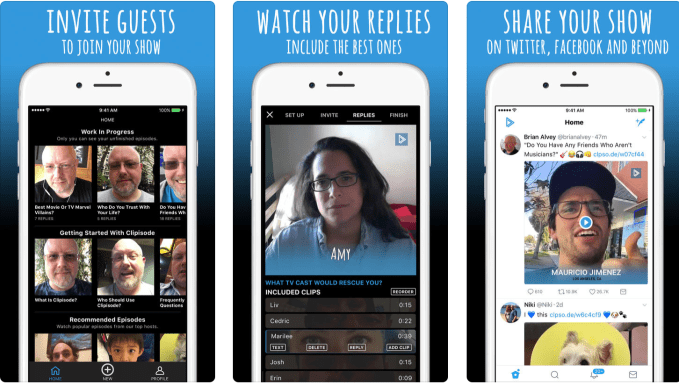
A company called Clipisode is today launching a new service that’s essentially a “talk show in a box,” as founder Brian Alvey describes it. Similar to how Anchor now allows anyone to build a professional podcast using simple mobile and web tools, Clipisode does this for video content. With Clipisode, you can record a video that can be shared across any platform – social media, the web, text messages – and collect video responses that can then be integrated into the “show” and overlaid with professional graphics.

The video responses feature is something more akin to a video voicemail-based call-in feature.

Here’s how it works. The content creator will first use Clipisode to record their video, and receive the link to share the video across social media, the web, or privately through email, text messaging, etc. When the viewer or guest clicks the link, they can respond to the question the show’s “host” posed.

For example, a reporter could ask for viewers’ thoughts on an issue or a creator could ask their fans what they want to see next.

How the video creator wants to use this functionality is really up to them, and specific to the type of video show they’re making.

To give you an idea, during a pre-launch period, the app has been tested by AXS TV to promote their upcoming Top Ten Revealed series by asking music industry experts “Who Is Your All-time Favorite Guitarist?

BBC Scotland asked their Twitter followers who they want to see hired as the new manager for the Scotland national football team.

A full-time Twitch gamer, Chris Melberger asked his subscribers what device they watch Twitch on.

The content creator can then receive all the video responses to these questions privately, choose which ones they want to include in their finished show, and drag those responses into the order they want. The creator can respond back to the clips, too, or just add another clip at the end of of their video. Uploading pre-recorded clips from services like Dropbox or even your phone is supported as well.

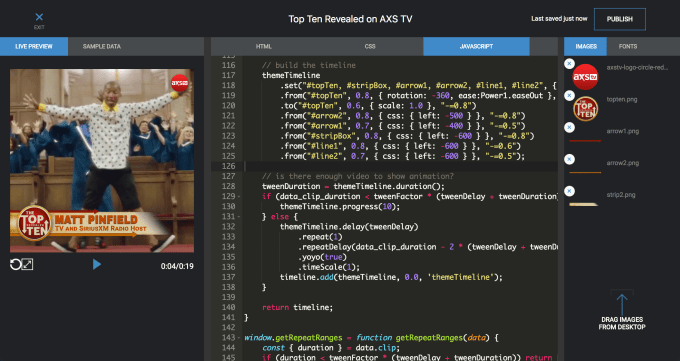
Plus, content creators can use Clipisode to overlay professional-looking animations and graphics on top of the final video with the responses and replies. This makes it seem more like something made with help from a video editing team, not an app on your phone.

Because Clipisode invitations are web links, they don’t require the recipients to download an app.

“[People] don’t want to download an app for a one-time video reply,” explains Alvey. “But with this, people can reply.” And, he adds, what makes Clipisode interesting from a technical perspective, is that the web links users click to reply can work in any app in a way that feels seamless to the end user.

“That’s our biggest trick – making this work in other people’s apps, so there’s no new social network to join and nothing to download,” he says.

The app is free currently, but the plan is to generate revenue by later selling subscription access to the authoring suite where users can create the animated overlays and branding components that give the video the professional look-and-feel.

In an online CMS, creators can author, test and deploy animated themes that run on top of their videos.

The final video product can be shared back to social media, or downloaded as a video file to be published on video-sharing sites, social media, or as a video podcast.

Clipisode has been in development for some time, Alvey says. The company originally raised less than a million from investors including Mike Jones and Mark Cuban for a different product the founder describes as a Patreon competitor, before pivoting to Clipisode. Investors funded the new product with less than half a million.

The app itself took a couple of years to complete, something that Alvey says has to do with the animation studio it includes and the small team. (It’s just him and technical co-founder Max Schmeling.)

Clipisode is a free download on iOS and Android.


from Mobile – TechCrunch https://ift.tt/2J7NIBw
ORIGINAL CONTENT FROM: https://techcrunch.com/

TECH Solutions - Facebook’s mission changed, but its motives didn’t

In January, Facebook announced that it would be changing its feed algorithm to promote users’ well-being over time spent browsing content. That’s a relatively new approach for a company whose ethos once centered around “move fast, break things.”

It wasn’t all that long ago (approximately a year and a half before the algorithm change) that Facebook VP Andrew “Boz” Bosworth, published an internal memo called “The Ugly,” which was circulated throughout the company. In it, Boz made it clear to employees that connecting people (i.e. growth) is the main focus at Facebook, at all costs.

Buzzfeed first published the memo, which said:

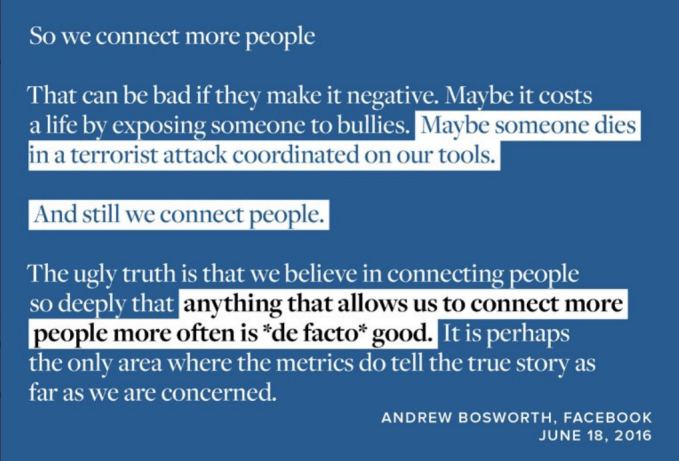
Maybe it costs a life by exposing someone to bullies. Maybe someone dies in a terrorist attack coordinated on our tools.

And still we connect people.

The ugly truth is that we believe in connecting people so deeply that anything that allows us to connect more people more often is *de facto* good. It is perhaps the only area where the metrics do tell the true story as far as we are concerned.

He goes on:

That isn’t something we are doing for ourselves. Or for our stock price (ha!). It is literally just what we do. We connect people. Period.

That’s why all the work we do in growth is justified. All the questionable contact importing practices. All the subtle language that helps people stay searchable by friends. All of the work we do to bring more communication in. The work we will likely have to do in China some day. All of it.

Facebook launched in 2004 and ushered in a honeymoon period for users. We reveled in uploading photos from our digital cameras and sharing them with friends. We cared about each and every notification. We shared our status. We played Farmville. We diligently curated our Likes.

But the honeymoon is over. Facebook grew to 1 billion active users in 2012. The social network now has over 2 billion active users. A growing number of people get their news from social media. The size and scope of Facebook is simply overwhelming.

And we’ve been well aware, as users and outsiders looking in on the network, that just like any other tool, Facebook can be used for evil.

But there was still some question whether or not Facebook leadership understood that principle, and if they did, whether or not they actually cared.

For a long time, perhaps too long, Facebook adhered to the “Move fast, break things” mentality. And things have certainly been broken, from fake news circulated during the 2016 Presidential election to the improper use of user data by third-party developers and Cambridge Analytica. And that’s likely the tip of the iceberg.

The memo was written long before the shit hit the fan for Facebook. It was published following the broadcast of Antonio Perkins’ murder on Facebook. This was back when Facebook was still insisting that it isn’t a media company, that it is simply a set of pipes through which people can ship off their content.

What is so shocking about the memo is that it confirms some of our deepest fears. A social network, with a population greater than any single country, is solely focused on growth over the well-being of the society it’s built. That the ends, to be a product everyone uses, might justify the means.

Facebook has tried to move away from this persona, however gently. In late 2016, Zuckerberg finally budged on the idea that Facebook is a media company, clarifying that it’s not a traditional media company. Last year, the company launched the Journalism Project in response to the scary growth of fake news on the platform. Zuckerberg even posted full-page print ads seeking patience and forgiveness in the wake of this most recent Cambridge Analytica scandal.

While that all seems like more of a public relations response than actionable change, it’s better than the stoic, inflexible silence of before.

After Buzzfeed published the memo, Boz and Zuckerberg both responded.

Boz said it was all about spurring internal debate to help shape future tools.

Zuck had this to say:

Boz is a talented leader who says many provocative things. This was one that most people at Facebook including myself disagreed with strongly. We’ve never believed the ends justify the means.

We recognize that connecting people isn’t enough by itself. We also need to work to bring people closer together. We changed our whole mission and company focus to reflect this last year.

If Boz wrote this memo to spark debate, it’s hard to discern whether that debate led to real change.

The memo has since been deleted, but you can read the full text below:

The Ugly

We talk about the good and the bad of our work often. I want to talk about the ugly.

We connect people.

That can be good if they make it positive. Maybe someone finds love. Maybe it even saves the life of someone on the brink of suicide.

So we connect more people

That can be bad if they make it negative. Maybe it costs a life by exposing someone to bullies. Maybe someone dies in a terrorist attack coordinated on our tools.

And still we connect people.

The ugly truth is that we believe in connecting people so deeply that anything that allows us to connect more people more often is *de facto* good. It is perhaps the only area where the metrics do tell the true story as far as we are concerned.

That isn’t something we are doing for ourselves. Or for our stock price (ha!). It is literally just what we do. We connect people. Period.

That’s why all the work we do in growth is justified. All the questionable contact importing practices. All the subtle language that helps people stay searchable by friends. All of the work we do to bring more communication in. The work we will likely have to do in China some day. All of it.

The natural state of the world is not connected. It is not unified. It is fragmented by borders, languages, and increasingly by different products. The best products don’t win. The ones everyone use win.

I know a lot of people don’t want to hear this. Most of us have the luxury of working in the warm glow of building products consumers love. But make no mistake, growth tactics are how we got here. If you joined the company because it is doing great work, that’s why we get to do that great work. We do have great products but we still wouldn’t be half our size without pushing the envelope on growth. Nothing makes Facebook as valuable as having your friends on it, and no product decisions have gotten as many friends on as the ones made in growth. Not photo tagging. Not news feed. Not messenger. Nothing.

In almost all of our work, we have to answer hard questions about what we believe. We have to justify the metrics and make sure they aren’t losing out on a bigger picture. But connecting people. That’s our imperative. Because that’s what we do. We connect people.


from Social – TechCrunch https://ift.tt/2E7sX4Y
Original Content From: https://techcrunch.com

Google’s on-by-default ‘Articles for You’ leverage browser dominance for 2,100 percent growth

When you’ve got leverage, don’t be afraid to use it. That’s been Google’s modus operandi in the news and publishing world over the last year or so as it has pushed its AMP platform, funding various news-related ventures that may put it ahead, and nourished its personalized Chrome tabs on mobile. The latter, as Nieman Labs notes, grew 2,100 percent in 2017.

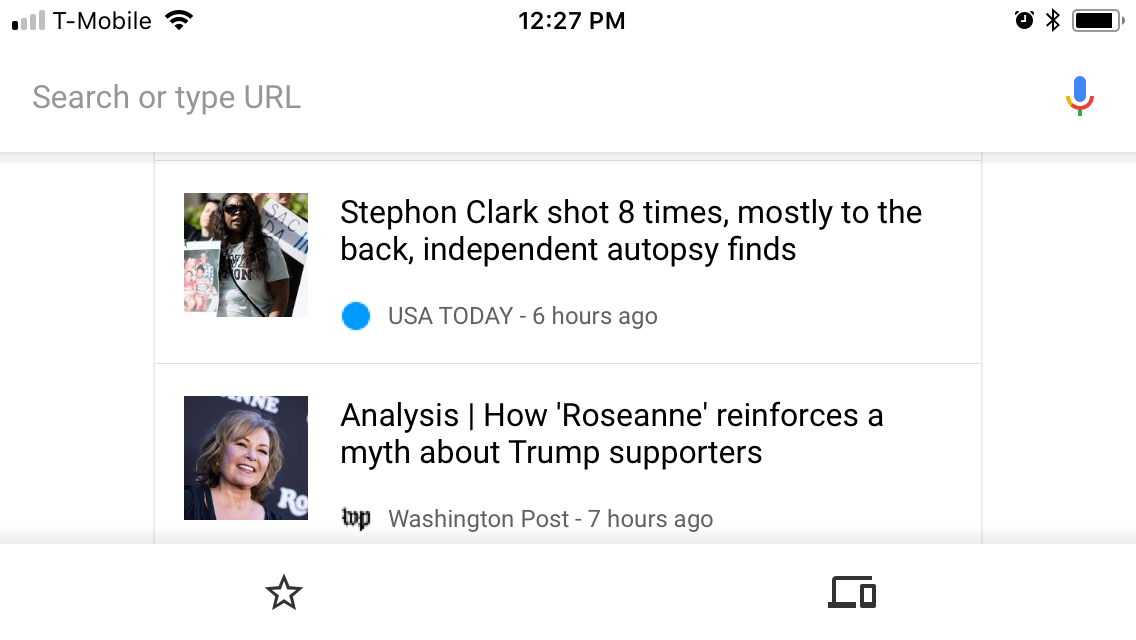
You may have noticed, since Chrome is a popular mobile browser and this setting is on by default, but the “Articles for You” appear automatically in every new tab, showing you a bunch of articles the company things you’d like. And it’s gone from driving 15 million article views to a staggering 341 million over the last year.

In late 2016, when Google announced the product, I described it as “polluting” the otherwise useful new tab page. I also don’t like the idea of being served news when I’m not actively looking for it — I understand that when I visit Google News (and I do) that my browser history (among other things) is being scoured to determine what categories and stories I’ll see. I also understand that everything I do on the site, as on every Google site, is being entered into its great data engine in order to improve its profile of me.

Like I said, when I visit a Google site, I expect that. But a browser is supposed to be a tool, not a private platform, and the idea that every tab I open is another data point and another opportunity for Google to foist its algorithms on me is rankling.

It has unsavory forebears. Remember Internet Explorer 6, which came with MSN.com as the default homepage? That incredible positioning drove so much traffic that for years after (and indeed, today) it drove disgusting amounts of traffic to anything it featured. But that traffic was tainted: you knew that firehose was in great part clicks from senior citizens who thought MSN was the entire internet.

Of course the generated pages for individual users aren’t the concentrated fire of a link on a major portal, but they are subject to Google approval and, of course, the requisite ranking bonus for AMP content. Can’t forget that!

But wherever you see the news first, that’s your news provider. And you can’t get much earlier than “as soon as you open a new tab.” That’s pretty much the ultimate positioning advantage.

Just how this amazing growth occurred is unclear. If there’s been any word of mouth, I missed it. “Have you tried scrolling down? The news is just right there!” It seems unlikely. My guess would be that the feature has been steadily rolling out in new regions, opting in new users who occasionally scroll down and see these stories.

And unlike many other news distribution platforms, there isn’t much for publishers or sites like this one to learn about it. How are stories qualified for inclusion? Is there overlap with Google News stuff? What’s shown if people aren’t signed in? I’ve asked Google for further info.

Do you, like me, dislike the idea that every time you open a tab — not just when you use its services — Google uses it as an opportunity to monetize you, however indirectly? Fortunately, and I may say consistent with Google’s user-friendliness in this type of thing, you can turn it off quite easily — on iOS, anyway.

Open the menu at the top right of any tab and hit settings. There should be a “Suggested articles” toggle — disable that and you’re done. While you’re at it, you might just head into Privacy and disable search and site suggestions and usage data.

On Android? You’ll have to dig into the app’s flags and toggle the hidden setting there. Not as user-friendly.


from Mobile – TechCrunch https://ift.tt/2GobJ9O
ORIGINAL CONTENT FROM: https://techcrunch.com/

Huawei says it’s still committed to the U.S., in spite of, well, everything

A funny thing happened the last couple of times I was briefed on a Huawei flagship product: news was breaking about some major roadblock for the company’s U.S. distribution plans. First it was AT&T backing out in the midst of CES and then it was Best Buy’s decision to drop the company just ahead of the big P20 launch (though a rep for the company told me the States were never part of its plans for that handset). 

It’s been one thing after another as the Chinese hardware maker has worked to establish a meaningful presence here in the States. In spite of all of this fallout from government pushback, however, the company insists that it’s not going anywhere.

In an email to CNET, the company’s consumer CEO reaffirmed that commitment. “We are committed to the U.S. market and to earning the trust of U.S. consumers by staying focused on delivering world-class products and innovation,” Yu writes. “We would never compromise that trust.”

The sentiment echoes statements Yu made on-stage at CES in the wake of the AT&T deal implosion — albeit much more measured this time around. Most of Yu’s followup reinforced his earlier assertions that, in spite of multiple warning from various US security departments, this whole thing is blow entirely out of proportion.

“The security risk concerns are based on groundless suspicions and are quite frankly unfair,” Yu adds. ”We welcome an open and transparent discussion if it is based on facts.”

Even if the company’s intentions are as stated, Huawei’s got an epic uphill climb if it’s going to make any sort of dent in the world’s third-largest mobile market. The company’s carrier play is non-existent in a country where most phones are purchased through telecoms. And abandonment by the biggest big box store in the States was insult to injury.

And if the company does manage to reverse those trends, it will still be a hard sell for U.S. consumers after several warnings from the country’s defense departments. 


from Mobile – TechCrunch https://ift.tt/2J5UOq5
ORIGINAL CONTENT FROM: https://techcrunch.com/

Tech Solutions - #585 XIaomi Mediatek, LG Q7, Enjoy8, Jio Tops Again, Jio Juice, J8 Battery

#585 XIaomi Mediatek, LG Q7, Enjoy8, Jio Tops Again, Jio Juice, J8 Battery
Hi Friends: This is my Blog Technical Solutions created to share videos and content of technical solutions with the world. At this blog you can find videos about Free Search Engine Optimization Course, how to develope Android Applications and What is Computer hardware and software, you would be able to increse your channel views, or boost your website. so guys keep visiting my blog for learning technical things. Thank You!


Technical Solutions - Tech Talks #464 - Oneplus 6 Notch, Jio Prime Free, Moto G6, US Visa, Jio Juice, Canon 120MP

Tech Talks #464 - Oneplus 6 Notch, Jio Prime Free, Moto G6, US Visa, Jio Juice, Canon 120MP
EduBirdie.com Professional Term Paper Writing Service - choose and hire a professional to write your term paper for you: http://bit.ly/TechnicalGurujiYT " TG Deals@ https://tg.deals/ New Channel: https://goo.gl/Jz6p5K Namaskaar Dosto, Tech Talks ke is Episode mein maine aapse kuch interesting Tech News Share ki hai jaise Oneplus 6 Notch Design, Jio Prime Membership Free, Facebook Fact Check, iOS 11.3 Update, JioJuice, US Visa, Flying Fox, SpaceX Internet aur bahut kuch. Mujhe umeed hai ki yeh video aapko pasand aayega. Share, Support, Subscribe!!! Subscribe: http://bit.ly/1Wfsvt4 Android App: https://ift.tt/2mrm9Gy Youtube: http://www.youtube.com/c/TechnicalGuruji Twitter: http://www.twitter.com/technicalguruji Facebook: https://ift.tt/1Pi5LDP Facebook Myself: https://goo.gl/zUfbUU Instagram: https://ift.tt/1OW2vue Google Plus: https://ift.tt/1Pi5LDS Website: https://ift.tt/2mcM6KV Merchandise: https://ift.tt/2lN4Vbu About : Technical Guruji is a YouTube Channel, where you will find technological videos in Hindi, New Video is Posted Everyday :)


Technical Solutions - Jio Prime Free for 1 Year!!! Jio PRIME Free Till 2019!!

Jio Prime Free for 1 Year!!! Jio PRIME Free Till 2019!!
Namaskaar Dosto, is video mein maine aapse baat ki hai Jio Prime Offer ke baare mein, jisme aapko Jio Prime Membership milne waali ekdum Free 2019 tak. Mujhe umeed hai ki aapko Jio Prime ke bare mein aapko yeh video pasand aayegi. Share, Support, Subscribe!!! Subscribe: http://bit.ly/1Wfsvt4 Android App: https://ift.tt/2mrm9Gy Youtube: http://www.youtube.com/c/TechnicalGuruji Twitter: http://www.twitter.com/technicalguruji Facebook: https://ift.tt/1Pi5LDP Facebook Myself: https://goo.gl/zUfbUU Instagram: https://ift.tt/1OW2vue Google Plus: https://ift.tt/1Pi5LDS Website: https://ift.tt/2mcM6KV Merchandise: https://ift.tt/2lN4Vbu About : Technical Guruji is a YouTube Channel, where you will find technological videos in Hindi, New Video is Posted Everyday :)


Tech Solutions - Jio Prime Membership Now Free

Jio Prime Membership Now Free
Hi Friends: This is my Blog Technical Solutions created to share videos and content of technical solutions with the world. At this blog you can find videos about Free Search Engine Optimization Course, how to develope Android Applications and What is Computer hardware and software, you would be able to increse your channel views, or boost your website. so guys keep visiting my blog for learning technical things. Thank You!


TECH Solutions - Lindsay Lohan loses GTA V privacy case appeal

The actress fails to convince judges that a character in the game was based on her.

from BBC News - Technology https://ift.tt/2E77Wrg
Original Content From: http://bbci.co.uk

Technical Solutions - Battery Free Phone - No More Charging??

Battery Free Phone - No More Charging??
Namaskaar Dosto, is video mein maine aapse baat ki hai ek aise phone ke baare mein jisme koi battery nahi hai fir bhi kaam karta hai aur aap is se voice calls kar sakte hai lagataar bina kisi charging ke. University of Washington ke researchers ne yeh technique develop ki hai jaha hum Radio waves se energy ko harvest karte hai aur bina battery ke backscatter ki madad se phone ko use kar paate hai. Mujhe umeed hai ki aapko yeh video pasnad aayegi. Read in Detail: https://ift.tt/2sMpdQP Share, Support, Subscribe!!! Subscribe: http://bit.ly/1Wfsvt4 Android App: https://ift.tt/2mrm9Gy Youtube: http://www.youtube.com/c/TechnicalGuruji Twitter: http://www.twitter.com/technicalguruji Facebook: https://ift.tt/1Pi5LDP Facebook Myself: https://goo.gl/zUfbUU Instagram: https://ift.tt/1OW2vue Google Plus: https://ift.tt/1Pi5LDS Website: https://ift.tt/2mcM6KV Merchandise: https://ift.tt/2lN4Vbu About : Technical Guruji is a YouTube Channel, where you will find technological videos in Hindi, New Video is Posted Everyday :)


TECH Solutions - Facebook 'ugly truth' growth memo haunts firm

The firm denies it believes that growth at all costs is "good" even if it leads to deaths.

from BBC News - Technology https://ift.tt/2IfBLZc
Original Content From: http://bbci.co.uk

TECH Solutions - iQiyi: 'China's Netflix' shares dip in US stock debut

Shares in Baidu's iQiyi streaming platform fell below their opening price on Wall Street's Nasdaq.

from BBC News - Technology https://ift.tt/2GqGXJq
Original Content From: http://bbci.co.uk

Thursday, March 29, 2018

TECH Solutions - Can targeted ads really change votes?

Online political advertising that uses big data to target individuals - how influential is it?

from BBC News - Technology https://ift.tt/2uxxOwR
Original Content From: http://bbci.co.uk

TECH Solutions - Facebook tries to prove it cares with “Fighting Abuse @ Scale” conference

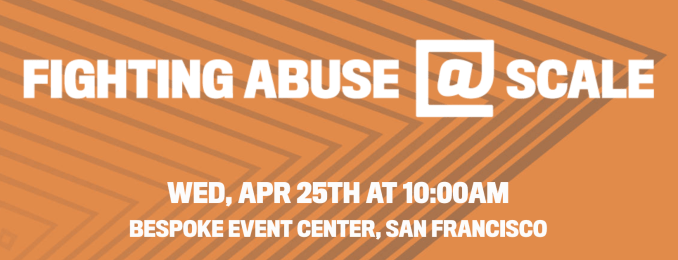
Desperate to show it takes thwarting misinformation, fraud, and spam seriously, Facebook just announced a last-minute “Fighting Abuse @Scale” conference in San Francisco on April 25th. Speakers from Facebook, Airbnb, Google, Microsoft, and LinkedIn will discuss how to stop fake news, prevent counterfeit account creation, using honeypots to disrupt adversarial infrastructure, and how machine learning can be employed to boost platform safety.

Fighting Abuse @Scale will be held at the Bespoke Event Center within the Westfield Mall in SF. We can expect more technical details about the new proactive artificial intelligence tools Facebook announced today during a conference call about its plans to protect election integrity. The first session is titled “Combating misinformation at Facebook” and will feature an engineering director and data scientists from the company.
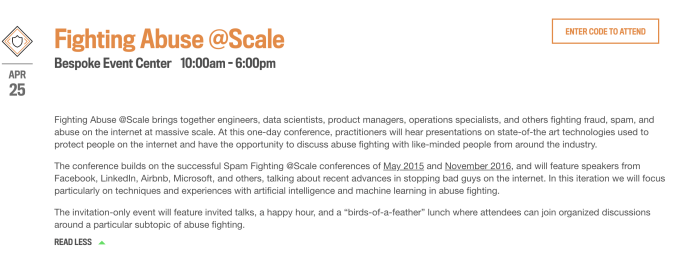
Facebook previously held “Fighting Spam @Scale” conferences in May 2015 and November 2016 just after the Presidential election. But since then, public frustration has built up to a breaking point for the social network. Russian election interference, hoaxes reaching voters, violence on Facebook Live, the ever-present issue of cyberbullying, and now the Cambridge Analytica data privacy scandal have created a convergence of backlash. With its share price plummeting, former executives speaking out against its impact on society, and CEO Mark Zuckerberg on a media apology tour, Facebook needs to show this isn’t just a PR problem. It needs users, potential government regulators, and its own existing and potential employees to see it’s willing to step up and take responsibility for fixing its platform.


from Social – TechCrunch https://tcrn.ch/2Gkhrcu
Original Content From: https://techcrunch.com